What’s Actually in a Disposable Diaper?
Turn a diaper package over and look for the ingredient list. There isn’t one. For a product worn against a newborn’s skin roughly around the clock for two or three years, that’s a strange gap, and it isn’t an oversight. Diapers are regulated as consumer products rather than as anything that has to declare its contents.
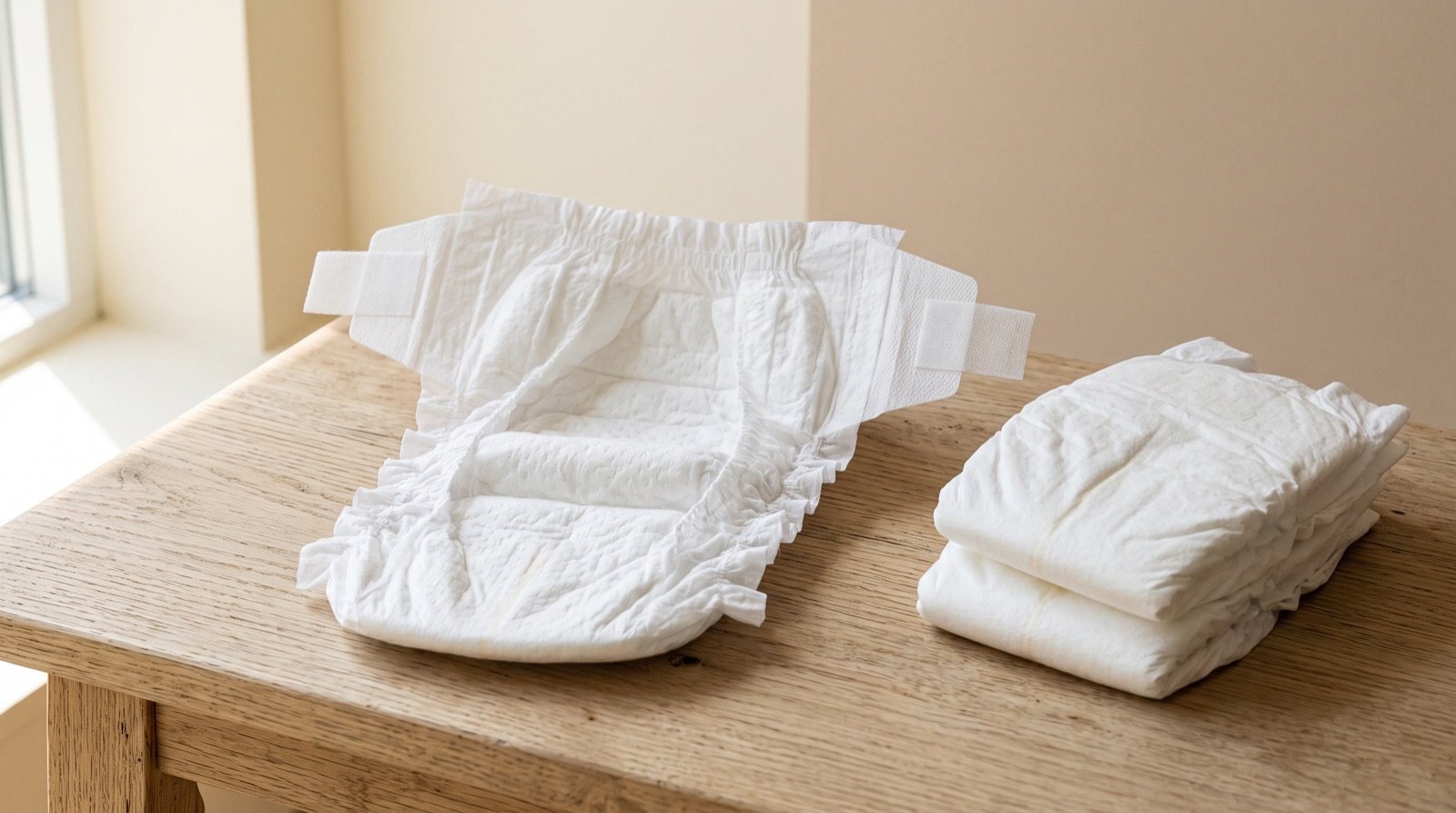
Short answer: a modern disposable diaper is mostly three things. A polypropylene top sheet against the skin, an absorbent core of wood pulp fluff mixed with sodium polyacrylate crystals, and a polyethylene backsheet to stop leaks. Add elastics, adhesives, and sometimes fragrance, lotion or a wetness-indicator dye. The absorbent chemistry is not the part worth worrying about. The undisclosed extras usually are.
The layers, from the skin outward
The top sheet is the part that touches your baby. It’s almost always a nonwoven polypropylene, chosen because it lets liquid through quickly and then stays relatively dry to the touch. Some brands add a lotion or a layer of cotton here, which is where the differences between brands start to show up.
The absorbent core does the actual work, and it’s two materials. Fluff pulp, which is wood cellulose, gives it bulk and wicks liquid sideways. Sodium polyacrylate is the superabsorbent polymer, the stuff that turns into gel and can hold many times its own weight in liquid. If you’ve ever seen little clear crystals on your baby’s skin after a very full diaper, that’s it, and it’s the single most-Googled scary thing about diapers.
The backsheet is a thin polyethylene film, sometimes laminated to a soft nonwoven so it doesn’t feel like a plastic bag. This is the layer that makes a disposable disposable, and it’s also the main reason a diaper takes centuries to break down.
Then the hardware: elastic in the leg cuffs and waistband, hot-melt adhesive holding the layers together, and the fastening tabs.
Sodium polyacrylate, and why it isn’t the problem
This is the ingredient parents ask about most, so it’s worth answering directly. Sodium polyacrylate replaced the old cellulose-only diapers in the 1980s, and it’s the reason a modern diaper can go overnight without leaking.
It is not the same material implicated in the toxic shock cases that pulled Rely tampons off the market in 1980, which used different superabsorbents entirely. Sodium polyacrylate is not absorbed through skin, and the gel beads that occasionally escape a saturated diaper are an aesthetic problem rather than a safety one.
There’s a real tradeoff, though it isn’t toxicity. It’s that superabsorbent cores work so well that a diaper can hold an enormous amount of urine while still feeling dry, which makes it easy to leave one on far too long. That matters more for diaper rash than any ingredient does.
The parts actually worth scrutinizing
Everything above is standard construction. The differences between a $12 pack and a $105 box mostly live in the extras.
Fragrance. Undisclosed, unnecessary, and applied to skin under occlusion for hours. We’ve written up why it’s in diapers at all.
Lotions and emollients. Often petrolatum or similar, sometimes with fragrance carried in them. Fine for many babies, a trigger for some, and rarely itemized.
Dyes. The wetness indicator stripe, the cartoon prints, the colored waistband. Small amounts, but they’re pigment against skin for no functional benefit beyond convenience.
The bleaching process. How the fluff pulp was whitened is a genuine difference between brands, and it’s the one with actual regulatory history behind it. That’s covered in chlorine-free versus totally chlorine-free.
| Quick facts | The disposable diaper |
|---|---|
| Top sheet | Nonwoven polypropylene, sometimes with cotton or lotion |
| Absorbent core | Fluff pulp plus sodium polyacrylate superabsorbent |
| Backsheet | Polyethylene film, occasionally partly plant-based |
| Required ingredient list | None. Diapers are not required to declare contents |
| Worth avoiding | Added fragrance, unnecessary dyes, undisclosed lotions |
| Not worth panicking about | Sodium polyacrylate itself |
So what should a parent actually do
Skip fragrance. That’s the single highest-value filter, and it costs nothing because plenty of unscented options exist at every price point.
After that, the honest ranking is: fragrance-free first, then a cleaner bleaching process, then materials like cotton or bamboo top sheets if your baby has reactive skin, then everything else. Certifications help here because nothing on the package is required to be true, and marks like MADE SAFE audit the full formulation rather than a single claim.
Fit matters more than any of it for rash prevention, and so does changing frequency. A perfectly clean diaper left on too long will cause more trouble than an ordinary one changed promptly. Our vetted diaper picks sort the brands by what they actually leave out.
Frequently asked questions
Is sodium polyacrylate in diapers safe?
By current evidence, yes. It’s a superabsorbent polymer that turns liquid into gel, it isn’t absorbed through skin, and the occasional gel beads on a baby’s skin from an overfull diaper are messy rather than harmful. It is not related to the superabsorbent linked to toxic shock in 1980s tampons. The bigger practical risk is that it works so well it encourages leaving a diaper on too long.
Do diapers have to list their ingredients?
No. Diapers are regulated as general consumer products in the US, with no requirement to declare materials or additives, which is why two diapers can look identical on the shelf and differ substantially inside. Some brands publish full material lists voluntarily, and that willingness is itself a useful signal when you’re choosing.
Are bamboo or cotton diapers actually better?
They change the layer against the skin, which can really help a baby who reacts to polypropylene, and they shift some material away from fossil-derived plastic. What they usually do not change is the superabsorbent core or the waterproof backsheet, so a “bamboo diaper” is generally a bamboo top sheet on a conventional core. That’s a real improvement, just a narrower one than the marketing implies.
What causes diaper rash, the diaper or something else?
Most commonly moisture, friction and time rather than a specific ingredient. Prolonged contact with urine and stool raises skin pH and breaks down the barrier, so changing frequency and fit do more than brand choice. Where the diaper itself is the culprit, fragrance, lotions and dyes are the usual suspects, which is why an unscented, dye-free diaper is the sensible starting point for reactive skin.
Related reading
The rest of this series: why there’s fragrance in diapers, chlorine-free versus totally chlorine-free, and the honest math on cloth versus disposable. For vetted brands, see the best natural diapers.