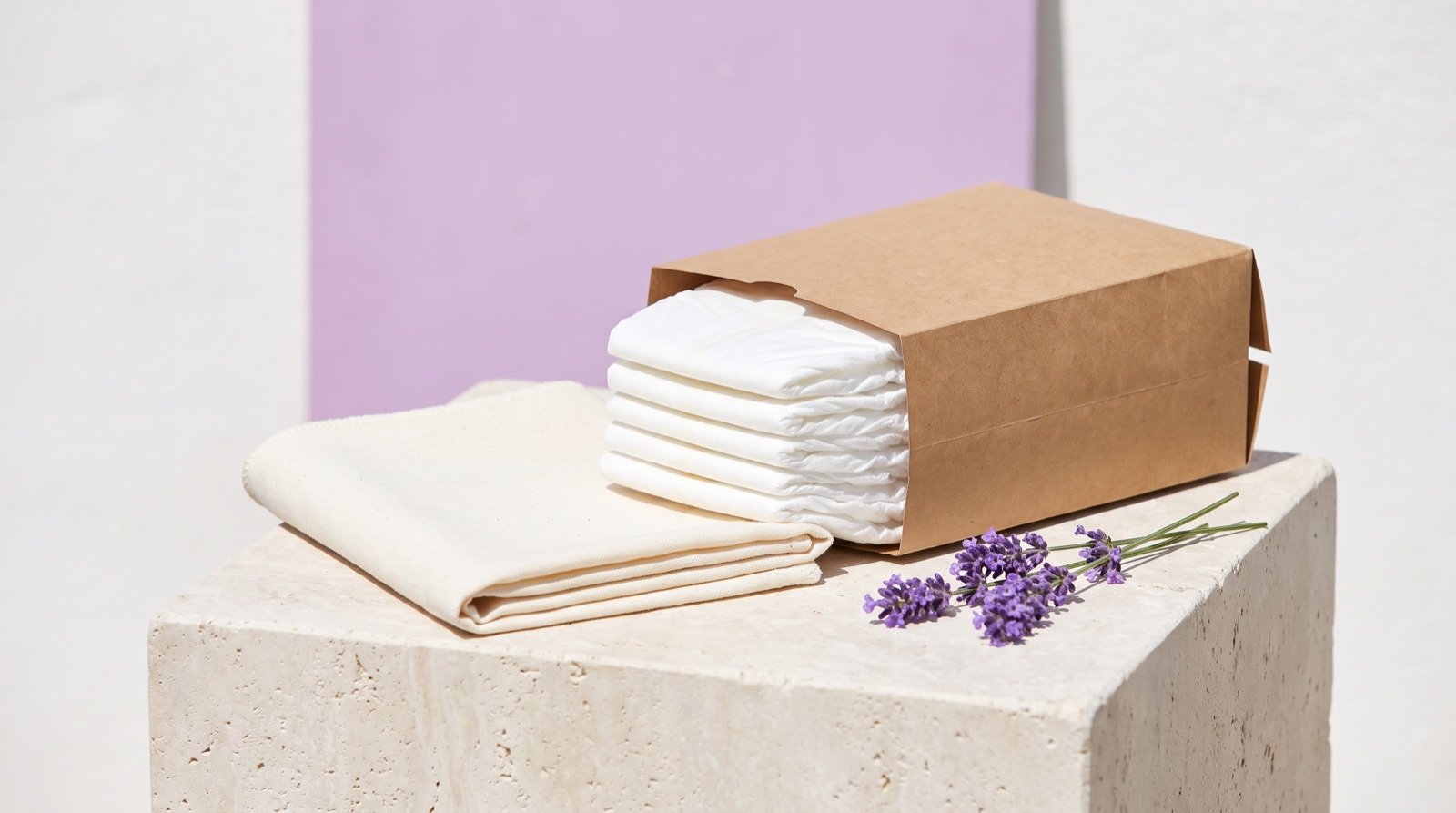
Fragrance in Diapers: Why It’s There, and Why to Skip It
Open a pack of conventional diapers and there’s often a smell before anything has happened. Powdery, faintly floral, unmistakably added. Somebody put perfume in a product designed to be worn against a newborn’s skin, and it’s worth asking who that was for.
Short answer: it’s for the adult. Diaper fragrance exists to mask odor at the change table and in the pail, and it does nothing for the baby wearing it. In the US, “fragrance” on a label can stand in for dozens of undisclosed ingredients, and unlike perfume on an arm, a diaper holds it against skin under occlusion for hours at a time. If you change one thing about the diapers you buy, make it this.
The exposure is different from other scented products
Perfume on your wrist evaporates into a room. Fragrance in a diaper sits inside a sealed plastic envelope, pressed against thin, often damp skin, in the warmest part of a baby’s body, for hours.
That combination is the whole argument. Occlusion increases absorption. Damp skin increases absorption. Infant skin is thinner and more permeable than adult skin, and a newborn’s surface-area-to-weight ratio means any given dose lands harder. None of those factors are unique to diapers, but few products stack all four the way a diaper does.
And unlike a lotion you could stop using at the first sign of irritation, a diaper is on nearly all the time for two or three years.
One word, and what it’s allowed to hide
The word “fragrance” or “parfum” on a US label is a category, not an ingredient. It can represent a blend of many individual chemicals, protected as a trade secret, with no requirement to name them.
We’ve unpacked how that loophole works in cleaning products, and the mechanism is identical here. Europe has moved: the EU now requires more than 80 individual fragrance allergens to be named on labels, which we covered in the fragrance allergens piece. The US still requires none.
So “fragrance” on a diaper package is not a description of a thing. It’s the absence of one.
The specific concern people raise is phthalates, which have been used as fragrance fixatives and are the reason this shows up in the same conversation as hormone-disrupting ingredients in cosmetics. Many brands have moved away from them, but because the blend isn’t disclosed, “moved away from” is a claim you can’t verify from the outside.
What it’s actually doing for the product
Nothing functional. Fragrance in a diaper doesn’t improve absorbency, fit, leak protection or skin dryness. It covers smell, and it does that for the person doing the changing.
There’s a second, quieter job it does: it makes the product feel clean and premium in the aisle. Scent is a powerful shortcut for perceived quality, which is why so many household products carry it despite adding nothing.
Neither of those is a bad reason to want something. They’re just not reasons that survive the question “and what does the baby get out of it.”
The one place it does help, and the better fix
Diaper pails smell. That’s real, and the fragrance is doing something there, at least for a few seconds.
The better fix is the pail rather than the diaper. Emptying more often, a pail with a proper seal, or a lidded bin outside the room all solve the odor problem at the point where the odor is, rather than by perfuming the thing worn on your child.
What to look for instead
“Fragrance-free” is the phrase you want. “Unscented” is not the same thing, and the distinction matters: unscented can mean a masking fragrance was added to cover the raw material smell, which means fragrance is still present. Fragrance-free means none was added.
Beyond the word, the strongest signal is a brand that publishes its full material list voluntarily, since nothing compels them to. Certifications that audit the whole product, like MADE SAFE, do the verification work you can’t do from a package. Our vetted diaper picks are all fragrance-free, and note which ones carry that kind of audit.
Frequently asked questions
Are scented diapers actually harmful?
For most babies they cause no obvious problem, and it would be overstating the evidence to call them dangerous. The honest case against them is different: the fragrance provides zero benefit to the wearer, its contents are undisclosed, and it’s applied to thin damp skin under occlusion for hours a day across years. When a product adds risk you can’t quantify in exchange for no benefit to the person exposed, skipping it is the easy call.
What’s the difference between “unscented” and “fragrance-free”?
Fragrance-free means no fragrance was added. Unscented can mean a masking fragrance was added specifically to neutralize the smell of the raw materials, so the product smells like nothing while still containing fragrance ingredients. If a baby is reacting and you’ve switched to “unscented” with no improvement, this is often why.
Do fragrance-free diapers smell worse in the pail?
Slightly, and briefly. What you notice is the absence of a masking scent rather than a worse underlying smell. Most parents who switch report adjusting within a few days, and a well-sealed pail emptied regularly closes the gap entirely. That’s a better solution anyway, since it deals with the odor where it is rather than perfuming your baby.
Is fragrance the cause of my baby’s diaper rash?
It can be a trigger for reactive skin, but it’s usually not the main driver. Most diaper rash comes down to moisture, friction and how long a diaper stays on. If you’ve ruled those out and rash persists, switching to a fragrance-free, dye-free, lotion-free diaper is a sensible next step, and worth raising with your pediatrician rather than working through brands alone.
Related reading
The rest of this series: what’s actually in a disposable diaper, chlorine-free versus totally chlorine-free, and cloth versus disposable. See also the fragrance loophole and our vetted diaper picks.