
Ahimsa
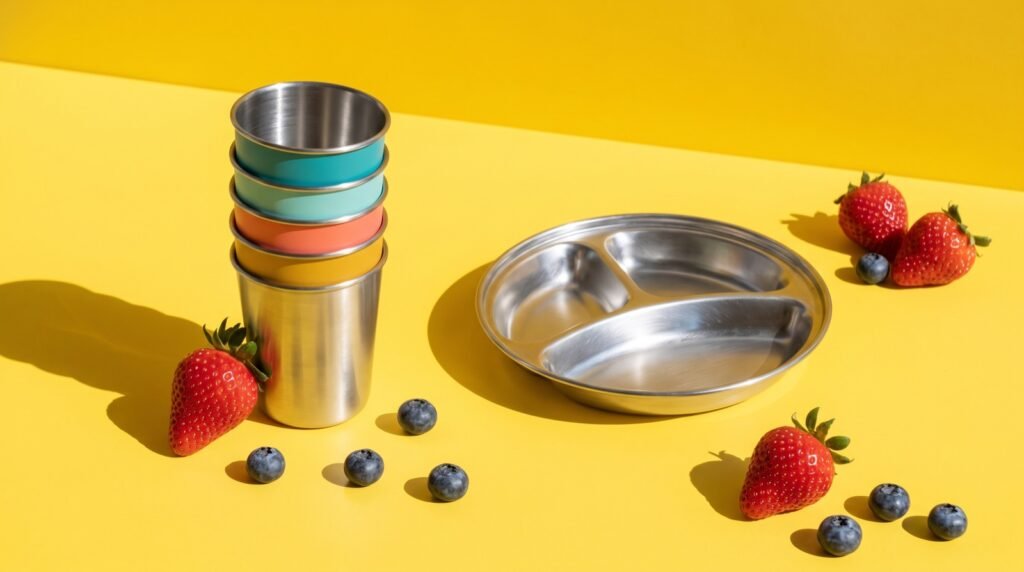
Quick verdict: A pediatrician got tired of telling parents to avoid plastic and then watching them hand a toddler a plastic plate, because there wasn’t much else. So she made the alternative. Ahimsa is stainless steel, it holds a real MADE SAFE certification on 20 products, and it comes with a lifetime warranty against cracking. It also costs about twice what a steel kids’ cup normally does. Our rating: 3.7 out of 5.
Who they are
Dr. Manasa Mantravadi is a practicing pediatrician in Indianapolis. She founded Ahimsa in 2019 after the American Academy of Pediatrics published its 2018 statement on food additives and children’s health, and after finding that the market for non-plastic kids’ dishware was basically empty.
She’s still the only officer named on the company’s SEC filings. Ahimsa has raised roughly $1.65 million across four small offerings since 2020, with investor counts of one, five, four and one, so there’s outside money in it. Nobody has published the split. There’s no parent company and no acquisition.
The name is the Sanskrit word for non-harm.
What they get right
The MADE SAFE certification is the brand’s own, and we counted it. MADE SAFE lists exactly 20 Ahimsa products under the brand’s own name. This matters more than it sounds. The commonest error in this category is a certificate that belongs to a supplier or a parent company while the brand takes the credit. Ahimsa holds its own.
The testing disclosure goes further than most. Its safety page names what gets tested and for what: lead, cadmium, mercury and arsenic, plus leaching tests under heat, oil and acid, against CPSIA, FDA, EU and Prop 65 limits. Steel grade is specified as 304 18/8. The colors come from physical vapor deposition, which bonds pigment into the surface rather than sitting on it as paint. For a kids’ product that’s the difference between a claim and a method.
There’s a named scientific advisory council. Leonardo Trasande and Bruce Lanphear sit on it, both of whom publish widely on children’s environmental health. Companies list advisors all the time. Listing two people whose research a parent could go read is different.
The warranty is for the lifetime of the product. Breaking and cracking are covered, which on steel is close to saying “forever,” and that’s rather the point of buying steel.
Where they fall short
They won’t say who makes it. The answer to where Ahimsa dishware comes from is one FAQ line: designed in the USA, made in India, tested in a CPSC-certified lab. No factory, no city, no supplier, no audit, no impact report. For a brand this specific about chemistry, the silence about the supply chain is a strange gap.
You’re paying about double. A single 12 oz Conscious Cup is $14.99. A comparable stainless kids’ cup from Klean Kanteen or Green Sprouts runs $6 to $8, and a plastic one is $2 to $4. Steel lasts, and if a set survives two children the math works out. But nobody should pretend the entry price is small.
It’s a narrow catalog and a narrow window. Cups, bowls, plates, compartment plates, storage, utensils, trays. That’s it, and most of it is sized for toddlers and young children. Once your kid moves to adult dishes, you’re done buying from Ahimsa.
Steel is loud, cold and not microwaveable. A dropped steel bowl on a tile floor at 6am is an experience. Metal doesn’t go in the microwave. Neither of those is a flaw in the product so much as a fact about the material, and both are worth knowing before you switch a whole kitchen over.
What they sell and what it costs
Around 119 listings, of which roughly a third are bundles. Single items run $12 to $50: the 8 oz Conscious Cup is $12.99, the 12 oz is $14.99, a utensil set is $11.99, a four-pack of 12 oz cups is $49.99. Larger sets climb toward $470, which is a whole-kitchen purchase rather than a starter one. $$$ for the category, and honestly so.
Who it’s actually for
Buy Ahimsa if you’ve decided to get plastic out of your kid’s meals and you want the decision to hold for years rather than months. The certification is real, the testing detail is unusual, and steel doesn’t degrade the way plastic does after fifty dishwasher cycles.
If budget is the constraint, a stainless cup from Klean Kanteen does the same physical job for half the money without the MADE SAFE screen behind it. And if you want the bigger picture on what’s actually in kids’ plastic, our piece on microplastics from kitchen plastics covers why this category exists at all.
Deals and discounts
No affiliate relationship on our side. Ahimsa discounts a good share of the catalog through the year, and the multi-item sets are where the per-piece price actually drops.
Related reading
Frequently asked questions
Is Ahimsa MADE SAFE certified?
Yes, and the certificate is the brand’s own rather than a supplier’s. MADE SAFE’s directory lists 20 Ahimsa products under Ahimsa as the vendor, which we counted at the issuer rather than taking from the brand’s marketing.
Which steel does Ahimsa use?
Premium grade 304 18/8 stainless steel. The colored pieces get their color from physical vapor deposition, a process that bonds the pigment into the metal surface instead of coating it with paint or electroplating, so there’s no layer to chip off into food.
Where is Ahimsa made?
India, with design done in the USA and testing in a CPSC-certified lab. The company doesn’t name the factory or publish a supplier list, which is the biggest gap in an otherwise detailed disclosure.
Is Ahimsa worth the price?
If it replaces plastic for two kids over several years, probably. A 12 oz cup at $14.99 is roughly double a comparable steel cup and four times a plastic one, and the return is a lifetime warranty against cracking on a material that doesn’t leach. Buy the sets rather than singles if you’re doing a whole kitchen.
Can Ahimsa dishes go in the dishwasher or microwave?
Dishwasher yes. Microwave no, because it’s metal. That’s the practical tradeoff of switching to steel, along with the noise when a toddler drops a bowl on a hard floor.