The Best Non-Toxic Cookware, Sorted by What It’s Actually Made Of
Go look at your most-used nonstick pan. See where the coating’s scratched and flaking near the middle? That’s the part worth worrying about. Conventional nonstick is made with PFAS, the “forever chemicals” that don’t break down in your body or the environment, and when the coating degrades, it doesn’t just vanish. Researchers counted roughly 9,100 particles shed from a single scratch. Some of it ends up in your food, and some of it ends up in you. Not ideal.
PFAS are on the list of hormone disruptors we’d rather keep out of the house, and cookware is one of the biggest sources most people never think about. The good news is that non-toxic cookware has gotten seriously good, and you have real choices at every price.
Here’s the thing that makes this category confusing, though: “non-toxic” splits into two very different camps. There’s coated cookware (ceramic nonstick, PFAS-free) that’s easy to use but wears out over years, and there’s uncoated cookware (cast iron, stainless, carbon steel) that lasts a lifetime but asks a little more of you. Both are safe. Which one’s right depends on how you cook. And if you’ve wondered about the aluminum underneath most of it, that’s a shorter story than the internet suggests.
So here’s how we picked. Three things had to line up:
- No PFAS, PTFE, or PFOA: in any coating, anywhere.
- A safe, durable base material: ceramic, iron, or steel that holds up.
- Independent ownership: checked for every brand, and disclosed when it isn’t.
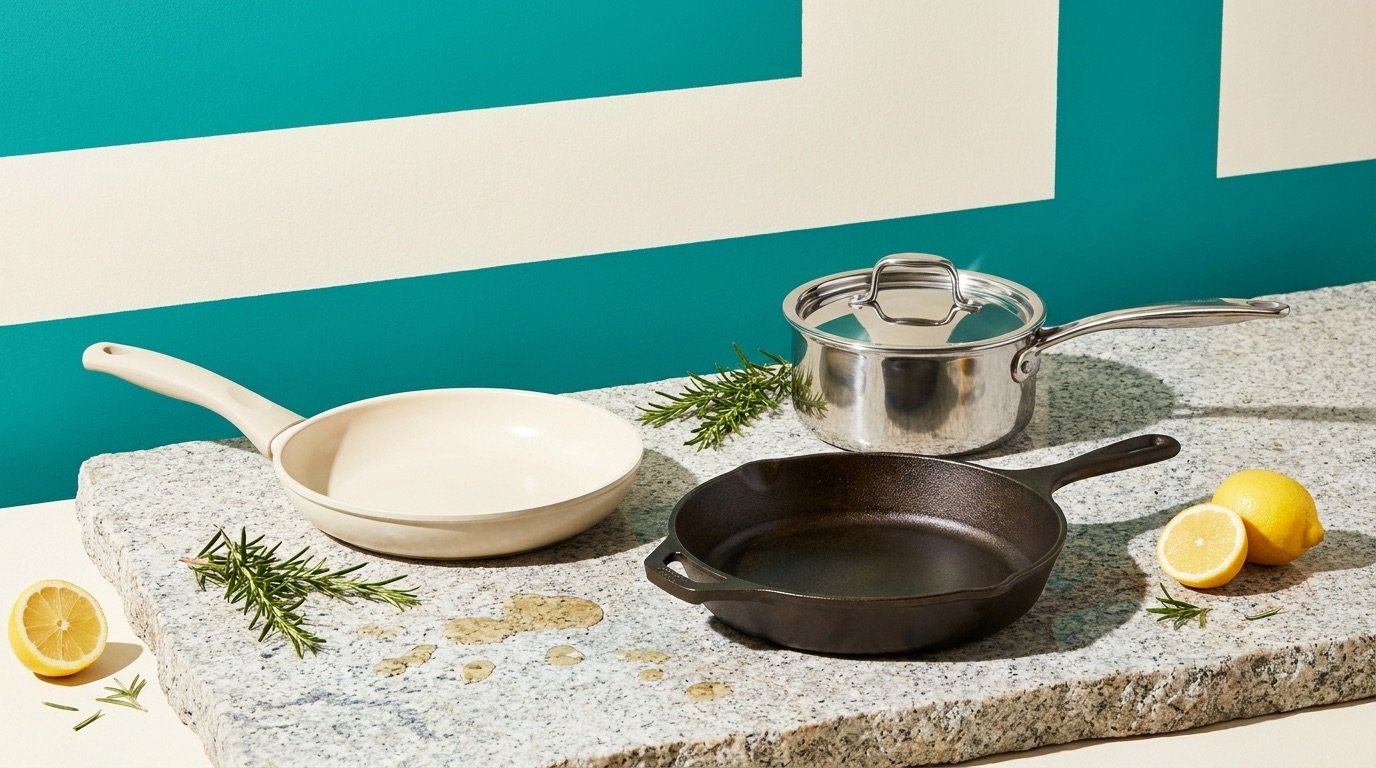
If you want one answer: buy a Lodge skillet for $29.95 and you have solved non-toxic cooking forever, because there’s no coating to fail. If you want something that behaves like nonstick, Our Place is the one we’d start with, as long as you accept you’re buying a consumable.
We sorted the picks by material so you can jump to the kind you want.
Our picks at a glance
- Best ceramic nonstick: Our Place
- Best known, read the fine print: Caraway
- Best coating-free purist pick: Xtrema
- Best for pro-style cooking: Made In
- Best budget: Lodge
- Best cast iron upgrade: Field Company
- Best for color and personality: Great Jones
| Brand | Material | Start with | Nonstick? | Lasts |
|---|---|---|---|---|
| Our Place | Ceramic nonstick on aluminum | Always Pan 10.5″, $135 | Yes | A few years, it’s a consumable |
| Xtrema | Solid ceramic, no coating | Signature Skillet 9″, $160 | No | Indefinitely, if you don’t drop it |
| Made In | Carbon steel and stainless | Blue Carbon Steel 10″, $119 | Seasons like cast iron | Decades |
| Lodge | Cast iron | Classic Skillet 10.25″, $29.95 | Seasons like cast iron | Generations |
| Field Company | Cast iron, machined smooth | No.8 Skillet, $165 | Seasons like cast iron | Generations |
| Great Jones | Enameled cast iron | Large Fry 10.25″, $105 | No | Decades, chip the enamel and it’s done |
| Caraway | Ceramic nonstick on aluminum | Covered below, not a recommendation | Yes | A few years |
Prices checked on each brand’s own storefront on August 19, 2026, at full list price. Two of these are almost always on sale: Xtrema runs a discount on effectively every variant, and Lodge’s classic skillets sit in its own sale collection, so expect to pay less than the number above.
Our Place: the ceramic nonstick we’d start with
Best for: easy, safe nonstick in a small kitchen, accepting it won’t last forever | Price: $118–$370 | Start with: Always Pan 10.5 inch, $135 | Ownership: independent
Our Place built its whole pitch around the Always Pan, a single PFAS-free ceramic nonstick piece that does the job of a fry pan, saucepan, steamer, and more. For a small kitchen or a first apartment, replacing eight things with one is the entire point, and the colors are a big part of the appeal.
The coating caveat applies here as it does to every ceramic pan, so keep the heat moderate and skip the metal utensils. If your storage is tight and you’d rather own fewer, better things, this is the pick that leans all the way into that.
Caraway: popular, and worth reading the fine print on
Best for: people set on the look, willing to baby the coating | Price: from $135 | Ownership: independent, founder-led and venture-backed
Caraway is the ceramic set most people have seen, and the pans do what they say: free of PFAS, PTFE and PFOA, even heating, good release, and storage racks that make a cupboard behave.
We’re covering it rather than recommending it, and the reason is worth stating. It carries no third-party certification of any kind, the ceramic coating is a consumable at a price that implies otherwise, and when we scored it for the directory it came out lower than anything we list there. Our own write-up kept pointing readers toward Lodge or Made In instead, which told us what we actually thought.
If you want it, treat it gently: low-to-medium heat, wooden or silicone tools, hand wash. It’ll last years that way and fade fast if you don’t.
Xtrema: the purist option with zero coating
Best for: the truly cautious who want no coating at all | Price: $94–$189 | Start with: Signature Skillet 9 inch, $160 list, and it’s discounted more often than not | Ownership: family-owned since 2007
Xtrema is the one for people who don’t want any coating at all, ever. It’s 100% ceramic all the way through, no metal core, no nonstick layer, nothing to scratch off or wear down. It’s about as inert as cookware gets, which makes it the most conservative non-toxic choice on this list.
The tradeoffs are real: it’s heavy, it can crack if you drop it or shock it with temperature changes, and it takes patience to learn because it holds heat differently than metal. But nothing is coming off of it into your dinner, now or in 10 years. Nothing at all. For the truly cautious, it’s the gold standard.
Made In: pro-grade stainless and carbon steel
Best for: buy-it-once uncoated pans that cook like a restaurant kitchen | Price: $99–$179 | Start with: Blue Carbon Steel Frying Pan 10 inch, $119 | Ownership: independent
If nonstick coatings are the thing you want to leave behind entirely, Made In makes the uncoated pans that professional kitchens actually use. Its stainless steel and carbon steel have no coating to fail, and with basic care they last decades. The carbon steel, once seasoned, even develops its own natural nonstick surface.
Uncoated cooking has a learning curve, mostly about preheating and using enough fat so food doesn’t stick. Push through the first few weeks and you end up with pans you’ll hand down. This is the buy-it-once, keep-it-forever pick.
Lodge: cast iron that costs almost nothing
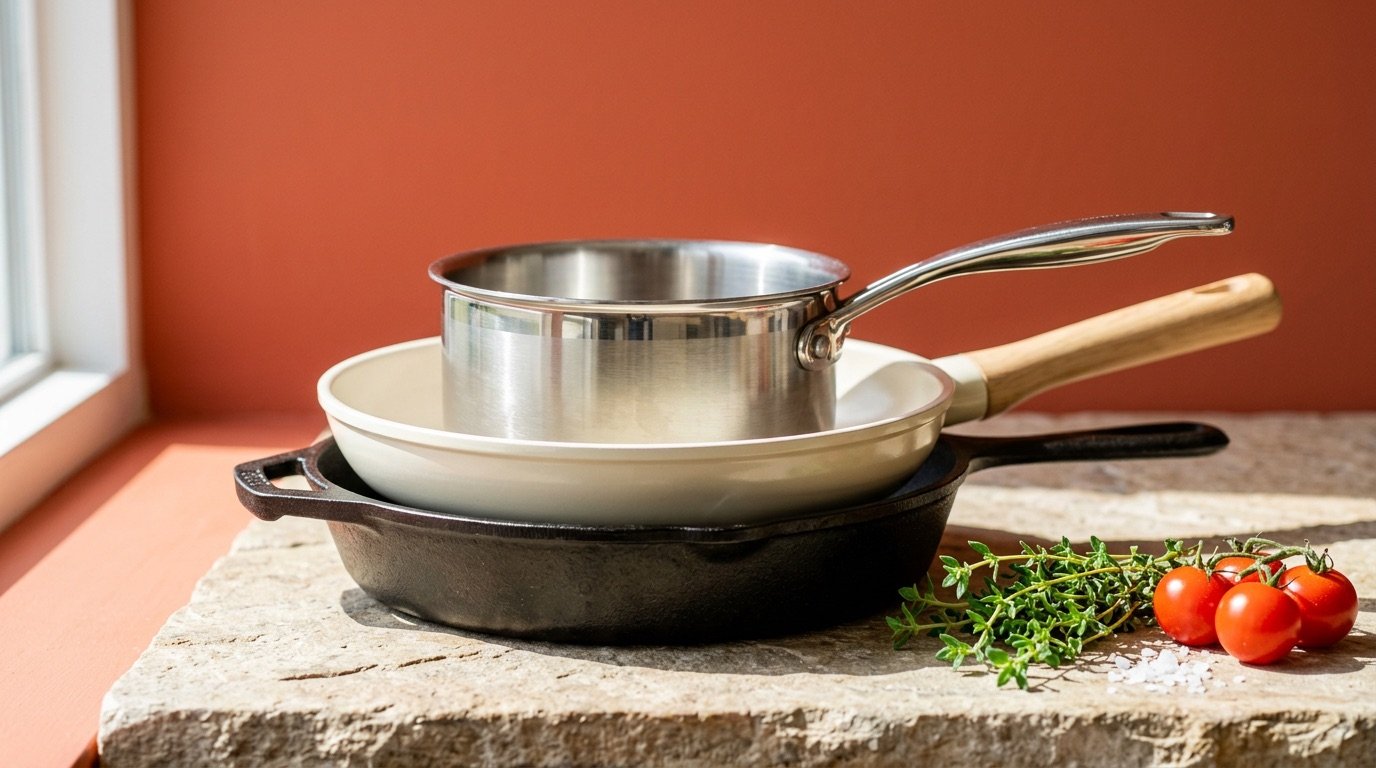
Best for: budgets, and anyone who wants one pan to outlive them | Price: from $20 | Start with: Classic Cast Iron Skillet 10.25 inch, $29.95 | Ownership: family-owned since 1896
Here’s the one that breaks the “non-toxic costs a fortune” assumption completely. Lodge has been making cast iron in Tennessee since 1896, it’s family-owned, and a skillet starts around $20 to $35. Cast iron is just iron, zero PFAS risk, and seasoned properly it becomes naturally nonstick and lasts for generations. People cook on hand-me-down Lodge pans older than they are. That’s the whole case.
It’s heavy, it needs seasoning and a little care (dry it, oil it, don’t leave it wet), and it’s not for delicate tasks. But for the money, nothing on earth is safer or more durable.
Field Company: cast iron, refined
Best for: cast iron without the weight or the rough surface | Price: $100–$350 | Start with: No.8 Cast Iron Skillet, 10.25 inch, $165 | Ownership: independent, family-run
If Lodge is the workhorse, Field Company is the heirloom. This small American maker mills its cast iron smoother and lighter than the rough-cast standard, which fixes the two things people dislike about cast iron: the weight and the pebbly surface. It seasons beautifully and cooks like a dream.
You pay more than you would for a Lodge, obviously. But if the heft of traditional cast iron has kept you away, this is the version that changes your mind, and it’ll still be around in 50 years.
Great Jones: the one that makes safe cookware fun
Best for: colorful enameled cast iron with personality | Price: $105–$205 | Start with: Large Fry, 10.25 inch, $105 | Ownership: owned by Meyer Corporation (since 2023)
Non-toxic cookware has a reputation for being a little serious. Great Jones, founded by two women, throws that out with colorful enameled cast iron and clean stainless in shades you actually want on the stove. The enameled Dutch oven (“The Dutchess”) is the star, and enamel-coated cast iron gives you the durability of iron without the seasoning routine.
It sits at a premium price, and the range is more focused than comprehensive. For someone who wants their safe cookware to have personality, though, few brands make it this appealing.
Reading the box without being fooled
Cookware marketing runs on words that sound like guarantees and aren’t. Four of them do most of the work.
| On the box | What it actually means |
|---|---|
| PFOA-free | One specific chemical, phased out of US production years ago. Says nothing about the other PFAS |
| PTFE-free | The one that counts. PTFE is Teflon, and PTFE is itself a PFAS |
| Ceramic | Usually not ceramic. It’s a sol-gel silica coating sprayed onto metal, and it wears out |
| Non-toxic | Not regulated, not defined, and nobody checks it before it goes on the box |
The one that catches people is “PFOA-free,” because it’s technically true on nearly every pan sold today and it implies something much bigger than it delivers. If a pan is nonstick and slippery out of the box, something is making it slippery. Either the brand tells you what, or you assume PTFE.
The other half of this is heat. PTFE coatings start breaking down at high temperature, which is why the advice with any nonstick pan is to keep it at low to medium and never preheat it empty. Cast iron, carbon steel and stainless have no such ceiling, which is the real argument for them: there’s no coating to degrade in the first place. Aluminum sits in its own category, and the Alzheimer’s scare attached to it doesn’t hold up, though reactivity with acidic food is a real reason to want it anodized or clad.
What to throw out, and why
The cookware to retire is any scratched or flaking conventional nonstick, the classic Teflon-style pans. Once that PFAS coating starts degrading, it sheds into your food and releases fumes when overheated. If a pan is chipped, pitted, or worn through to the metal, it’s done.
One more warning: “PFAS-free” has no legal definition, and some brands quietly swap one questionable coating for another while keeping the clean-sounding label. If a nonstick pan won’t tell you exactly what the coating is made of, treat that silence as an answer. Our greenwashing guide covers how that label game works.
How to actually choose one
Don’t start with the brand. Start with how you cook.
If you want easy nonstick and you’re at peace with replacing it every few years, Our Place. If you never want a coating to worry about, Made In (stainless and carbon steel) or Xtrema (pure ceramic) are the ones. And if budget rules everything, a Lodge cast iron skillet is the single safest, cheapest pan you can buy, full stop.
Most kitchens do best with a mix: one safe nonstick for eggs and delicate jobs, and one uncoated workhorse (cast iron or stainless) for everything else. You don’t need a 12-piece set. You need three or four good pans you’ll actually use.
Frequently asked questions
What makes cookware “non-toxic”?
In practice, it means no PFAS, PTFE, or PFOA, the fluorinated chemicals used in conventional nonstick coatings that can migrate into food and release fumes when overheated. Non-toxic cookware is either coated with a PFAS-free ceramic layer or made from uncoated safe materials: cast iron, stainless steel, carbon steel, or 100% ceramic.
Is ceramic nonstick actually safe?
The good ones, yes. Quality ceramic nonstick, Our Place included, is free of PFAS and doesn’t release the same chemicals conventional nonstick does. The catch isn’t safety, it’s longevity: the ceramic coating wears down over a few years of use, so it’s a consumable you’ll eventually replace, unlike cast iron or stainless.
Is cast iron really non-toxic?
Yes, and it’s about as simple as cookware gets. Cast iron is just iron with a seasoned layer of oil baked on, with zero PFAS risk. It can add a small amount of dietary iron to your food, which is a plus for most people. Seasoned and cared for, a single pan lasts for generations, which is why it’s our budget top pick.
Is “PFOA-free” the same as PFAS-free?
No, and the gap between those two claims is where most of the confusion lives. PFOA is a single chemical that was phased out of US nonstick manufacturing years ago, so “PFOA-free” describes almost every pan on the market and tells you nothing about what replaced it. PFAS is the whole family, thousands of chemicals wide, and PTFE belongs to it. Look for “PTFE-free” or a material with no coating at all.
How hot is too hot for a nonstick pan?
Hot enough that the honest answer is to stop using nonstick for anything that needs real heat. PTFE coatings degrade as temperature climbs, and an empty pan on a high burner gets there faster than anyone expects, because there’s no food absorbing the energy. Searing, wok cooking and anything you’d finish under a broiler belong in cast iron, carbon steel or stainless. Keep nonstick for eggs and delicate fish on a low flame.
Do I need to throw out all my old nonstick pans?
Not necessarily all at once, but retire any that are scratched, chipped, or flaking, since that’s when the PFAS coating degrades into your food. Intact, gently used nonstick is lower risk, but if you’re replacing anyway, the pans that show wear are the ones to swap first.
Related reading
Want the detail behind the picks? We’ve written up each thing we screened for: PFAS in nonstick cookware, is ceramic cookware safe, and is aluminum cookware safe.
Rethinking the rest of the kitchen? Our zero-waste kitchen swaps guide covers storage, prep, and cleaning, the same PFAS question turns up in your tap in the best water filters, and if you want to understand the ingredients driving all of this, start with our guide to endocrine disruptors and the chemicals worth avoiding. Most of the picks above also have a scored profile in our brand directory.