Do Cleaning Products Have to List Their Ingredients?
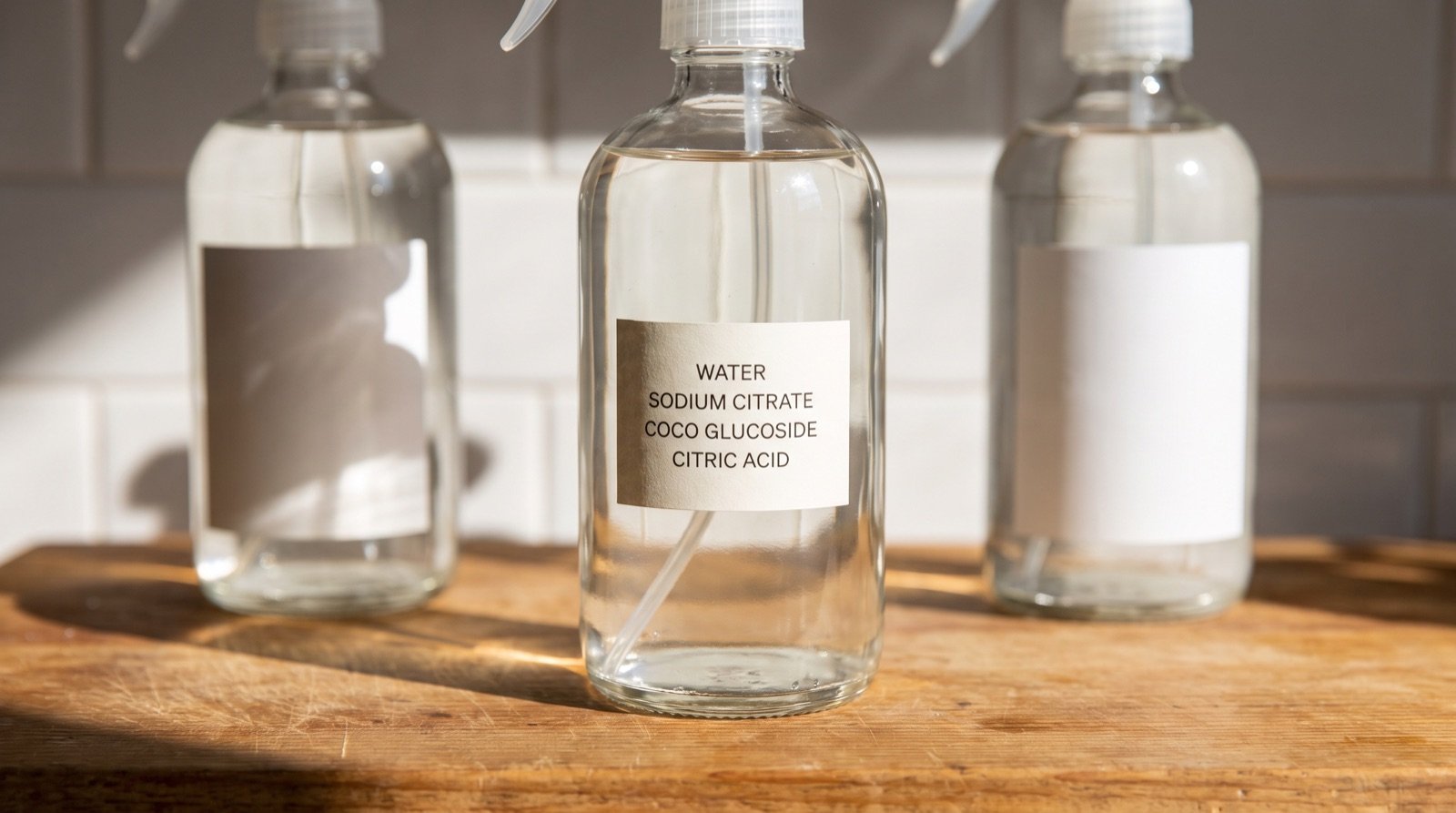
Your toothpaste has to list every ingredient in descending order of quantity. Your shampoo too.
The all-purpose spray under your sink doesn’t have to list any.
Short answer: there’s no federal ingredient disclosure requirement for cleaning products, only a rule that hazards be flagged. One state law changed the market, and it has two carve-outs that matter: fragrance stays largely hidden, and disinfectants are exempt from label disclosure entirely. So the product most likely to contain something you’d want to know about is the one least likely to tell you.
The federal rule is about hazard, not ingredients
The Federal Hazardous Substances Act is what governs a bottle of cleaner, and what it requires is the common or chemical name of the hazardous substance, or of each component that contributes substantially to its hazard, plus a signal word, the principal hazard, precautionary measures and first aid.
Read that carefully. It’s hazard identification, not an ingredient list. Everything that isn’t classified as hazardous can stay off the label completely, and that includes plenty of things people would like to know about.
Compare it with cosmetics, where a full ingredient declaration in descending order of predominance is mandatory, or with food, where the same logic applies. Cleaning products sit in a gap between the two, and they always have.
One state changed the whole market
California’s Cleaning Product Right to Know Act, SB 258, was signed in October 2017 with two deadlines: website disclosure from January 2020, on-label disclosure from January 2021.
Online, it requires all intentionally added ingredients with their CAS numbers and functional purpose, nonfunctional constituents at or above 0.01 percent, and links to safety data sheets, all reachable within five clicks of the URL printed on the label.
On the label, it requires either the chemicals appearing on any of a set of designated hazard lists, or all intentionally added ingredients, plus a toll-free number and a website address.
Because manufacturers don’t run separate label runs per state, this became the de facto national standard. In practice, most compliant labels you see anywhere in the US are compliant because of California. That’s a description of how the market responded rather than a legal requirement outside the state.
The fragrance carve-out is bigger than it sounds
Here’s the gap that swallows the most.
The law defines a fragrance ingredient as any intentionally added substance or complex mixture whose sole purpose is to impart or counteract an odor. Online, a company must list fragrance ingredients that appear on a designated hazard list, fragrance allergens from the EU list at or above 0.01 percent, and other fragrance ingredients at that threshold unless they’re confidential business information.
On the label, fragrance ingredients “may be listed on the product label as ‘fragrances’.” One word, as before.
So: a hazardous or allergenic fragrance component has to surface somewhere on a website. The rest of the blend stays inside a single word on the bottle, and a trade-secret claim can withhold even the ones that would otherwise be named, with a generic descriptor substituted.
That’s meaningfully better than nothing. It is not full disclosure, and we’ve written before about how much hides in that one word.
And disinfectants are exempt from the label rule
This is the part that caught us out.
A designated product regulated as a pesticide under federal law, which is every disinfectant, gets website disclosure only. It’s exempt from the on-label ingredient requirement, because the federal pesticide label preempts the state’s.
So the bleach spray and the disinfecting wipes, the products carrying the most active chemistry in the cupboard, are the ones you’re least likely to find an ingredient list on. Not a loophole anybody snuck in. Just how two layers of law interact.
The law also doesn’t cover foods, drugs, cosmetics, personal care products, industrial products or trial samples. What it does cover is air care, automotive, general cleaning and polish or floor maintenance products for household, janitorial and institutional use.
New York tried and is still trying
New York had a disclosure program of its own, and a court struck it down.
In August 2019 an Albany County court held the state’s program policy null and void, on the grounds that it functioned as a rule but skipped the required rulemaking process. The matter went back to the agency to do it properly.
It still isn’t operational. Outreach meetings have happened, no formal comment period has opened, and the program remains in rulemaking limbo seven years later.
What we’d actually do
Use the website, not the bottle. If a product carries a URL under SB 258, the online listing is far more complete than the label, and it takes about a minute.
Treat the word “fragrance” as an unanswered question rather than an ingredient. Brands that list every fragrance component voluntarily are telling you something real, because nothing requires them to.
And hold onto the distinction that matters most here: disclosure is not restriction. Nothing in SB 258 bans a single chemical. It made information available, which is worth a lot and is not the same as making products safer, and “full ingredient disclosure” is the marketing summary of this law rather than what the statute says.
The brands worth your money are the ones disclosing more than they have to, which is one of the things we weigh in the non-toxic cleaning roundup. For the wider picture on what the word non-toxic is claiming when nobody regulates it, we pulled that apart separately.
Frequently asked questions
Do cleaning products have to list ingredients in the US?
Not federally. The Federal Hazardous Substances Act requires hazard warnings and the names of components contributing substantially to a hazard, not a full ingredient list. California’s SB 258 requires much fuller disclosure online and a partial list on the label, and because manufacturers use one label nationally, it effectively set the standard everywhere.
Why does my cleaner just say “fragrance”?
Because that’s permitted. California’s law lets fragrance ingredients be listed on the label as a single word, and requires only hazardous or allergenic fragrance components to be named online, at or above 0.01 percent, and even those can be withheld as confidential business information.
Are disinfectants covered by ingredient disclosure laws?
Only partly. Disinfectants are regulated as pesticides under federal law, and that federal label preempts California’s on-label requirement, so they’re exempt from it. They still have to publish ingredient information on the manufacturer’s website.
Where can I find out what’s actually in a cleaning product?
Start with the manufacturer’s website, which under California’s law has to carry a much fuller listing than the label, reachable within five clicks. Safety data sheets, also linked there, list hazardous components. Independent ingredient databases are useful for what the disclosure still leaves out.
Related reading
More on what’s hidden in cleaning products: the fragrance loophole, what “non-toxic” actually claims, and 1,4-dioxane in detergent. For picks, the best non-toxic cleaning products.