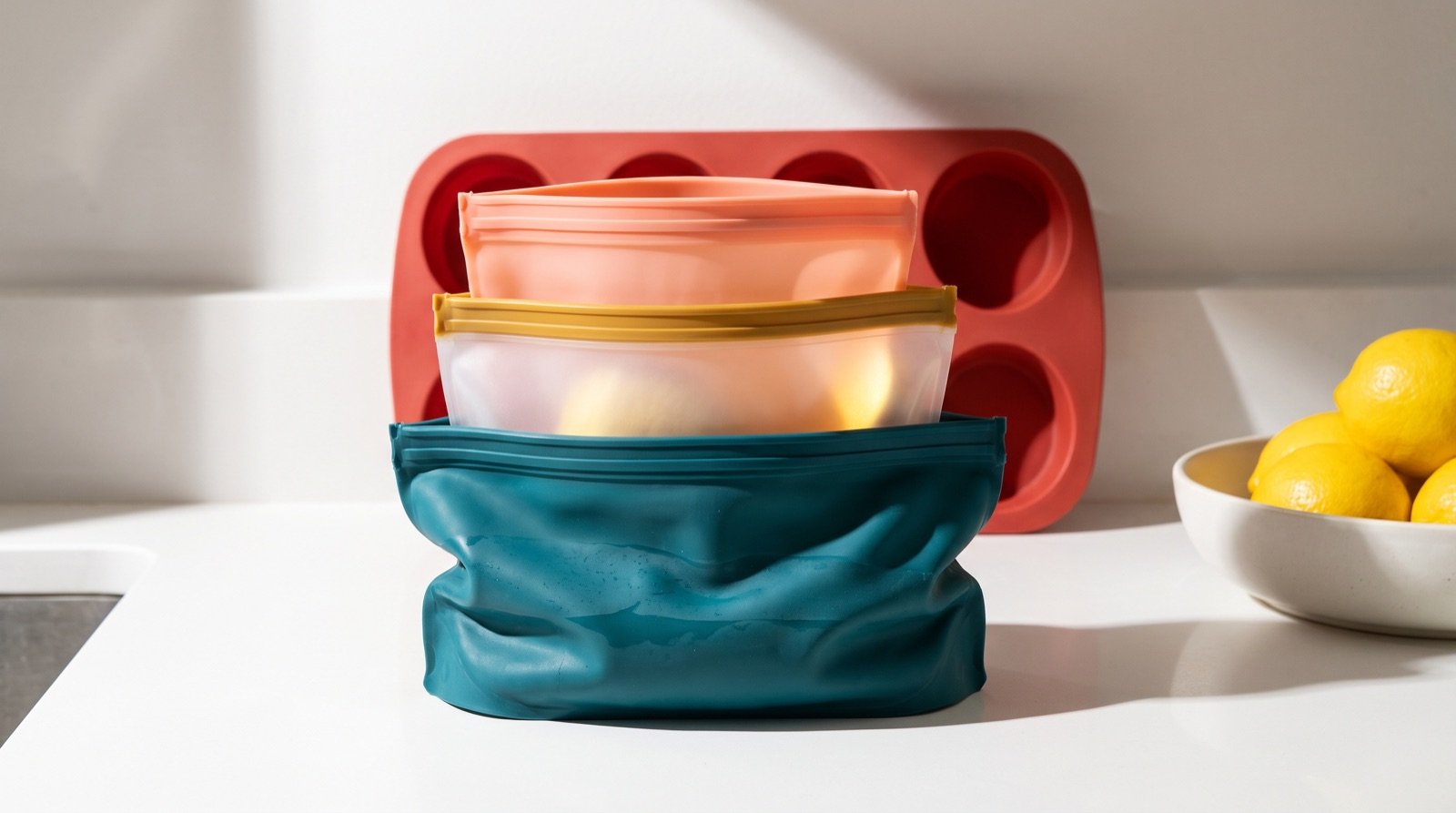
Is Food-Grade Silicone Safe? The Honest Answer
Silicone is the swap almost every zero-waste guide reaches for. Reusable bags instead of plastic wrap, molds instead of parchment, lids instead of foil. Ours does it too.
So it’s worth knowing what a 2025 study found when researchers actually measured what comes out of a silicone baking mold and into the food.
Short answer: silicone is one of the better materials in a kitchen, and it isn’t inert. Leftover small molecules called siloxanes migrate out, more into fatty food, more at heat, and more on the second and third use than the first. Most of them go into your kitchen air rather than your dinner. A well-made mold is fine. A cheap one is a coin flip, and there’s no label that tells you which you bought.
The label says food grade. That means less than you think
In the US the standard is 21 CFR 177.2600, which sets limits on how much can be extracted out of a finished rubber article under reflux. Twenty milligrams per square inch into water in the first seven hours. Into hexane, standing in for fatty food, the allowance is 175. Nearly nine times as much, which tells you where the regulator expects the trouble.
Notice what that is: a conditions-of-use rule the manufacturer checks itself against. There’s no FDA certificate for a silicone spatula, and no agency tested the one in your drawer. “Food grade” is a claim about meeting a standard, not proof that anyone verified it.
Germany’s BfR Recommendation XV is stricter and more useful: no more than 0.5 percent volatile organic content, no more than 0.5 percent extractable, and no peroxide residue. It’s the closest thing Europe has to a rule, because silicone has no harmonized EU measure at all. Plastics and ceramics do. Silicone falls back to the general framework and national law.
Does the 0.5 percent bar get met? Mostly. A 2025 Bavarian survey of 60 silicone baking utensils found three that exceeded it, running 0.7 to 1.6 percent, with three more borderline. Ninety percent passed. So one in twenty is over, and you can’t tell by looking.
Where the siloxanes actually go
This is the finding that reframes the whole question.
A 2019 study baked cakes in 14 silicone molds and measured the room as well as the food. Indoor air right after baking hit 301 micrograms per cubic meter of one siloxane, 212 of another. Four of the 14 molds pushed past the German precaution guide value for indoor air. In the cake itself, levels were higher at the edges than the center, in the low single-digit milligrams per kilogram.
Follow-up work found that across five baking cycles, roughly 1 percent of one common siloxane migrated into the food while about 98 percent evaporated. Your cake gets a little. Your kitchen gets most of it.
The same 2019 team found that using a mold more than once reduced the air concentrations substantially. Which points at something practical, though we should be straight that no regulator issues it as advice: the first bake in a new mold is doing you a favor.
The part that surprised us
Post-curing, sometimes sold as tempering, is the manufacturing step that bakes off leftover small molecules before the product ships. Good brands do it. It works, up to a point, and the point is sharper than the marketing suggests.
The 2025 migration study put the small-oligomer transfer into shortcrust pastry at 153 milligrams per kilogram from a mold that hadn’t been post-cured, against 9.5 from one that had. A sixteen-fold improvement. Then it looked at the larger molecules and found migration of those is almost independent of post-curing.
Total siloxane migration in the third baking cycle: 167 milligrams per kilogram. The EU’s overall migration limit for food contact materials is 60.
Three things follow from that, and none of them are in anybody’s marketing. Migration got worse with repeated use rather than better. Even a gentle job, chocolate held at 45 degrees for two hours, transferred 21.5 milligrams per kilogram by the third round. And the standard oil simulant used for compliance testing underestimates real food, because it strips the material in the first two cycles and then has nothing left to find. A mold can pass its test and still exceed the limit in a real kitchen.
About the twist test
You’ve probably seen the advice: twist or pinch the silicone, and if it turns white it’s cut with cheap plastic filler.
We went looking for a source. There isn’t one. No regulator, no standards body, no peer-reviewed paper addresses it, and both sides of the argument live entirely on blogs with something to sell.
Worse, the premise is wrong. Unfilled silicone has poor tensile strength, so reinforcing silica filler is in essentially all practical silicone rubber, including the good stuff. What the whitening seems to distinguish is one legitimate filler from another: precipitated silica strains white, fumed silica doesn’t. So a mold that passes the test and one that fails it may both be perfectly ordinary silicone.
We’re not going to tell you it’s debunked either, because the people debunking it are manufacturers. What we can say is that it rests on a claim about fillers that isn’t true, so we wouldn’t buy or bin anything based on it.
So what we’d actually do
Keep it. It beats plastic wrap, it beats disposable parchment, and unlike a plastic board it isn’t shedding microplastics into your food every time you use it.
Buy from brands that say platinum-cured and post-cured in writing. Platinum curing leaves no reaction byproduct; the peroxide alternative leaves residues that can come off later under heat. If a listing won’t say which, that’s information.
Run a new mold through one empty bake before you use it, with the extractor on. Keep silicone away from long contact with hot fatty food where you have a choice, since fat is what pulls the most out. Storage in the fridge, steaming, freezing: no concern worth having. And retire a mold that’s gone sticky, cloudy or smells off, because that’s the material degrading rather than a cosmetic problem.
For the heat-and-fat jobs, metal, glass and ceramic-coated pans are still the better tool.
Frequently asked questions
Does silicone leach into food?
Yes, in small amounts, and mostly as leftover siloxanes rather than the polymer itself. Migration rises with fat content, temperature and contact time, and research has found it increasing over the first few uses rather than falling. Water-based, cold or brief contact transfers very little.
Is silicone safer than plastic?
For most kitchen uses, yes. It doesn’t shed microplastics under a knife, it doesn’t contain BPA or phthalates, and it tolerates heat that would warp plastic. It’s still a synthetic material that releases something, so “safer than plastic” is the accurate claim rather than “inert”.
How hot can silicone bakeware safely go?
Follow the manufacturer’s stated limit, which is usually somewhere between 400 and 450 degrees Fahrenheit. You’ll see a specific figure attributed to Health Canada circulating online; we looked and couldn’t find it on any Health Canada page, so treat it as folklore. The polymer itself doesn’t break down until far higher temperatures, and what comes off in an oven is leftover material rather than the silicone degrading.
Are silicone food storage bags safe for the freezer and microwave?
Both are the easy cases. Cold slows migration to almost nothing, and microwaving is usually short and water-based. The scenario to think about is oily food held hot for a long stretch, which is where the migration research finds its highest numbers.
Related reading
More on kitchen materials: what plastic boards and sponges shed, the PFAS story behind nonstick, and whether ceramic pans live up to it. For what to buy, see the best non-toxic cookware and our zero-waste kitchen swaps.