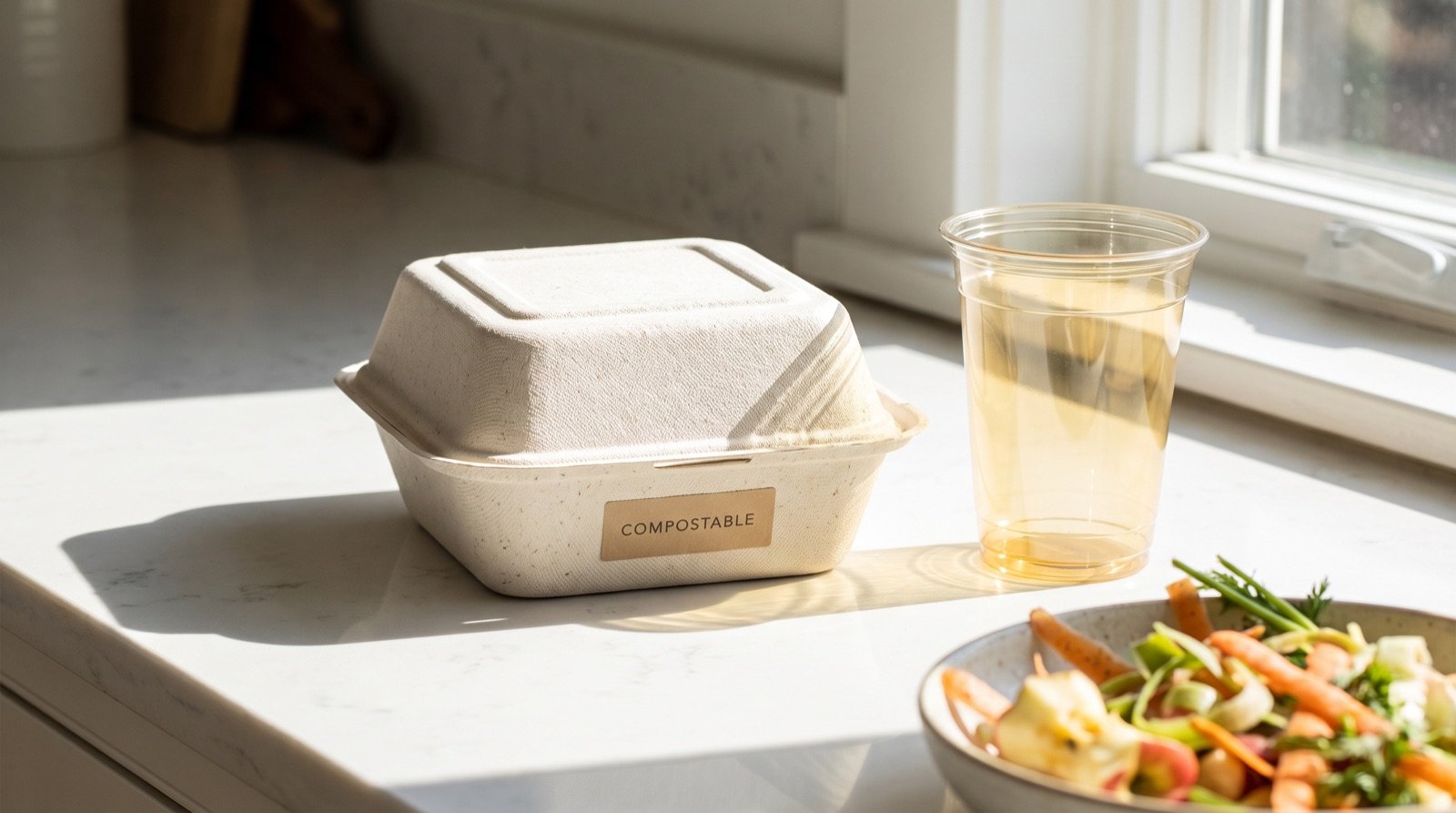
What Does “Compostable” Actually Mean on Packaging?
Did you know that the word “biodegradable” on a package is close to meaningless, while “compostable” means something quite specific, and neither tells you what will actually happen to the thing in your hand?
Short answer: compostable means certified to break down under industrial composting conditions, which are hot, turned, and monitored. Certified packaging really does break down there, at 98 percent in the biggest study anyone’s run. Roughly nine in ten American households have no organics collection at all, and over half the ones that do won’t accept compostable packaging. The material isn’t the failure. The system is.
The standards, and the word hiding in the title
ASTM D6400 is the standard behind almost every compostable plastic claim in North America. Its full title is worth reading: Standard Specification for Labeling of Plastics Designed to be Aerobically Composted in Municipal or Industrial Facilities.
Municipal or industrial. It’s in the name of the standard, and it means the test conditions are thermophilic, running hot enough that a backyard heap won’t get close. Its companion D6868 covers coated paper and molded fiber, which is what your lined cup and your takeout bowl are.
Europe’s equivalent is EN 13432, and it drives the certification most people actually see on packs.
Which brings us to the split that matters. TUV Austria runs two schemes: OK compost INDUSTRIAL, tested at facility temperatures of 55 to 60 degrees Celsius, and OK compost HOME, which covers products that break down at the lower, wobblier temperatures of a garden heap. TUV says it plainly: industrial-certified products should not go into the garden compost.
Home certification is much harder to get, for the obvious reason. You take away the guaranteed heat and most of the materials stop performing.
“Biodegradable” is the word to distrust
Everything eventually biodegrades. Given a few centuries, so does a plastic bag. That’s why the term on its own carries no information.
The FTC agrees, and its rule has teeth. Under 16 CFR 260.8, an unqualified degradable claim is deceptive if the item doesn’t completely decompose within one year after customary disposal. The rule goes further and names the problem outright: unqualified degradable claims for items customarily disposed of in landfills, incinerators or recycling facilities are deceptive, because those places don’t produce complete decomposition within a year.
That covers nearly all packaging. So if a package says biodegradable with nothing after it, either it’s home compostable and should say so, or the claim shouldn’t be there.
The compostable rule has its own requirement people ignore: if composting facilities aren’t available to a substantial majority of consumers where the item is sold, the claim has to be clearly and prominently qualified. Look at how many packages carry that qualification.
BPI is the certifier, and its PFAS rule bit hard
In North America the mark to look for is BPI, a nonprofit that verifies products against the ASTM standards. It’s a trade certifier, not a government body, and it’s the closest thing to an authority the category has.
Its most consequential move was on PFAS. BPI set a maximum of 100 parts per million total organic fluorine, effective January 2020, and it didn’t grandfather anyone in: every product not verified against the new limit was removed from the certified database at the end of 2019. That’s a real enforcement action, and it’s why molded fiber bowls got reformulated.
One quirk of the scheme is worth knowing. BPI only certifies products with a connection to food scraps and yard trimmings, which is why you can’t find a certified compostable toothbrush or clothes hanger no matter how it’s made.
The material works. The system doesn’t.
Here’s the finding that changed our view.
The Composting Consortium ran an 18-month study across ten commercial composting facilities, testing more than 23,000 packaging units across 31 product types. Compostable plastic packaging disintegrated 98 percent by surface area. Compostable fiber packaging managed 83 percent. Both clear the industry thresholds.
Now the other half. BioCycle’s 2023 survey counted 710 US communities with curbside or drop-off food waste collection, covering 14.9 million households. Against roughly 132 million US households, that’s about one in nine, and the figure is our arithmetic rather than BioCycle’s.
Then it gets worse. Of those programs, 56 percent of curbside collections don’t accept compostable packaging at all.
And among composting facilities themselves, 29 percent refuse it. The top reason, given by 78 percent of the facilities that decline, is contamination from look-alike single-use plastic. They can’t tell your certified cup from an ordinary one at speed, so they take neither.
That’s the real story. The packaging does its job. It just never gets to the place where its job is possible.
Where it actually goes instead
In a landfill, a compostable package is not composting. There’s no oxygen, no heat, no turning. PLA, the most common compostable plastic, is close to inert down there: research has found it produces no significant methane and no meaningful population of organisms breaks it down anaerobically, with estimates of a century or more before chemical hydrolysis gets going.
That’s arguably a small mercy, since methane is a worse greenhouse gas than carbon dioxide. It is not composting.
In the plastics recycling stream it’s a contaminant, though the scale of that problem is smaller than it’s often described.
What we’d actually do
Find out what your area takes before you buy anything on the strength of the word. Municipal websites list it, and five minutes settles it. It should only take that.
If you have collection that accepts packaging, certified compostable is a good choice and the evidence says it works. If you don’t, and most people don’t, compostable packaging is a landfill item with a nicer label, and reusable beats it every time. That’s the reasoning behind most of our zero-waste kitchen swaps.
Look for the BPI mark or OK compost HOME rather than the word alone, and treat “biodegradable” with nothing after it as a claim the FTC would likely find deceptive. That pattern, a technically defensible word doing work it hasn’t earned, is the whole subject of our greenwashing guide.
Frequently asked questions
What’s the difference between compostable and biodegradable?
Compostable is a defined, testable claim: certified to break down into usable compost within a set time under specified conditions, usually industrial ones. Biodegradable has no such requirement and no timeframe, so on its own it tells you nothing. The FTC treats an unqualified degradable claim as deceptive if the item won’t fully decompose within a year of normal disposal.
Can I put compostable packaging in my home compost?
Only if it’s certified home compostable, such as OK compost HOME. Most certified compostable packaging is certified for industrial conditions at 55 to 60 degrees Celsius, and the certifier states directly that those products shouldn’t go into a garden heap. In a cold backyard bin they’ll mostly sit there.
Does compostable packaging break down in landfill?
No. Landfills are anaerobic and cold, which is the opposite of what composting needs. PLA in particular appears close to inert in landfill conditions, with estimates running past a century. A compostable package in the trash is a plastic package in the trash.
Why do composting facilities reject compostable packaging?
Mainly because they can’t distinguish it from ordinary plastic quickly enough. In a national survey, 78 percent of facilities that refuse it cited contamination from look-alike single-use plastic. Others cited items not breaking down fully, selling compost to certified organic growers, and PFAS concerns in molded fiber.
Related reading
More on packaging claims: what plastic boards and sponges shed and how to spot greenwashing. For the practical version, our zero-waste kitchen swaps and the whole-home list.