Do Plastic Cutting Boards Shed Microplastics Into Your Food?
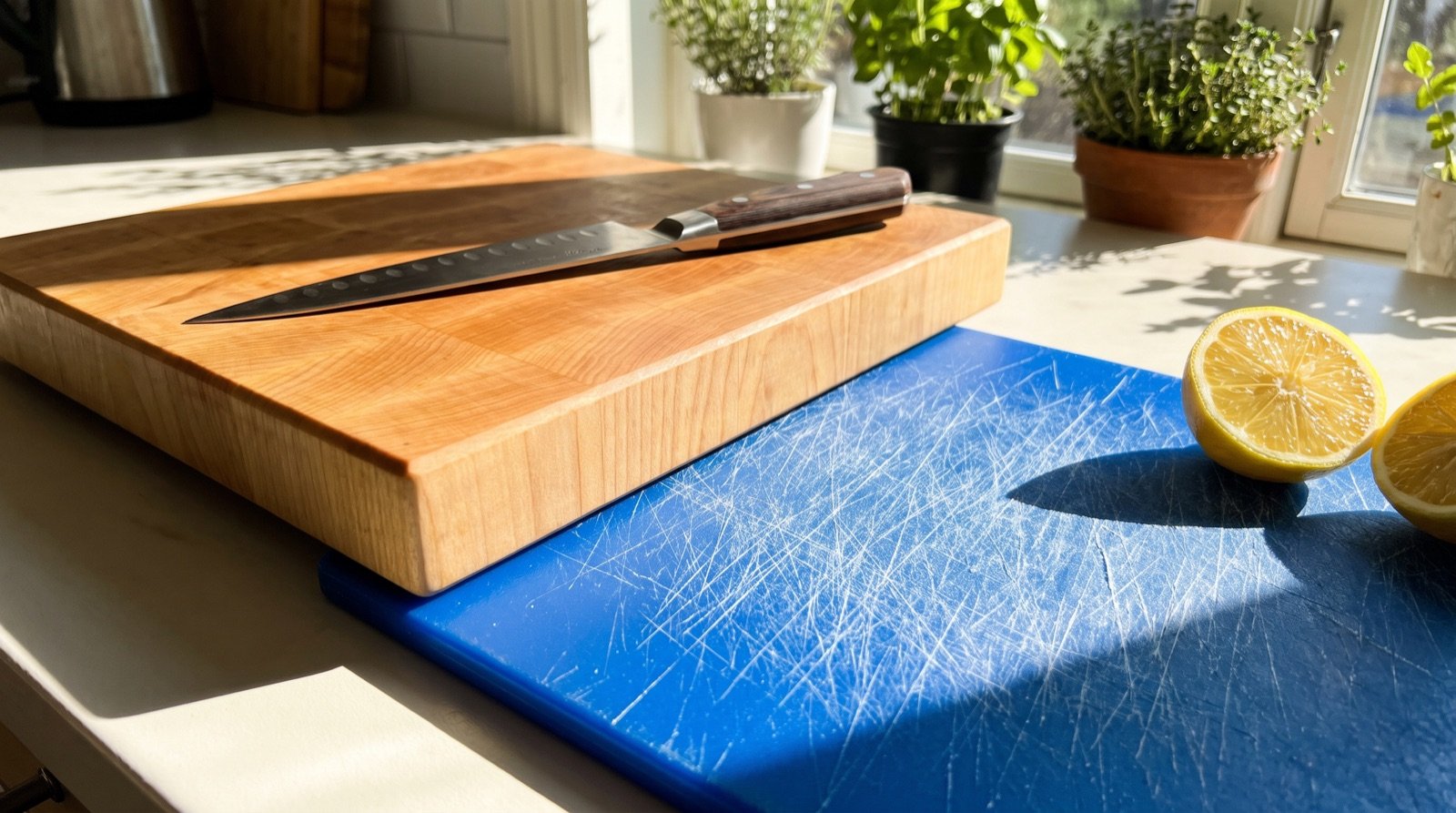
Ever looked at the scratches on a plastic cutting board and wondered where all that plastic went?
Short answer: into your food, in quantities somebody has finally measured. A 2023 study in Environmental Science and Technology estimated that chopping on a polypropylene board releases around 79 million microplastic particles per person per year, roughly 50 grams of plastic. Then the same team ran a cell toxicity test on those particles and it came back clean. Same paper. Guess which half made the headlines.
We think switching your board is worth doing. We also think the reason to do it isn’t the one you’ve been given.
The number everybody quoted, and the sentence nobody did
The researchers chopped on polyethylene and polypropylene boards under controlled conditions and counted what came off. Polypropylene shed more: 79.4 million particles a year against 14.5 to 71.9 million for polyethylene. Most of the fragments were smaller than 100 micrometers, which is roughly the width of a human hair.
Here’s the part that got left out. The paper’s own preliminary toxicity work found the polyethylene particles had no adverse effect on the viability of mouse fibroblast cells over 72 hours.
That’s not a clean bill of health. It’s a short viability assay on one cell line, not a study of what happens to people over decades. But it’s the most reassuring line in the file, and it sat in the abstract the entire time the internet was telling you your kitchen was poisoning you.
One more thing about that headline figure. The range for polyethylene spans nearly sevenfold, because it’s modeled from assumptions about how often you chop and how hard, not measured out of anybody’s dinner. A number with that much room in it is a starting point, not a verdict.
Your sponge is doing it too, and worse
The board isn’t the loud part of the kitchen. Not close. Melamine foam, the stuff sold as a magic eraser, breaks down under friction into fibers between 10 and 405 micrometers long. Research published in 2024 found worn sponge releases about 6.5 million of those fibers per gram.
You’ll see that reported as “1.55 trillion fibers a month.” That figure comes from the press release, not the paper. The study itself gives a global total with no time period attached at all, which is a good reminder to check where a scary number was born.
Ordinary polyurethane dish sponges shed too, though far less: a University of Bonn team put it at 0.68 to 4.21 grams per person per year depending on the sponge. The same work found something more useful, which is that 85 to 97 percent of the environmental impact of washing dishes by hand came from the water, not the plastic.
The hygiene argument was backwards from the start
Most of us own plastic boards because somebody said they were more sanitary than wood. That was tested. UC Davis, 1994. The result went the other way.
Bacteria on plastic blocks survived for hours and multiplied overnight. On wood, counts fell by at least 98 percent, and often more than 99.9 percent. The authors wrote that their results did not support the often-heard assertion that plastic boards are more sanitary than wood. A companion paper found that boards with heavy knife scarring were hard to clean by hand.
So the plastic board may lose the microplastics argument and the argument it was actually sold on. It still dulls your knives faster than wood, for what it’s worth.
What anyone honest will tell you about the health risk
Nobody knows. That’s the real state of it, and the agencies that would know say so out loud.
The FDA’s position, as of July 2024, is that current scientific evidence does not demonstrate that the levels of microplastics detected in food pose a risk to human health, and that a proper risk assessment isn’t feasible yet for lack of standard definitions and methods. EFSA says it cannot conclude on potential health effects and won’t publish a full scientific opinion until the end of 2027. The WHO’s 2019 review of drinking water landed in the same place: no apparent risk at current levels, very limited data on the smallest particles, please fund more research.
The most alarming finding out there is a 2024 New England Journal of Medicine paper that found polyethylene in the carotid plaque of 150 of 257 surgical patients, and those patients had a much higher rate of heart attack, stroke or death over the following 34 months. Read it carefully, though. It’s observational, it’s 257 people already sick enough to need surgery, and it says nothing whatsoever about kitchenware.
And the famous credit card a week? A 2022 rebuttal in Journal of Hazardous Materials Letters concluded the original calculation overestimated the ingested mass by several orders of magnitude. WWF, which popularized it, has since appended a note that the science has moved on. We’d stop repeating it.
So what would we actually do
Replace the plastic board with wood or bamboo when the current one gets scarred. Not tomorrow. Not in a panic. A deeply scored board is worse on every axis, so let the scratches be your timer.
Skip the melamine eraser where a cloth will do. Keep the plastic board, if you like, for raw meat, and run it through a hot dishwasher.
| Plastic | Wood | Stainless | |
|---|---|---|---|
| Sheds microplastics | Yes, more as it scars | No | No |
| Bacteria overnight | Multiply | Drop 98%+ | Wipes clean |
| Knife edge | Dulls faster | Kind to it | Dulls fastest |
| Dishwasher | Yes | No, hand wash and oil | Yes |
The honest case for switching isn’t fear. It’s that a wood board is cheap, lasts decades, treats your knives better, handles bacteria better, and takes one worry off the pile. That’s a low-regret swap, which is the same logic behind most of our zero-waste kitchen swaps.
Frequently asked questions
Are microplastics from cutting boards dangerous?
No regulator will say yes, and none will say no. The FDA states that current evidence does not demonstrate a risk at the levels found in food, and EFSA says it cannot conclude on health effects until its full assessment lands at the end of 2027. The particles from the 2023 board study showed no effect on cell viability in a short lab test. Treat it as unresolved rather than settled in either direction.
Is bamboo better than wood for a cutting board?
Both beat plastic on shedding, and both are hard on nothing but your washing-up routine. Bamboo is harder, so it’s slightly rougher on knife edges than maple or walnut, and it’s usually glued, so check the glue is food-safe. Either one needs hand washing and an occasional coat of mineral oil.
Should I throw out my plastic cutting board right now?
We wouldn’t. Shedding rises as the surface gets scored, so a smooth board is doing far less than a chewed-up one, and binning a usable object has its own footprint. Replace it when it’s visibly scratched, and use that one for raw meat in the meantime.
Do glass cutting boards solve this?
They solve the plastic problem and create a knife problem. Glass is harder than steel, so it rolls and chips your edge fast. Stainless is the same trade. If you want no shedding and a knife that stays sharp, end-grain wood is the answer.
Related reading
The same particle story shows up in drinking water, where a 2024 study counted around 240,000 particles per liter of bottled water. We went through what that number means.
More on where household plastic ends up: what synthetic swimwear sheds in the wash, and the PFAS story in nonstick pans. For what to buy instead, see the best non-toxic cookware and the zero-waste swaps we’d make first.