Why Do Mattresses Contain Fiberglass?
Somewhere on your mattress there’s a tag that says do not remove cover. Most people read that the way they read the tag on a pillow, which is to say not at all.
Short answer: it’s often there because the flame barrier underneath is fiberglass, and taking the cover off releases glass fibers into your bedroom. The reason it exists at all is a federal fire rule from 2007, and fiberglass is the cheapest way to pass it. Nothing about it is illegal, no mattress has ever been recalled for it, and it has still generated years of lawsuits from people whose homes were contaminated.
The rule that created the problem
On July 1, 2007 the Consumer Product Safety Commission’s open-flame standard for mattress sets took effect. It’s 16 CFR Part 1633, and it’s a good rule: it exists to stop people dying in mattress fires, and it works.
What it demands is performance, not a recipe. Set the mattress alight in a lab and the peak rate of heat release can’t exceed 200 kilowatts at any point in a 30-minute test, and total heat release can’t exceed 15 megajoules in the first 10 minutes.
Polyurethane foam is essentially solid petroleum. Left alone it fails that test badly. So a mattress needs something between the fire and the foam, and the standard doesn’t say what.
Here’s the twist. The regulation that filled American mattresses with fiberglass never mentions fiberglass. The CPSC says so itself: the standard “does not require the use of any specific material or chemical, including flame retardants.”
So nobody mandated it. Industry found the cheapest route to 200 kilowatts, and the cheapest route is a woven fiberglass sock pulled over the foam core under the outer cover. It chars into a protective shell instead of burning. It costs very little. It works.
Why removing the cover is the disaster
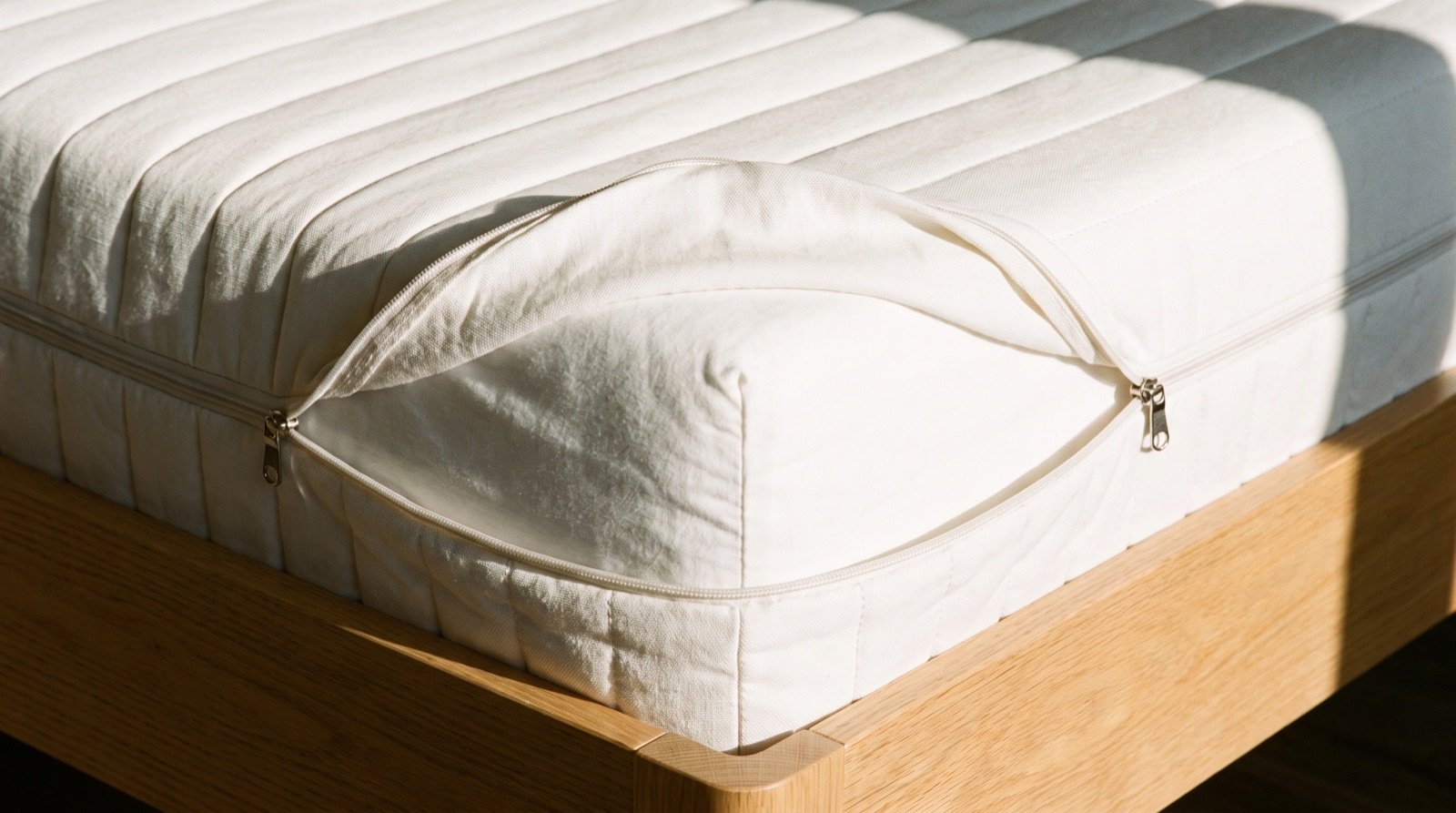
Here’s what nobody tells you at the point of sale: on a lot of budget mattresses, the outer cover has a zip.
A zip reads as an invitation. People unzip it and machine-wash the cover, which is a reasonable thing to think you’re allowed to do, and the fiberglass sock underneath is now bare. Glass fibers are brittle, microscopic and airborne. They travel through the house on air currents, embed in carpet, upholstery, clothing and HVAC ducts, and they cause itching and respiratory irritation on contact.
Cleaning them up is the part that ruins people. Fiberglass isn’t a spill you mop. It’s a particle problem spread through soft furnishings, and the remediation bills in the lawsuits run into thousands of dollars, sometimes with families discarding most of what was in the room.
The instruction is there. It’s four words on a tag, competing with a zip that says the opposite.
The lawsuits, and what’s actually true about them
Search this topic and you’ll find pages promising settlement payouts with neat compensation tiers. Be careful, because a lot of that is invented.
Here’s the real record. The one case with public numbers is Todd v. Ashley Furniture, which won preliminary approval in March 2026 and covers mattresses bought between October 2017 and June 2024. It sets up a $9 million voucher fund, paid pro rata as store credit at Ashley, Nectar, DreamCloud and Siena rather than cash, with a final approval hearing set for September 2026.
The Zinus cases are different. Gutierrez v. Zinus was filed in California in July 2022 and terminated in August 2023, and the docket records no settlement amount, no class certification and no claims administrator. A long-running case against Amazon as retailer reached judgment in April 2026 with terms that aren’t public. Newer suits naming other brands were filed through 2025 and haven’t resolved.
And one fact that surprised us: the Consumer Product Safety Commission has never recalled a mattress for containing fiberglass. Not once. Its mattress recalls are for beds that fail the flammability standard, like the 100,000 Crayan mattresses pulled in June 2025. Using fiberglass to pass the rule is fully legal, which is exactly why the fight has happened in civil court instead.
One state has moved. California’s AB 1059, signed in October 2023, bans textile fiberglass in mattresses, upholstered furniture and juvenile products sold in the state. Note the date on it though: it doesn’t bite until January 1, 2027. New York has bills filed and has passed none. So today, nowhere in the US prohibits this.
What the good mattresses use instead
Wool, mostly. It’s naturally flame-resistant, it needs no chemical treatment, and it passes the same test without a single glass fiber. Silica-treated rayon and thistle-based barriers are the other routes.
The catch is cost. Wool is expensive and fiberglass is close to free, which is why the split falls almost exactly along price: the cheap compressed foam mattress in a box needs a cheap barrier, and a certified organic build uses wool because it’s already using wool.
Worth saying plainly that a mattress without fiberglass isn’t automatically clean. Polyurethane foam still off-gasses, and treated fabrics elsewhere in a bed can carry their own chemistry, which is the same thread we pulled on in formaldehyde in wrinkle-free bedding.
How to find out what’s in yours
Look at the law tag first. If it lists glass fiber, fiberglass, or a percentage of “glass” in the fill, you have your answer. Some list it as modacrylic or rayon instead, which is a good sign.
If the tag is vague, work backwards. A zip-off cover with a do-not-remove warning is close to a confession, because there’d be no reason to warn you off a wool barrier. Price is the other tell: under about $500 for a queen, assume fiberglass unless the brand says otherwise in writing.
Then just ask. Email the company and request confirmation in writing that the mattress contains no fiberglass or glass fiber. A brand that won’t answer that question in a sentence has told you something.
And if you already own one? Don’t panic and don’t unzip it. Intact and covered, it isn’t doing anything to you. Use a zippered protector over the top, keep the original cover on, and replace it in the normal course of things rather than tonight.
Frequently asked questions
Is fiberglass in mattresses illegal?
Not today, anywhere in the US. It’s a legal way to meet the federal open-flame standard in 16 CFR Part 1633, and the CPSC has never recalled a mattress for containing it. California’s AB 1059 will ban it in that state from January 1, 2027, which is the first and so far only enacted ban. The lawsuits have mostly argued that warnings and labeling were inadequate rather than that the material itself is banned.
How do I know if my mattress has fiberglass?
Check the law tag for “glass fiber” or “fiberglass” in the fill list. A removable zip cover carrying a do-not-remove warning is a strong signal, since there’s no reason to warn you away from a wool barrier. Cheap foam mattresses in a box are where it’s concentrated. If the tag is unclear, email the manufacturer and ask for confirmation in writing.
What happens if fiberglass gets out of a mattress?
The fibers are microscopic, brittle and easily airborne, so they spread through a home on air currents and settle into carpet, bedding, clothing and ventilation. They irritate skin, eyes and airways on contact. Removal is difficult and expensive because normal vacuuming redistributes them, and households in the reported cases have thrown out large amounts of soft furnishing.
Are expensive mattresses always fiberglass-free?
Not always, but the odds are much better, and certification is the reliable answer rather than price. A mattress certified to GOTS for its cotton and wool, or GOLS for its latex, uses wool as the flame barrier by definition. Anything else, ask in writing.
Related reading
More on what’s in your bed: formaldehyde in wrinkle-free bedding, what GOTS and OEKO-TEX each actually certify, and the organic sheets worth buying. For picks, see the best non-toxic mattresses.