Is CertiPUR-US Actually Meaningful?
If you’ve shopped for a mattress you’ve seen the CertiPUR-US logo, and if you’ve read a few sustainability blogs you’ve seen it dismissed as a rubber stamp the foam industry wrote for itself.
Half of that is right. We went and read the actual standard, and the half everyone attacks turns out to be the half that holds up.
Short answer: CertiPUR-US is administered by a foam industry body, and the chemical testing behind it is real, outsourced to three accredited labs, and published in full. The honest criticism isn’t that it’s fake. It’s that it certifies one component of a mattress and shoppers read the badge as a verdict on the whole bed.
Who runs it
The Alliance for Flexible Polyurethane Foam administers the program. It’s a 501(c)(6) business league, which is the IRS category for trade associations, tax-exempt since 2010 with revenue of about $1.4 million.
So yes. The people who make polyurethane foam wrote the standard for polyurethane foam. Worth knowing.
It’s also how a lot of certification works, and it isn’t the same as fraud. For a picture of what real fake certification looks like, the FTC’s 2013 case against Ecobaby Organics alleged the certifier was an alter ego of the company, awarding its own seal to its own products with no objective standard behind it. CertiPUR-US is structurally not that, and no regulator or court has ever gone after it.
The testing is more serious than the critics say
We expected self-certification. We didn’t find it.
The published technical guidelines name three approved labs and only three: Intertek in Michigan, Eurofins in Denmark, TÜV Rheinland in Germany. Emissions testing runs in a sealed chamber under ISO 16000 protocols, with the foam conditioned for 72 hours before anyone measures anything. Metals go through acid digestion and ICP using a CPSC-referenced method. Certification has to be renewed at six months and then every year, and the program pulls random samples from production plants at its own expense.
The limits are public and specific. Formaldehyde under 0.015 milligrams per cubic meter. Total VOCs under 0.5. Lead under 90 parts per million, mercury under 60. Phthalates and PBDEs each capped at 0.01 percent by weight. A list of banned flame retardants including TDCPP and TCEP, plus every substance classified as a category 1A or 1B carcinogen, mutagen or reproductive toxin.
That’s a real standard, freely downloadable, which is more than several certifications that get an easier ride.
One half of it really is self-certified
Here’s what surprised us. It’s the opposite of the usual complaint.
Chemical and emissions testing has to go to Intertek, Eurofins or TÜV Rheinland. But the standard says physical property testing, the density and compression and fatigue work that tells you whether the foam will sag in two years, “can be done by a company’s internal lab.”
The self-certification critique aims at the chemistry, which is independent. It misses durability, which isn’t.
There’s a smaller sleight of hand worth naming too. The standard measures emissions in milligrams per cubic meter, then converts to parts per million “for simplicity in consumer marketing materials,” in its own words. The public methodology sheet advertises less than 0.1 ppm formaldehyde. The actual limit in the standard works out around 0.012 ppm. The marketing number is roughly eight times looser than the rule it’s describing.
Where the badge stops
This is the real gap, and it’s wider than most people realize.
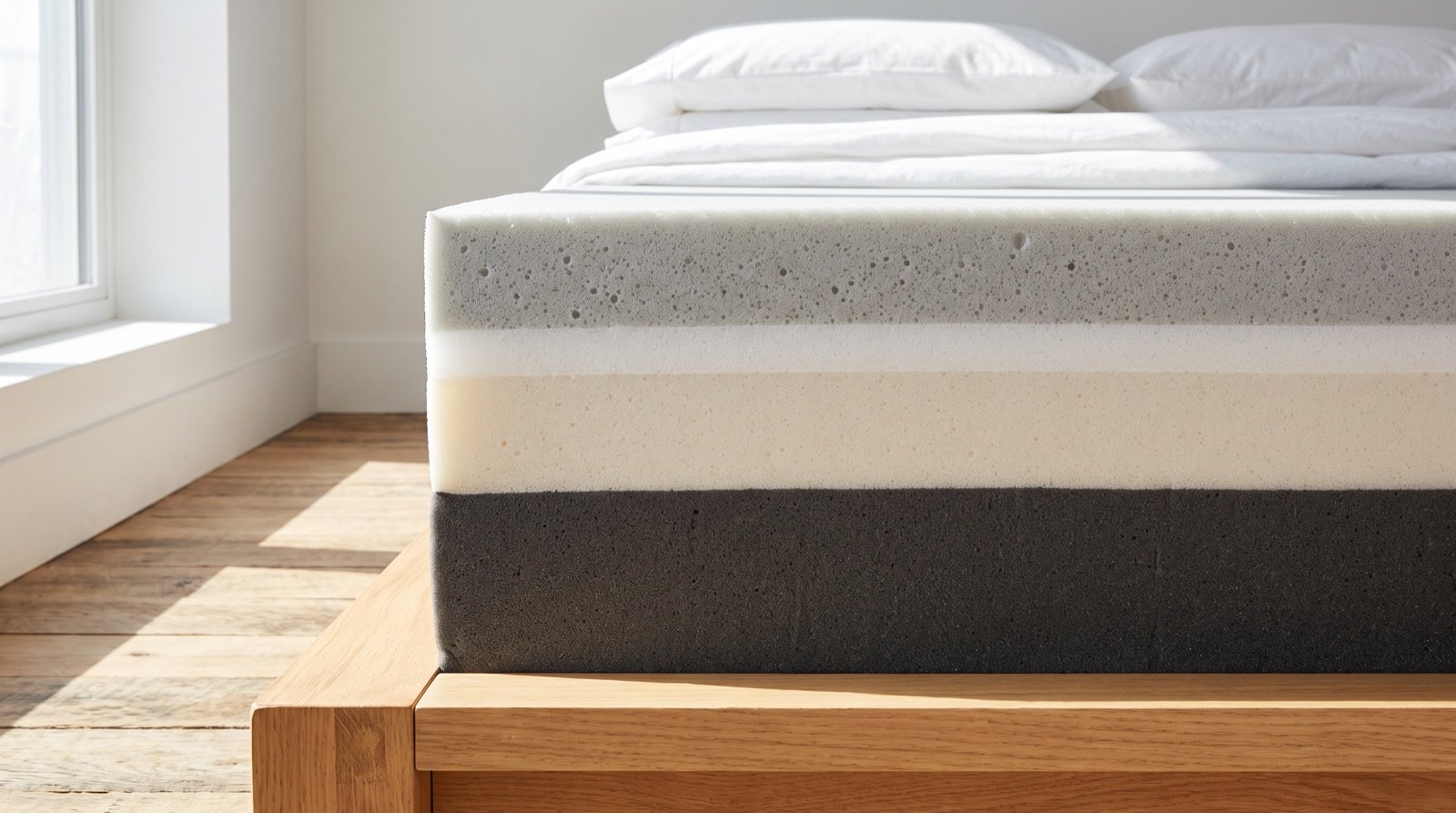
CertiPUR-US says it plainly in its own FAQ: “We do not certify furniture, product lines or companies. We only certify flexible polyurethane foam.”
Not the mattress. Not the cover. Not the adhesives, the coils, the antimicrobial or cooling treatments, or the fragrance. And not the fire barrier, which is where fiberglass lives. The program says so directly: foam producers don’t use fiberglass to make the foam it certifies. A mattress can carry the badge and have a fiberglass sock inside it.
Nothing in it addresses worker conditions, carbon, or whether the foam is petroleum-based at all. And the “certified biobased” variant requires a minimum of 25 percent biobased content, which means up to three quarters of a plant-sounding foam can still be fossil carbon.
How it stacks up against the other seals
GREENGUARD Gold is the one worth comparing, because it answers a bigger question. Run by UL Solutions, it certifies finished products rather than components, and its emission limits are tighter: total VOCs at 220 micrograms per cubic meter against CertiPUR-US’s 500, formaldehyde at 9 micrograms against 15.
So on formaldehyde CertiPUR-US beats base-tier GREENGUARD and loses to Gold. On total VOCs it matches base tier and Gold is more than twice as strict. And Gold is testing the whole bed.
GOTS and GOLS aren’t stricter versions of any of this. They certify fiber and latex origin, so a polyurethane mattress can never hold either, no matter how clean its foam. If you want the difference laid out properly, we compared GOTS and OEKO-TEX in their own piece.
One more thing worth correcting, because it’s repeated everywhere. You’ll read that EWG criticized CertiPUR-US as an industry trade group. We went looking and EWG has never named it. That line traces back to a competing mattress brand’s help center.
So how much weight should it carry
Treat it as a floor on one ingredient. Not a verdict on a bed.
If you’re buying foam anyway, foam with the badge beats foam without it, and that’s a real if unglamorous conclusion. If you want a statement about the finished mattress, GREENGUARD Gold is the stronger signal. If you want to skip the petroleum entirely, GOTS and GOLS are the certifications that answer that, and they’re what the mattresses we recommend carry.
And when a brand leads its marketing with CertiPUR-US and stays quiet about the cover, the barrier and the glue, notice the shape of that. It’s the same move we walk through in the greenwashing guide: a genuine credential for a narrow thing, presented as though it settles a wide one.
Frequently asked questions
Is CertiPUR-US a real certification or just marketing?
It’s real. The standard is published in full, the chemical and emissions testing has to be done by one of three named accredited labs, and foam is retested at six months and then annually with random plant sampling. It’s written and administered by a foam industry body, which is a fair thing to weigh, but no regulator has ever challenged it.
Does CertiPUR-US mean a mattress has no fiberglass?
No. The program certifies flexible polyurethane foam only, and fiberglass is used in the fire barrier, which sits outside that scope. CertiPUR-US says as much on its own site. A CertiPUR-US mattress can absolutely contain a fiberglass inner sock, so ask the manufacturer separately.
Is GREENGUARD Gold better than CertiPUR-US?
For judging a mattress, yes, on two counts. It certifies the finished product rather than one component, and its emissions limits are tighter, at 220 micrograms per cubic meter of total VOCs against 500. They’re not mutually exclusive, and a mattress carrying both is telling you more than one carrying either.
How much plant content is in “certified biobased” foam?
Under this program, that at least 25 percent of the foam’s carbon comes from plant sources, verified by carbon dating. The other 75 percent can be petroleum. It’s a genuine reduction and it isn’t the plant-based mattress the phrase suggests, so read it as a percentage rather than a category.
Related reading
More on what’s inside a mattress: why fiberglass ended up in there and formaldehyde in wrinkle-free bedding. On certifications generally, see GOTS versus OEKO-TEX and how to spot greenwashing. For picks, the best non-toxic mattresses.