
Veja
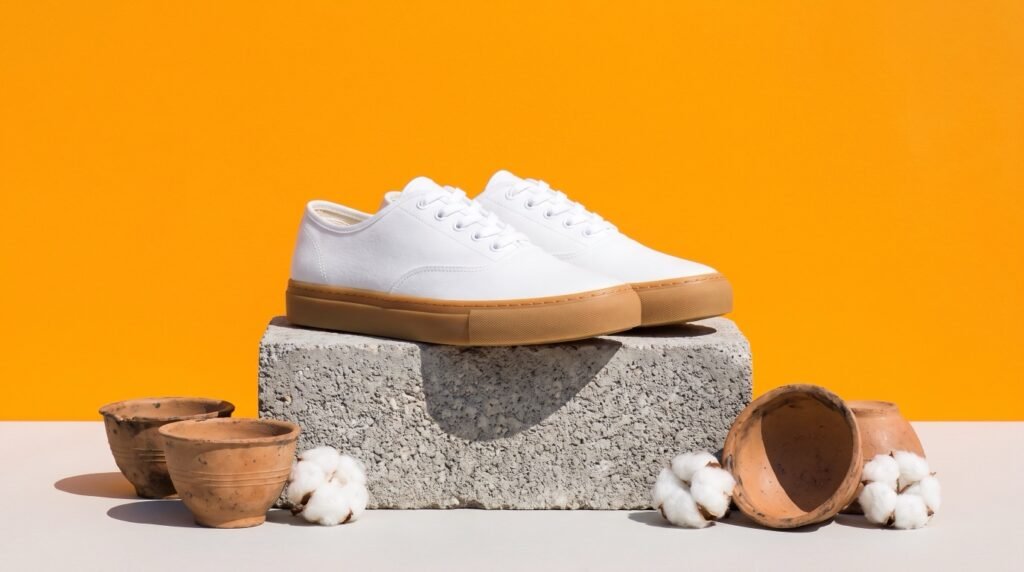
Quick verdict: Veja makes the rare eco-sneaker that people buy because they like the shoe, not because they feel they should. B Lab has certified it since 2018, the cotton is GOTS certified, and the rubber comes out of the Amazon at several times the market price. Then there’s the thing that really sets it apart: a page on its own website listing eight ways it’s still falling short. Our rating: 4.3 out of 5.
Who they are
Sébastien Kopp and François-Ghislain Morillion started Veja in 2004 after traveling through Brazil to see how supply chains actually worked. The first sneakers shipped in 2005. The company is based in Paris, the shoes are made in Brazil and Portugal, and by 2024 it was turning over about €250 million with more than 600 staff.
Two decades in, it still has no investors. That’s a deliberate refusal rather than an accident of scale, and it’s why ownership scores a full 1.0 here. Nobody is waiting for an exit.
The other founding decision was to buy no advertising at all. No campaigns, no sponsorships, no billboards. The founders’ explanation is simple arithmetic: the materials and the working conditions cost them three to five times what a conventional sneaker costs, and skipping the ad budget is what lets the shoes land at roughly the same shelf price as everyone else’s.
What they get right
- B Corp certified since December 2018, with an overall B Impact Score of 92.7 against 80 to qualify and a 50.9 median for businesses that finish the assessment. Its Workers score, 25.7, is the strongest section on the card.
- The cotton has an auditor attached. Veja buys organic and agroecological cotton straight from family producers in Brazil and Peru, on contracts signed before planting so growers know their price in advance. The Peruvian cotton is GOTS certified, which is the standard that makes “organic” mean something.
- Wild rubber, certified and paid for properly. The soles use rubber tapped in the Amazon rather than plantation rubber, which makes standing forest worth more to a tapper than cleared forest. Veja’s rubber page says the supply chain was certified Fair for Life in 2019, and that 22 associations and cooperatives it buys from were certified in 2022, covering more than 2,500 families.
- Logistics run through Ateliers Sans Frontières, a French rehabilitation association that employs people working their way back into the job market. It’s an odd thing to find inside a sneaker company’s warehouse operation, and it’s audited as part of the B Corp assessment.
Where they fall short
Start with the page most brands would never publish. Veja’s Limits page lists, in its own words, eight things it hasn’t solved. The vegan C.W.L. material is still 45% petroleum-based. It gave up on natural dyes in 2013 because the colors weren’t good enough, and on vegetable-tanned leather in 2015 because it cost too much and wore badly. Its e-commerce banking runs through partners with branches in tax havens. It can’t recycle other brands’ sneakers. It doesn’t source its own eyelets. And it openly wonders whether anyone needs to buy this many pairs of shoes.
That’s a real weakness list, published voluntarily. We’d still rather point out the things it leaves off.
Look at Veja’s own best-seller page and it’s leather, nearly all the way down. Campo, Esplar, V-90, Recife, Volley, all in ChromeFree leather. The tanning process skips chrome and heavy metals, which is a real improvement on standard tannery chemistry, but chrome-free leather is still cattle leather, and the wild-rubber-and-organic-cotton story does a lot of work covering a range that mostly isn’t either.
There’s no supplier list either. You get the Porto Alegre factory in photographs, certificates for chemical compliance, and a lot of description. You don’t get the roster of every facility with an audit date next to it, which is what separates Veja’s 0.8 on transparency from Patagonia’s 1.0.
One thing worth a diary note: Veja is certified against B Lab’s 1.6 standards, and B Lab’s new v2.1 rules bite in September 2026. Plenty of certified companies will have to requalify. We’ll re-check this one after that.
What they sell, and what it costs
Sneakers, mostly, plus running shoes, kids’ sizes and a few accessories. The Esplar and Volley run $155, Campo $175, Recife $180, and the V-90 tops out at $190. The V-10, the one most people picture, sits between $160 and $180.
Set that against $110 to $140 for a premium conventional sneaker and you’re paying a modest premium, not a luxury one. Veja also runs repair shops in a handful of cities, which stretches the math further. It’s not the cheapest way to buy a sustainable shoe. It’s a fair price for what’s in it.
Who it’s actually for
Anyone who wants a sustainable sneaker that reads as a normal, good-looking sneaker. The V-10 and Campo have been style staples for years now, and nobody looks at them and thinks “eco.”
Two caveats before you order. The soles are flat and firm, so these are walking shoes rather than running shoes, whatever the retro-running models look like. And if you want an all-vegan sneaker, the leather models are most of the range, so you’re shopping a smaller corner of it.
If certified organic fiber across the whole product is your line in the sand, Veja won’t clear it, because most of what it sells is leather. If you want a company that will tell you what it hasn’t fixed yet, it’s hard to beat.
Deals and discounts
No affiliate program on our side, so nothing here earns us anything. Veja rarely discounts and runs no sales calendar to speak of, which is consistent with the rest of how it operates.
Frequently asked questions
Is Veja a certified B Corp?
Yes. B Lab has certified Veja since December 2018, and its current overall B Impact Score is 92.7, against 80 to qualify. We checked this in B Lab’s own directory rather than taking it from Veja’s marketing. Worth knowing that the certification sits under B Lab’s 1.6 standards, and the tighter v2.1 standards take effect in September 2026.
Is Veja leather or vegan?
Both, but mostly leather. Veja’s best-selling models are made from ChromeFree leather, tanned without chrome or heavy metals in Brazil. There’s a vegan line using C.W.L., a material Veja itself says is still 45% petroleum-based. If you need vegan, the options exist but they’re the smaller part of the range.
Where are Veja sneakers made?
In Brazil and Portugal. Veja’s production is concentrated in Brazil, where its cotton and rubber supply chains also sit, and the company shows its Porto Alegre production line publicly. It does not publish a complete factory list.
Are Veja sneakers worth the price?
For most people, yes. At $155 to $190 they cost a little more than a premium conventional sneaker and a lot less than a designer one, and Veja runs repair shops that extend the life of a pair. The catch isn’t the price, it’s the fit: flat, firm soles that suit walking and standing rather than running.