Coconut Water vs Electrolyte Powder: What the Numbers Say
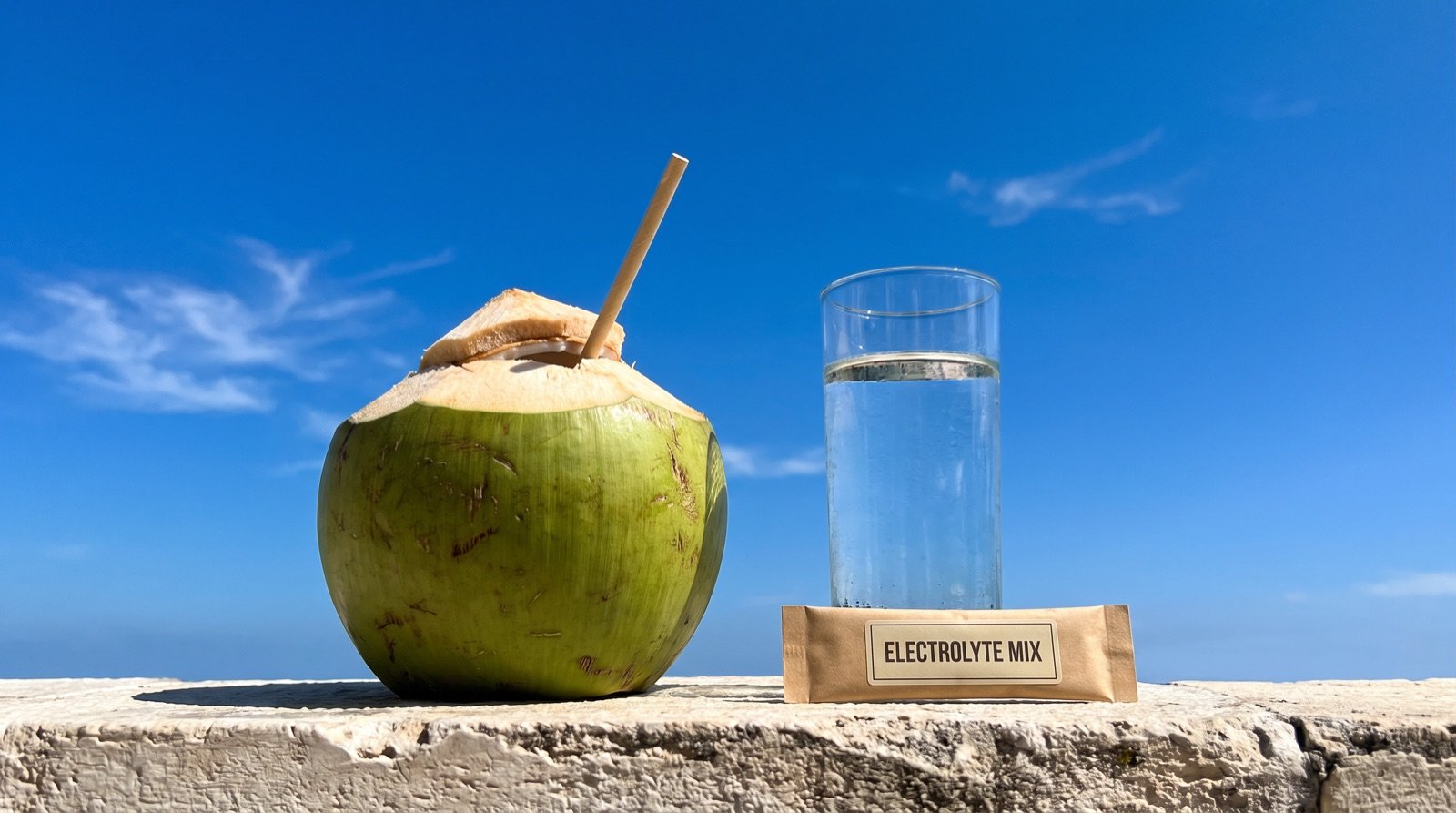
Coconut water has the best marketing in this whole category. It comes out of a fruit. It’s “nature’s sports drink.” It sounds like the obvious clean alternative to a packet of powder.
The nutrition panel tells a more specific story. It’s mostly about potassium.
Short answer: A cup of packaged unsweetened coconut water carries about 64 mg of sodium, 404 mg of potassium and nearly 10 g of sugar, according to USDA data. That makes it a reasonable drink after light exercise and a poor fit for heavy, salty sweating, where sodium is what you lose most. The small studies comparing it with sports drinks mostly found no difference, and the best-known one was funded by a coconut water company.
What’s actually in a cup
The USDA’s FoodData Central has two entries worth comparing.
Packaged unsweetened coconut water (FDC ID 174831) works out to about 64 mg of sodium, 404 mg of potassium and 9.6 g of sugar per cup. Fresh coconut water (FDC ID 170174) is listed higher in both, at roughly 252 mg of sodium and 600 mg of potassium per cup. That gap tells you something too. Coconuts vary, and so does processing.
Now put that next to what sweat takes out. Sweat runs about 230 to 1,610 mg of sodium per liter, and only a small fraction of that in potassium. A liter of packaged coconut water, about four cups, gives you roughly 260 mg of sodium. For a heavy sweater, that’s not much. Barely a top-up.
| Per serving | Coconut water, packaged (1 cup) | Coconut water, fresh (1 cup) | Typical high-sodium powder (1 stick) |
|---|---|---|---|
| Sodium | About 64 mg | About 252 mg | 1,000 mg |
| Potassium | About 404 mg | About 600 mg | 200 to 500 mg |
| Sugar | About 9.6 g | Varies | 0 g in unsweetened versions |
| Best fit | Light exercise, a tasty drink | Light exercise | Long, hot, salty sessions |
The powder figures are from the brands’ own labels, which we compare in how much sodium is in your electrolyte mix.
What the rehydration studies found
This is where it gets interesting. The research is small, and the funding is worth reading.
A 2002 study of eight men found coconut water, a sports drink and plain water rehydrated about equally after exercise, with coconut water causing less nausea. A 2012 trial of twelve found no difference in hydration or performance, but coconut water caused more bloating and stomach upset. That second study was funded by Vita Coco.
Then the sodium question. A 2007 study found that only coconut water with added sodium matched a sports drink for rehydration, which is the clearest hint that the low sodium is the limitation. A 2014 crossover found coconut water’s extra potassium gave no benefit over a sodium-based sports drink.
Two 2026 studies, one of eight people and one of twelve, found coconut water performed about the same as a sports drink.
So the fair read: for moderate exercise, coconut water works about as well as a sports drink, which is to say about as well as water. Nobody has shown it’s better, and the one study that tested a salty version suggests sodium is what it’s missing.
The potassium caveat
Potassium is why coconut water sounds healthy. For most people it is a plus. For a small group it’s a real risk.
A published case report describes a 78-year-old taking losartan and spironolactone, with kidney failure and diabetes, who drank a lot of king coconut water and developed a dangerously high potassium level with paralysis. Several factors were involved, but the lesson is specific: anyone with kidney disease or on potassium-sparing blood pressure medicines should check with their doctor before drinking coconut water in quantity.
What’s in the powder besides electrolytes
Powders have their own question, and it isn’t potassium. It’s what else comes along in the stick.
California’s Prop 65 system has started catching electrolyte powders for lead. Recent 60-day notices allege lead in an electrolyte drink mix in October 2025, and in two more electrolyte powders and a line of sport drink mixes in 2026, one of which settled out of court this month. A notice is an allegation rather than a lab finding the state has confirmed. It’s still a reminder that a powder is a concentrated, processed product, and that testing matters here the same way it does for protein powder.
That’s why our vetted electrolyte powders look at testing alongside the label.
So which should you drink?
If you’re doing a moderate workout and you like the taste, coconut water is a perfectly good drink. It’s real food, it has potassium most of us are short on, and it’s no worse than a sports drink for an hour at the gym. Watch the sugar if you’re drinking it daily.
If you’re a heavy or salty sweater, training long in heat, or recovering from illness, a powder with real sodium is the better tool. For illness specifically, the formula to look for is one close to the WHO’s oral rehydration solution, which coconut water isn’t.
And if you’re drinking either one at a desk, water does the job. We make that case properly in do you actually need electrolytes, and if you’re picking a powder, the sweetener question is the next thing to check.
Frequently asked questions
Is coconut water better than electrolyte powder?
Not for heavy sweating. Coconut water is high in potassium but low in sodium, about 64 mg per cup in packaged versions, while sweat loses mostly sodium. For moderate exercise, small studies found it rehydrates about as well as a sports drink. For long, hot sessions, a sodium-rich powder is the better fit.
How much sodium is in coconut water?
About 64 mg per cup of packaged unsweetened coconut water, according to USDA data, and roughly 252 mg per cup for fresh. Both vary with the coconut and the processing. That’s far less than a high-sodium electrolyte stick, which can carry 1,000 mg.
Is coconut water good for hydration?
Yes, about as good as water or a sports drink for typical exercise, according to several small studies. It caused less nausea in one study and more bloating in another, which was funded by a coconut water brand. It isn’t a substitute for an oral rehydration solution during illness.
Can you drink too much coconut water?
For most people, large amounts mainly mean extra sugar. For people with kidney disease or those taking potassium-sparing medicines, heavy intake can push potassium to dangerous levels, as one published case report showed. Check with a doctor if either applies to you.
Do electrolyte powders contain lead?
Some have been named in California Prop 65 notices alleging lead, including several electrolyte powders and sport drink mixes in 2025 and 2026. A notice is an allegation, not a confirmed finding. Choosing a brand that publishes heavy-metal testing is the practical safeguard.
Related reading
The rest of this series: do you actually need electrolytes, how much sodium is in your electrolyte mix, and sucralose, stevia and sugar in electrolyte powders. For vetted picks, see the best clean electrolyte powders.
Sources: USDA FoodData Central, coconut water entries 174831 (packaged) and 170174 (fresh). Baker, Sports Medicine, 2017. Saat et al., Journal of Physiological Anthropology, 2002. Kalman et al., JISSN, 2012. Ismail et al., 2007. Pérez-Idárraga et al., 2014. Case report, hyperkalemia and king coconut water. California Attorney General, Prop 65 notices 2025-04233, 2026-02514, 2026-02517, 2026-03657.