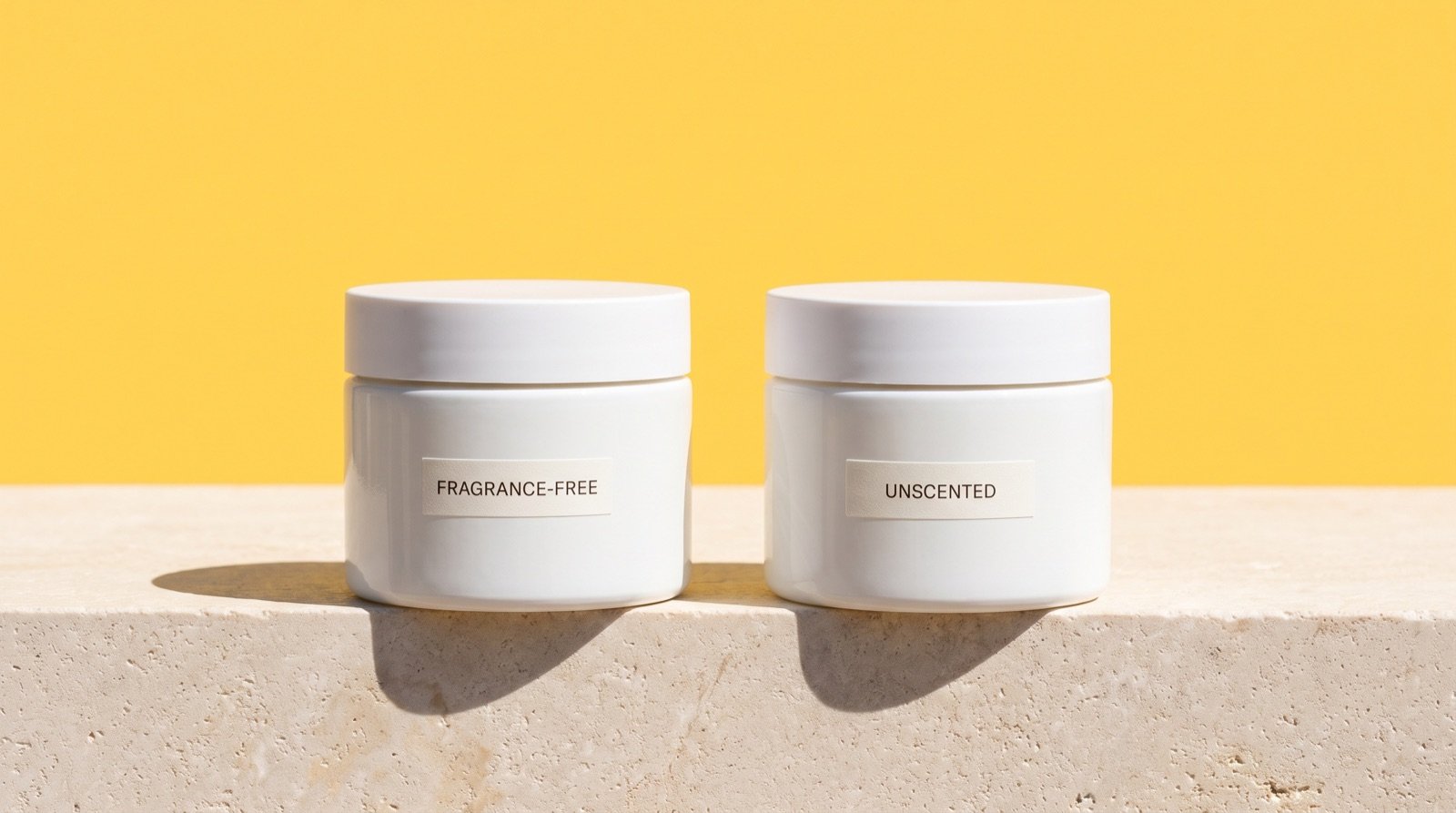
Fragrance-Free vs Unscented: Not the Same Thing
You may have assumed that unscented means nothing was added to make it smell like anything. It’s the reasonable reading. It is not what the word does on a label, though.
The FDA puts it about as plainly as a federal agency can: some products labeled “unscented” contain fragrance ingredients, because the manufacturer added just enough to mask the smell of everything else without giving the product a noticeable scent.
Short answer: Unscented means it doesn’t smell of much, and can legally contain masking fragrance. Fragrance-free is meant to mean no fragrance ingredients were added at all. Neither term is defined in US law, and when researchers checked 174 best-selling moisturizers, 45% of the ones claiming to be fragrance-free still contained a fragrance cross-reactor or a botanical.
Why the label can be this vague
Fragrance formulas are treated as trade secrets, and US labeling rules are built around protecting them. Under 21 CFR 701.3, ingredients are declared in descending order of predominance, except that a whole fragrance mixture can be declared with the single word “fragrance.” Where the FDA grants a trade-secret exemption, the phrase “and other ingredients” can close out the list instead.
One word. Dozens of substances behind it, and there’s no legal definition of “fragrance-free” or “unscented” holding either claim to a standard.
Two rules chip away at that. California’s Cosmetic Fragrance and Flavor Ingredient Right to Know Act, in force since January 2022, requires companies to report fragrance and flavor ingredients drawn from 23 designated hazard lists to a state database, with allergens reportable at 0.01% in rinse-off products and 0.001% in leave-on ones. It’s a database, though, not a label. Europe goes further and makes allergens appear on the box: 24 of them today, rising to 80 under a 2023 amendment, with new products needing to comply by July 2026. We went through how that labeling works in its own piece.
| The claim | What it’s meant to mean | What it can still contain |
|---|---|---|
| Fragrance-free | No fragrance ingredients added | Botanical extracts, essential oils, masking agents. No legal definition |
| Unscented | No noticeable smell | A masking fragrance, by the FDA’s own description |
| Naturally scented | Scent comes from plants | Limonene and linalool, which oxidize into two of the most common allergens in patch testing |
| Hypoallergenic | Nothing in particular | Anything. The term isn’t defined or enforced |
What patch testing keeps finding
This is the part that moved my own shopping. In the North American Contact Dermatitis Group’s 2021-2022 data, 3,056 patients were patch tested and 72% had at least one positive reaction. Hydroperoxides of linalool came fourth on the list of most common allergens at 10.1%, and reactions to hydroperoxides of limonene rose significantly against the previous cycle. The authors’ summary is that fragrance allergy is still very common, and that the markers are shifting.
Linalool and limonene are what lavender and citrus oils are partly made of. They oxidize on contact with air, and the oxidation products are the allergens. German researchers who tested 5,511 consecutive patients between 2018 and 2020 found 8.8% positive to linalool hydroperoxides and 3.1% to limonene hydroperoxides.
So “naturally scented” isn’t a safe harbor. An essential oil is a fragrance with a nicer origin story.
The 45% problem
In 2017, dermatology researchers analyzed 174 best-selling moisturizers from Amazon, Target and Walmart against the standard allergen series. Only 12% were free of those allergens entirely. Fragrance mix was the most common one, in 87 products, followed by paraben mix and tocopherol.
And of the products that claimed to be fragrance free, 45% contained a fragrance cross-reactor or a botanical ingredient anyway.
That isn’t a conspiracy. It’s a definition problem. If nobody defines the claim, a brand can use botanical extracts for scent, skip the word “fragrance” on the INCI list, and print “fragrance free” in good conscience.
How to read the label in 30 seconds
Ignore the front of the box. Go to the ingredient list. Look for parfum, fragrance, aroma and flavor, then for plant names that end in “oil” or “extract” near the bottom of the list, which is where scent lives. The EU allergen names are a useful giveaway too: if you see limonene, linalool, citronellol, geraniol or citral spelled out, something in there is fragrant, whether or not the word fragrance appears.
If your skin is calm and happy, none of this needs to change. Essential-oil scented products are lovely and most people wear them without trouble, which is why several of our vetted moisturizer picks are scented that way and say so.
If you’re reactive, eczema-prone, or in the middle of a flare, go properly fragrance-free, and check the INCI rather than the claim. It should only take a few seconds once you know what you’re looking for. The same habit works on everything else in the bathroom.
Frequently asked questions
What’s the difference between fragrance-free and unscented?
Fragrance-free is meant to mean no fragrance ingredients were added. Unscented means the product has no noticeable smell, which the FDA says can include a masking fragrance added to cover the odor of the other ingredients. Neither term is legally defined in the US, so both depend on the brand’s own interpretation.
Is fragrance-free better for sensitive skin?
Usually, yes. Fragrance is consistently among the most common allergens in patch-test data, with hydroperoxides of linalool reacting in 10.1% of patients in the most recent North American series. If you’re reactive, the ingredient list matters more than the claim, since 45% of moisturizers claiming fragrance-free in one analysis still contained a botanical or cross-reactor.
Do essential oils count as fragrance?
For your skin, yes. Essential oils are complex fragrance mixtures, and constituents like limonene and linalool oxidize into some of the most common contact allergens. A product scented with essential oils is a scented product, however the label frames it.
Does fragrance-free mean the product has no smell?
No. Raw materials have their own odors, so a truly fragrance-free cream can smell faintly of oils or plant extracts. That base smell is a sign nothing was added to cover it up.
Is “hypoallergenic” a regulated term?
No. There’s no federal standard or testing requirement behind it, and a product carrying the word can still contain common allergens. Treat it as marketing and read the ingredient list.
Related reading
The rest of this series: is mineral oil bad for your skin, phenoxyethanol, the preservative that replaced parabens, and what squalane, niacinamide and hyaluronic acid actually do. For vetted picks, see the best natural face moisturizers. We’ve also covered what “clean fragrance” means and the allergen labeling rules.
Sources: US Food and Drug Administration, Fragrances in cosmetics. 21 CFR 701.3. California Department of Public Health, SB 312. Xu et al., JAMA Dermatology, 2017. Houle et al., Dermatitis, 2025. Schubert et al., Contact Dermatitis, 2023.