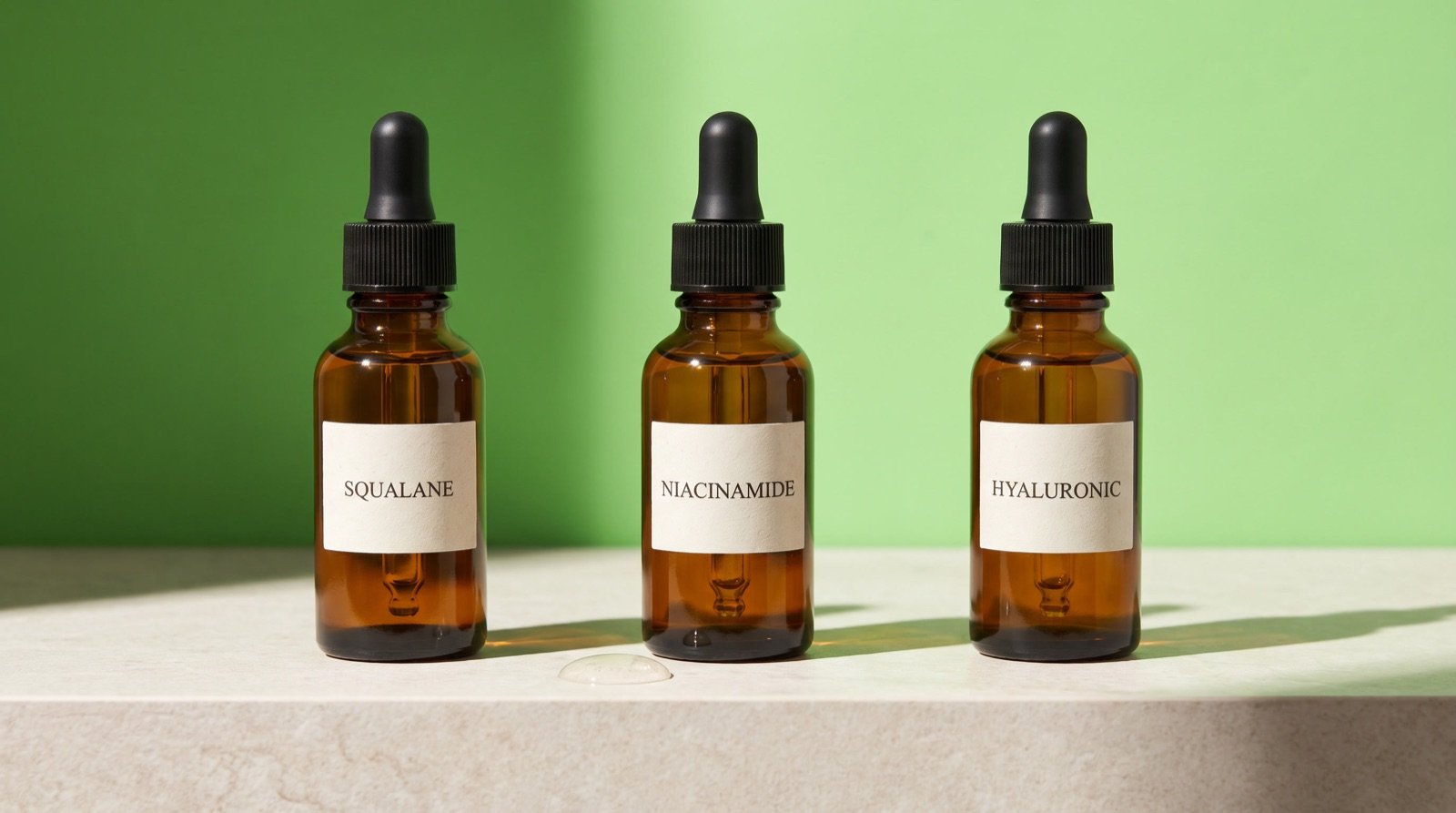
Squalane, Niacinamide and Hyaluronic Acid: What Each Actually Does
Three names do most of the selling on moisturizer labels right now. They’re on the front of drugstore tubes and on $110 jars, often all three at once, usually with no indication of what any of them is for.
Here’s what the research actually supports for each, including the one claim we couldn’t find a study behind anywhere.
Short answer: Niacinamide has the best clinical record of the three, with split-face trials showing improvements in fine lines, pigmentation and blotchiness at 5%. Hyaluronic acid is a humectant that pulls water into the surface layer and needs something over the top to hold it there. Squalane is an emollient that makes a formula feel good, and the question worth asking about it is which animal or plant it came from.
Niacinamide: the one with the trials
Start with the strongest evidence, because it’s decent by the standards of a cosmetic ingredient.
In a 2005 split-face trial published in Dermatologic Surgery, 50 women used 5% niacinamide on one side of the face and vehicle on the other, twice a day, double-blind, for 12 weeks. The niacinamide side showed significant reductions in fine lines and wrinkles, hyperpigmented spots, red blotchiness and sallowness, with elasticity improved on instrument measurement.
Pigmentation has a mechanism behind it too. A 2002 study in the British Journal of Dermatology found niacinamide did nothing to tyrosinase or melanin production in cultured melanocytes, but inhibited the transfer of pigment packages to skin cells by 35 to 68% in coculture. In the clinical arm, 18 subjects using a 5% niacinamide moisturizer showed significantly less hyperpigmentation than vehicle at four weeks, and a larger 120-subject arm used 2% alongside sunscreen.
Worth saying out loud: both studies came from Procter & Gamble research groups, and P&G sells niacinamide products. The work is well-designed, and the funding is still part of the picture.
Those trials also give you the useful numbers. 2% and 5% are the levels with evidence. A 10% serum isn’t twice as good, and for some people it stings.
Hyaluronic acid: a humectant, not a moisturizer
This one is a little tricky, because it works in a way the marketing never explains.
Hyaluronic acid is a humectant. It holds water in the outer layer of skin, and it doesn’t seal anything. A 2016 review in the Indian Journal of Dermatology calls humectants a double-edged weapon for exactly that reason: they raise water loss by drawing moisture up from deeper skin into the surface, where it evaporates. The fix isn’t to skip them. Put something on top, which is the entire reason your serum instructions tell you to follow with a cream.
What about molecular weight, the thing every brand now prints? The best trial we could find, published in 2024, tested low and high molecular weight hyaluronic acid on 36 nursing-home residents aged 60 to 80, with three randomized sites per person. The authors note plainly that low molecular weight is believed to work better and that clinical research supporting the belief is lacking. In their own results, the low molecular weight version beat both the high molecular weight one and the vehicle on skin capacitance at four weeks, with no significant difference in water loss or symptom scores.
Now the claim you’ve heard: that hyaluronic acid pulls water out of your skin in a dry climate and leaves you worse off. We went looking for the study behind it and came up empty. Every version traces to a brand blog or a quote in consumer press. The underlying mechanism is real, and the review above spells it out: humectants can raise water loss, and research on water activity in formulas found humectants promoting hydration even when the formula itself was drier than the skin. Apply it to damp skin, seal it, and stop worrying about the folk version.
Squalane: the feel, and the shark
Squalane is the hydrogenated, shelf-stable version of squalene, an oil your own skin makes. It spreads beautifully. Absorbs fast, doesn’t smell, which is why it shows up in everything from $12 gel creams to luxury facial oils.
The part the label often skips is where it came from. Squalene is extracted from olives, produced by fermenting sugarcane, or taken from shark livers. The French NGO Bloom tested 62 moisturizing creams and found one in five contained shark-derived squalene, with estimates of up to 3,000 sharks per tonne produced and around three million sharks killed each year for the industry, as reported by Earth.org. Of roughly 60 shark species targeted, 26 are listed as vulnerable.
The INCI name is the same whichever source it came from. So the brand has to tell you, and the good ones do: look for “plant-derived”, “olive-derived” or “sugarcane-derived” next to the word squalane, and treat silence as a question worth emailing about. It’s the same problem as any sourcing claim nobody is obliged to substantiate.
| Ingredient | What it is | Best evidence | What to check on the label |
|---|---|---|---|
| Niacinamide | Vitamin B3 derivative | Split-face trials at 5% over 12 weeks: fine lines, pigment, blotchiness | 2% to 5%; more isn’t better |
| Hyaluronic acid | Humectant that holds water in the surface layer | One 2024 trial favoring low molecular weight on hydration | Apply damp, follow with a cream |
| Squalane | Emollient, hydrogenated squalene | Long cosmetic use record rather than clinical trials | Plant-derived, olive or sugarcane, stated |
Two claims we couldn’t stand up
Being honest about the gaps is more useful than filling them.
The first is that niacinamide and vitamin C cancel each other out. Every source we opened for it was a brand blog or a retailer explainer, with no primary chemistry behind the version aimed at consumers. The second is the flushing story, which comes from niacin, a different form of the vitamin taken orally. We couldn’t verify either claim in a source worth citing, so we’re not going to repeat them as facts.
How to actually use all three
Thinnest to thickest. Damp to dry. Hyaluronic acid goes on damp skin. Niacinamide can sit in the serum or the moisturizer, at 2 to 5%. Squalane comes last or in the cream itself, as the thing that makes the whole routine feel pleasant rather than sticky.
And a moisturizer containing all three is not automatically better than one containing one of them well. What matters more is whether you’ll use it every day, which usually comes down to texture, scent and price. Our vetted picks name which of the three each formula actually carries, so you can match it to the job you’re hiring it for.
Frequently asked questions
Does niacinamide actually work?
It has the strongest evidence of the three. In a 12-week double-blind split-face trial, 5% niacinamide significantly reduced fine lines, hyperpigmented spots, red blotchiness and sallowness compared with vehicle. A separate study found it cuts the transfer of pigment to skin cells by 35 to 68% in cell culture. Both were run by Procter & Gamble research groups.
What percentage of niacinamide should I look for?
The clinical evidence sits at 2% and 5%. Higher percentages haven’t been shown to work better, and some people find 10% formulas irritating. If a product doesn’t state a percentage, the ingredient’s position on the list is a rough guide.
Does hyaluronic acid dry out your skin in a dry climate?
We couldn’t find a study showing that. Humectants can raise water loss by drawing moisture toward the surface, which is the real mechanism the claim is built on, but the fix is applying it to damp skin and sealing it with a moisturizer rather than avoiding it.
Is squalane vegan?
It depends on the source, and the ingredient name won’t tell you. Squalane is made from olives, fermented sugarcane or shark liver oil, and testing by the NGO Bloom found shark-derived squalene in one in five moisturizing creams it sampled. Look for a plant-derived claim on the label.
Can you use all three together?
Yes. Apply hyaluronic acid to damp skin, use niacinamide in a serum or moisturizer at 2 to 5%, and let squalane do the finishing work. Layering them is routine, and none of them needs a gap between steps.
Related reading
The rest of this series: is mineral oil bad for your skin, phenoxyethanol, the preservative that replaced parabens, and fragrance-free vs unscented. For vetted picks, see the best natural face moisturizers, and the best non-toxic skincare brands for the wider routine.
Sources: Bissett et al., Dermatologic Surgery, 2005. Hakozaki et al., British Journal of Dermatology, 2002. Sethi et al., Indian Journal of Dermatology, 2016. Muhammad et al., Archives of Dermatological Research, 2024. Albèr et al., International Journal of Cosmetic Science, 2014. BLOOM Association testing, reported by Earth.org, 2022.