Is Mineral Oil Bad for Your Skin? An Honest Answer
Read enough clean-beauty ingredient blacklists and you start to notice the same name near the top of all of them. Mineral oil. Usually with the word “carcinogen” somewhere in the same sentence.
Here’s the part those lists leave out: the research behind that word was done on factory workers, not on face cream.
Short answer: For the cosmetic grade, no. The International Agency for Research on Cancer classifies untreated and mildly-treated mineral oils as Group 1 carcinogens and highly-refined ones as Group 3, meaning not classifiable. Germany’s federal risk institute reviewed the cosmetic grade in 2018 and found no expected health risk on skin, because these oils are barely absorbed through it. The real catches are lip products, which you swallow, and the fact that it’s a petroleum product, which is a values question rather than a safety one.
Where the carcinogen story comes from
The IARC classification is real, and it’s worth reading properly. In its monograph, the agency splits mineral oils into two groups: untreated and mildly-treated oils are Group 1, with sufficient evidence of cancer in humans, while highly-refined oils sit in Group 3, where the human evidence is inadequate.
The Group 1 evidence came from jobs. Mule spinning in cotton mills, metal machining, jute processing. Workers had oil soaking their clothes for entire shifts, and the cancers that followed were squamous-cell skin cancers, especially of the scrotum. In one group of 682 metal turners exposed for five years or more, there were five squamous-cell carcinomas where 0.3 would have been expected. In a series of 344 scrotal cancer cases, the median time between first exposure and diagnosis was 34 years.
That’s crude machine oil against skin for decades. It isn’t the paraffinum liquidum in a jar of night cream, and IARC’s own split says so.
Europe made the distinction into law
The EU took the same two-tier view and wrote it into the Cosmetics Regulation. Petroleum fractions sit in Annex II, the banned list, with one exception: they’re allowed if the full refining history is known and the source substance can be shown not to be a carcinogen. Several related paraffin oil entries are banned outright if they contain more than 3% DMSO extract, which is a measure of the aromatic residue refining is supposed to remove.
So in Europe, a cosmetic mineral oil comes with paperwork. The company has to be able to show where it came from and how it was refined, which is the opposite of how the blacklists describe the situation.
What it’s actually good at
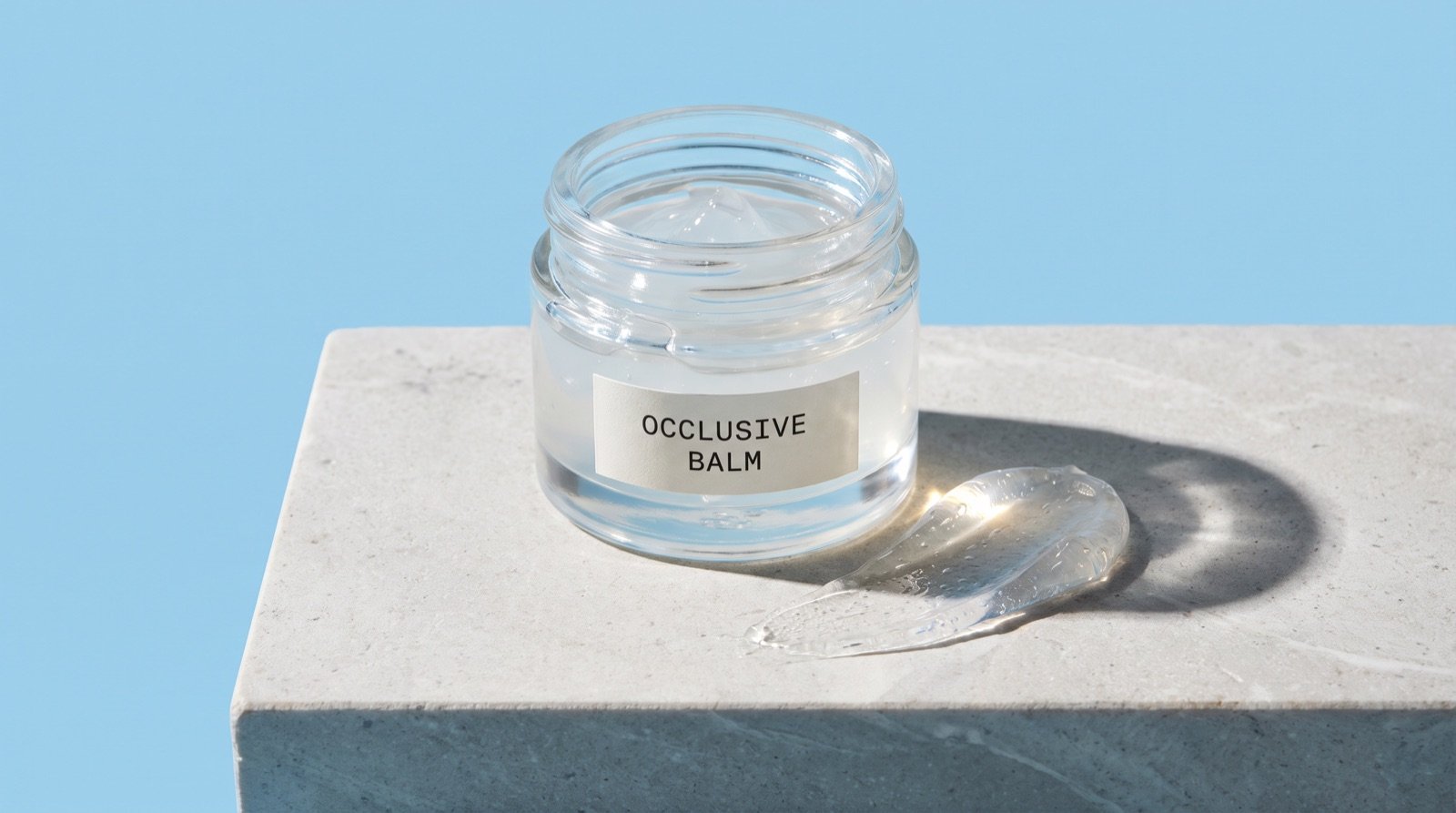
This is the part that gets lost. Mineral oil is an occlusive, meaning it sits on the surface and slows the water leaving your skin.
A 2012 review in the International Journal of Cosmetic Science put it through the usual barrier measures and found it improved skin softness and barrier function better than some other emollients, suppressed water loss in living skin, and held up well against a long list of vegetable oils. If your face stings in January, that mechanism is the thing you’re missing, not an active.
How strong an occlusive? A 2016 review in the Indian Journal of Dermatology ranks them: petrolatum at 5% or more cuts water loss by over 98%, while lanolin, mineral oil and silicones cut it by 20 to 30%. Petrolatum is the heavyweight. Mineral oil is the lighter, more cosmetically pleasant relative.
| Quick facts | Mineral oil, cosmetic grade |
|---|---|
| Also written | Paraffinum liquidum, liquid paraffin, white mineral oil |
| What it does | Occlusive: sits on the surface and slows water loss |
| Typical use | Balms, cleansing oils, rich creams, baby oil |
| Safety review | IARC Group 3 for highly-refined; BfR 2018 found no expected health risk on skin |
| The catch | Lip products get swallowed, and MOAH contamination is a real quality question |
Does it clog pores?
Honestly, this one is murkier than either side admits.
The comedogenic ratings that circulate online come from an animal model, the rabbit ear assay, rather than from human faces, and the one paper we could find asking the question directly is a short 2005 piece in the Journal of Cosmetic Dermatology whose numbers we couldn’t open to quote. So we’re not going to tell you it’s proven either way.
What’s fair to say: an occlusive does what an occlusive does. If your skin is oily and congested, sealing it under a heavy layer can feel worse, which is a texture decision rather than a toxicity one. Try it on your jaw for a week and believe your own face over a chart.
The two catches that are real
Contamination is the first. German consumer group Stiftung Warentest tested 25 mineral-oil cosmetics in 2015 and found aromatic hydrocarbons, the fraction known as MOAH, in every single one, from 0.005% in a body oil up to 9% in petroleum jelly. The European Food Safety Authority’s position is that the saturated fraction, MOSH, doesn’t pose a risk at current exposure levels, while one type of MOAH may contain genotoxic substances. That’s a refining-quality question, and it’s the strongest argument for buying from brands that can tell you about their supply chain.
Your mouth is the second. Germany’s BfR concluded in 2018 that highly refined oils on skin carry no expected health risk, and said plainly that these oils are hardly absorbed through skin, so there’s no meaningful systemic exposure. Lip care is different, because you eat it. The same opinion recommends medium and high-viscosity grades for lip products and estimates the oral dose from lip care at under 10% of the acceptable daily intake.
Skin, fine. Lip balm, worth a thought.
So why isn’t it in the products we recommend?
Because there’s a second question, and it isn’t about safety.
Mineral oil is a petroleum byproduct. Our readers are usually trying to buy fewer of those, and plant oils and butters do the same job well enough for most skin. That’s a legitimate reason to skip it, and it’s the reason most of the brands in our best natural face moisturizers don’t use it.
What we won’t do is call a well-refined ingredient dangerous because it’s convenient for the story. Greenwashing runs in both directions, and a “free-from” badge is still marketing when the thing it’s free from was never the problem.
Who this is actually for
If your barrier is wrecked, if you have eczema, or if you’re standing in a pharmacy at 11pm with cracked skin, petrolatum and mineral oil are among the most effective and least allergenic things on the shelf. Don’t feel bad about that.
If you’d rather stay plant-based, squalane is the closest swap in feel, and we go through what it and the other two famous ingredients actually do. Either way, the ingredient far more likely to irritate your face isn’t mineral oil at all. It’s fragrance, and the label rules around it are messier than they look.
Frequently asked questions
Is mineral oil a carcinogen?
Untreated and mildly-treated mineral oils are classified by IARC as Group 1 carcinogens, based on occupational exposure in industries like metal machining and cotton spinning. Highly-refined mineral oil, the kind permitted in cosmetics, sits in Group 3, meaning the evidence isn’t sufficient to classify it. The two are not the same material.
Does mineral oil clog pores?
There’s less evidence than the internet suggests. The comedogenic ratings people quote come from an animal assay rather than human testing. Mineral oil is occlusive, so heavy layers can feel worse on congested skin, but that’s about texture and formula rather than a known acne trigger.
Can you use baby oil on your face?
Baby oil is mostly mineral oil, and on skin that’s not a safety problem. The thing to check is the rest of the label, since many versions are fragranced, and fragrance causes far more contact allergy than the oil does. A fragrance-free version is the better pick.
What’s the difference between petrolatum and mineral oil?
They come from the same refining process, but petrolatum is the semi-solid jelly and mineral oil is the liquid. Petrolatum is the stronger occlusive by a distance, cutting water loss by more than 98% at 5% concentration, against 20 to 30% for mineral oil.
What should I use instead of mineral oil?
Squalane is the closest match for feel, and shea butter or a plant-oil balm will do the occlusive job if you want something heavier. None of them is more effective than petrolatum at sealing water in, so pick on ingredients you’re comfortable with rather than on performance alone.
Related reading
The rest of this series: phenoxyethanol, the preservative that replaced parabens, fragrance-free vs unscented, and what squalane, niacinamide and hyaluronic acid actually do. For vetted picks, see the best natural face moisturizers, and our skincare ingredients to avoid guide covers the ones that earned their reputation.
Sources: IARC, Mineral oils monograph, Supplement 7. BfR, Highly refined mineral oils in cosmetics, Opinion 008/2018. Rawlings & Lombard, International Journal of Cosmetic Science, 2012. Sethi et al., Indian Journal of Dermatology, 2016. Stiftung Warentest, Mineralöle in Kosmetika, 2015. EFSA, Mineral oil hydrocarbons.