Does Vinegar Actually Disinfect?
Vinegar kills extensively drug-resistant tuberculosis. Thirty minutes, six percent acetic acid, an eight-log reduction, published in a peer-reviewed journal.
It also does essentially nothing to the norovirus surrogate. Not at one minute, not at five, not at thirty.
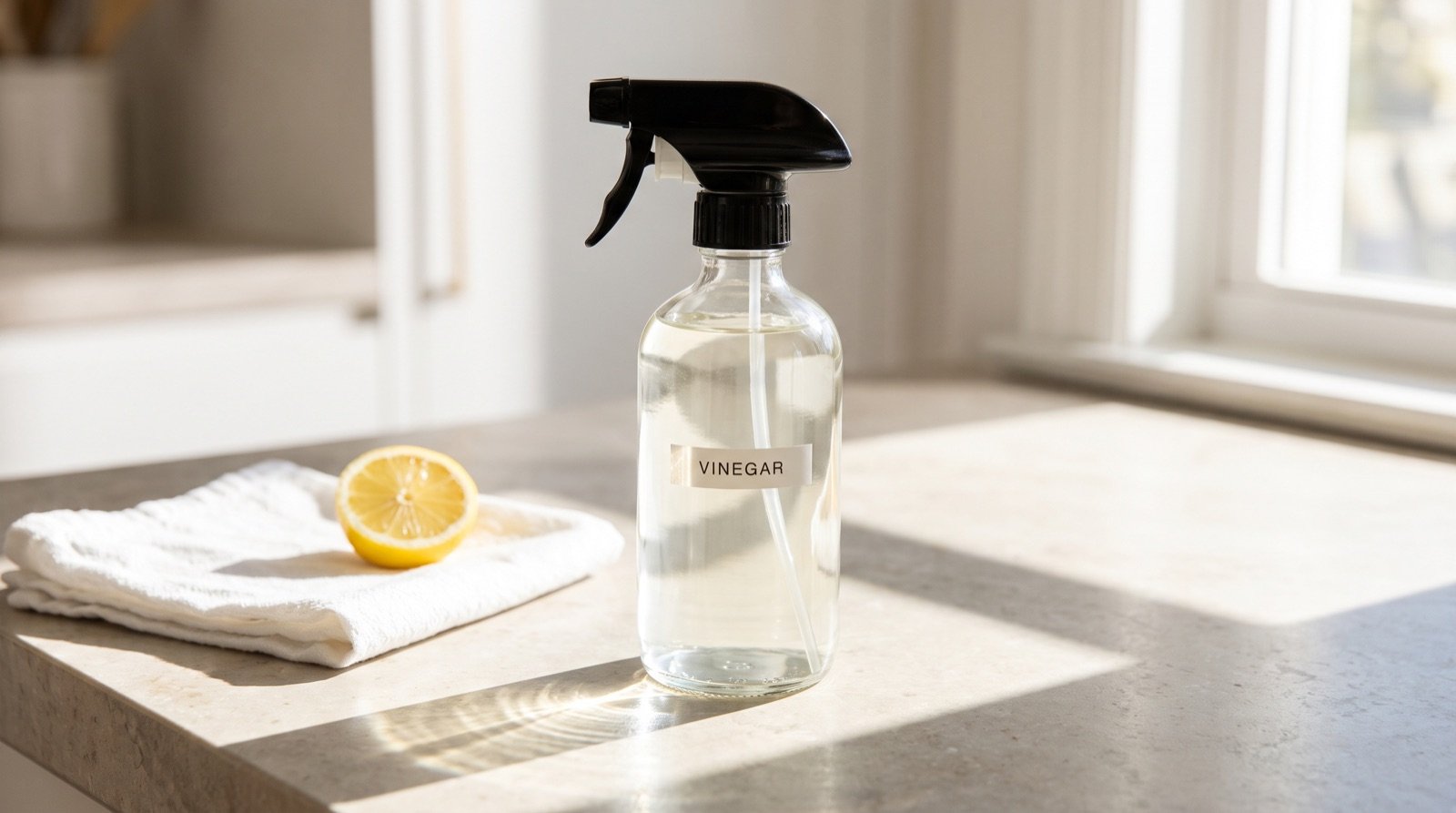
Short answer: vinegar is a decent cleaner and it is not a disinfectant. Against ordinary kitchen bacteria it manages under three logs of reduction where registered products deliver five to eight. It has no EPA registration, so it can’t legally be sold as a disinfectant, and the stomach bug most people are spraying for is the exact thing it fails against.
Why the EPA won’t let it say so
There’s a specific legal reason you’ll never see a bottle of vinegar labeled as a disinfectant.
The EPA’s rules on minimum risk pesticides state that vinegar, at a maximum of 8 percent acetic acid, can be used as an inert ingredient, and that it “is not listed as a minimum risk active ingredient and may not be used as an active ingredient in unregistered, minimum risk pesticides.” Above 8 percent it isn’t even called vinegar and isn’t eligible at all.
Registration is what separates a claim from a tested claim. The EPA’s position is that registered antimicrobial products may not make efficacy claims against specific pathogens unless the agency has reviewed the data supporting them. That’s why the pathogen lists exist: List N for coronavirus, List K for C. difficile spores, List G for norovirus.
Vinegar appears on none of them, because nobody has submitted data for it. That’s an absence of evidence rather than evidence of absence, and the evidence that does exist is not flattering.
Credit where it’s due
Because the tuberculosis result is remarkable. Six percent acetic acid for 30 minutes produced at least an eight-log reduction of Mycobacterium tuberculosis, including multi-drug-resistant and extensively drug-resistant clinical isolates. The researchers attributed the kill to the carboxylic acid function rather than to pH alone, since hydrochloric acid controls didn’t match it.
That’s a genuine finding with real implications for low-resource laboratories. It’s also 30 minutes of contact at a strength above household vinegar, which is not what happens when you spritz a counter and wipe.
Now the part that matters to you
Here’s the study that ought to end the debate, and it comes from an unexpected place.
Researchers tested 4 percent white distilled vinegar, grain vinegar and plain acetic acid against feline calicivirus, the standard surrogate for norovirus. None of them significantly inactivated it at one minute, five minutes or thirty. The same vinegars dropped influenza A below detection within a minute and took 30 minutes on SARS-CoV-2.
The study was funded by a vinegar manufacturer, and two authors work there. Which makes the negative result harder to wave away, not easier.
Norovirus is the winter stomach bug. It’s the thing people reach for a spray bottle about. Vinegar does not touch it.
On ordinary kitchen bacteria the picture is unglamorous too. A hospital-epidemiology study comparing home disinfectants and natural products found vinegar eliminated under three logs of Staphylococcus aureus and E. coli, while bleach, ethanol, Lysol and quaternary ammonium products delivered between 5.6 and 8.2 logs.
Spores are worse again. Much worse. Acetic acid appears in the literature as a booster for hydrogen peroxide and peracetic acid formulas rather than as a sporicide in its own right. For comparison, CDC records that bleach at 5,000 ppm chlorine inactivates a million C. difficile spores in ten minutes or less.
The surfaces it quietly ruins
Acid does what acid does. This catches a lot of people.
Natural stone is the big one. The Natural Stone Institute states that products containing lemon, vinegar or other acids may dull or etch calcareous stones. That’s marble, limestone, travertine, and it’s permanent. Cement-based grout is alkaline and takes damage by the same mechanism.
Wood floors: the National Wood Flooring Association says vinegar’s acidic nature can damage the wood and its finish over time, and can leave a sticky residue that attracts more dirt.
Rubber seals and hoses degrade too, which is why at least one major appliance manufacturer publishes a page telling you to stop cleaning your washing machine with it.
Two things never to mix it with
Bleach, first. Washington’s health department puts it plainly: when chlorine bleach is mixed with an acid, chlorine gas is given off. Mild exposure irritates eyes and airways. Higher exposures cause chest pain, vomiting, pulmonary edema, and can kill.
Hydrogen peroxide. The reaction makes peracetic acid, which is a legitimate industrial disinfectant and not something to generate in your kitchen by accident.
Neither of these is a rare event. People combine cleaners hoping for something stronger, and this is the most common way that goes wrong.
Where we land
Keep the vinegar. Really. Use it for what it’s good at: cutting grease, dissolving limescale and hard-water spots, deodorizing, cleaning glass, descaling a kettle. As a cleaner it earns its place in the cupboard.
Stop using it where a pathogen is actually in play. Raw chicken on the counter, someone in the house with a stomach bug, a bathroom after norovirus: those need an EPA-registered product and the contact time on its label. Cleaning removes germs; disinfecting destroys them, and those are different jobs.
Keep it off marble, limestone, travertine, grout, wood floors and rubber seals.
And notice the shape of the claim next time a brand leans on it. “Vinegar-powered” is a true statement about an ingredient doing a real job, deployed to suggest something the ingredient doesn’t do. That’s the same structure our greenwashing guide takes apart, and it’s worth spotting even on products we like. Several of the cleaning products we recommend are excellent cleaners that make no disinfection claim at all, which is the honest way to sell one.
Frequently asked questions
Is vinegar a disinfectant?
No. It has no EPA registration as a disinfectant, so it can’t legally be sold as one, and testing shows under three logs of reduction against common bacteria where registered products achieve five to eight. It’s an effective cleaner, which is a different and still useful thing.
Does vinegar kill norovirus?
No. In controlled testing, 4 percent vinegar failed to significantly inactivate the standard norovirus surrogate at one, five or thirty minutes. Since norovirus is the reason many people reach for a spray bottle in the first place, this is the most important gap in vinegar’s résumé.
Does vinegar kill mold?
It reduces surface mold and doesn’t reliably kill it in porous materials, where the roots sit below the surface. For a small patch on a hard non-porous surface it’s reasonable. For anything larger or on drywall, grout or wood, it’s the wrong tool and the moisture source is the real problem.
What should I use instead of vinegar to disinfect?
An EPA-registered disinfectant, used at the contact time printed on the label, which is usually longer than people allow. Clean first to remove soil, because most disinfectants are deactivated by organic matter, then apply and keep the surface visibly wet for the stated time.
Related reading
More on cleaning claims: what “non-toxic” is actually claiming, the fragrance loophole in cleaning products, and our non-toxic cleaning guide. For picks, the best non-toxic cleaning products.