Do Plastic Cutting Boards Shed Microplastics?
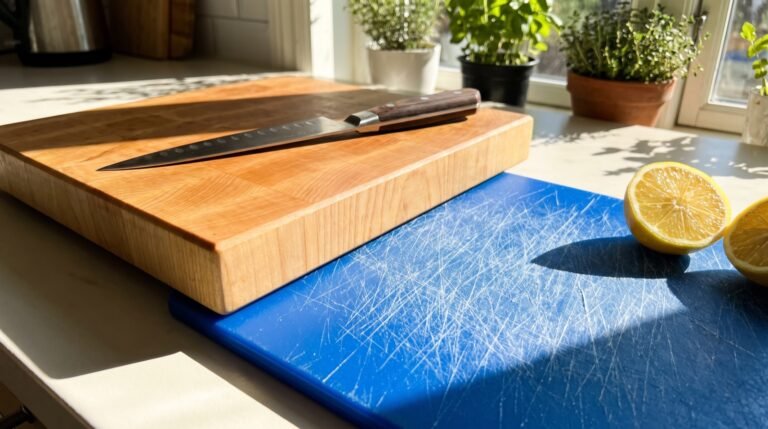
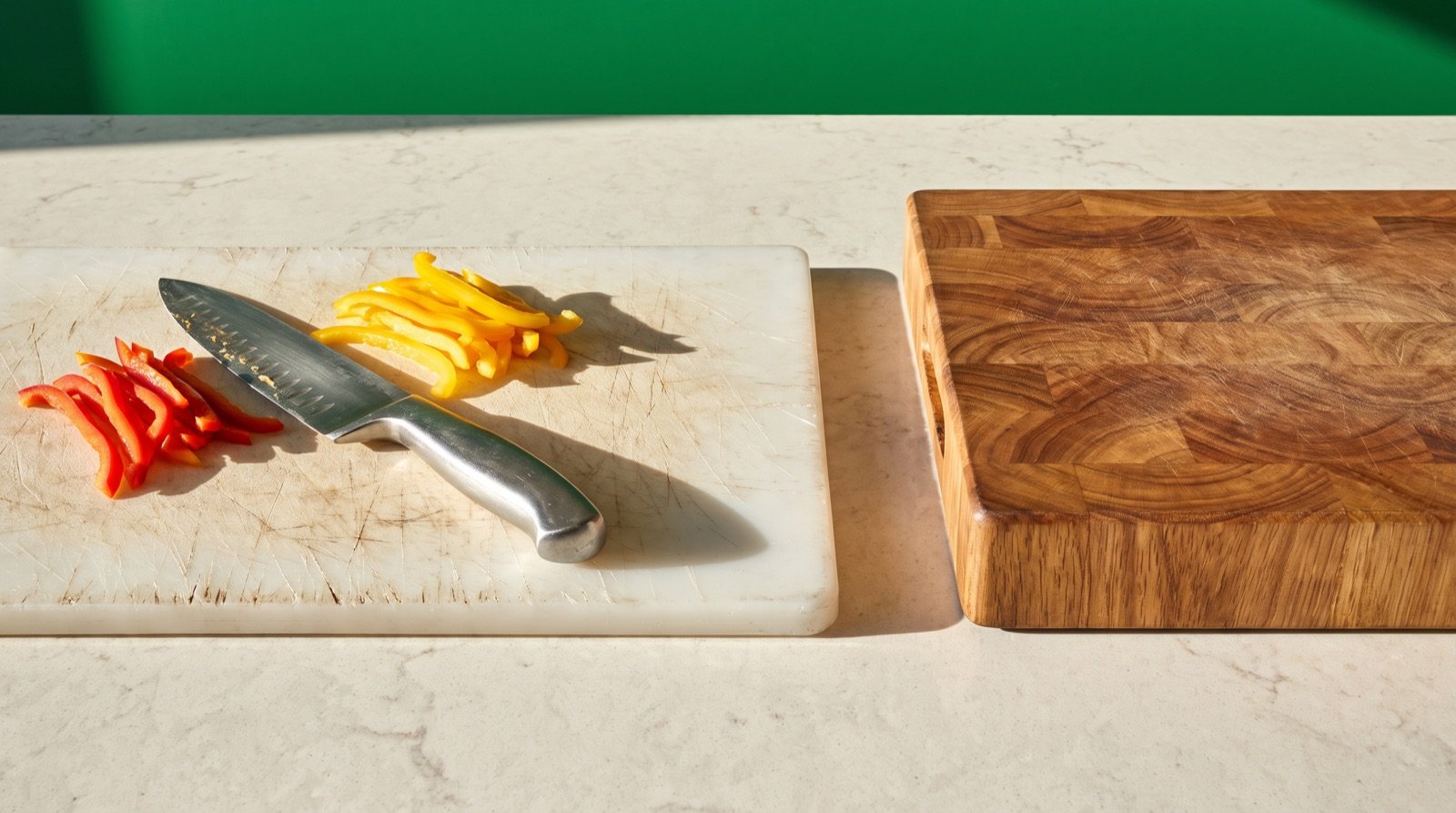
Look closely at an old plastic cutting board. All those fine grooves used to be board.
Where did that plastic go? Some of it went down the sink. Some of it, according to a study that got a lot of attention in 2023, went into dinner.
Short answer: Yes. A 2023 study modeled that chopping on polyethylene or polypropylene boards could release tens of millions of plastic particles a year per person, with polypropylene shedding more. Wood boards shed even more particles in the same study, but those particles are wood. The health effects of eating board plastic aren’t established, and the practical fix is cheap: replace grooved plastic boards, and use wood or solid bamboo for produce.
What the 2023 study actually measured
Researchers at North Dakota State University chopped on polyethylene (PE) and polypropylene (PP) boards and counted what came off. Using their own assumptions about how people cook, the paper in Environmental Science & Technology estimated that one person could ingest 7.4 to 50.7 grams a year from a polyethylene board, and 49.5 grams from polypropylene. In particle terms, that’s 14.5 to 71.9 million a year from PE and about 79.4 million from PP.
Polypropylene was the worse of the two, releasing 5 to 60% more by mass. Most particles were smaller than 100 micrometers. Food made it worse: chopping real carrots released more than chopping an empty board.
Then the detail most headlines skipped. In a preliminary test, polyethylene particles didn’t reduce the survival of mouse cells over 72 hours. That’s one small cell test, not a clean bill of health, but it’s not the alarming result the coverage implied either.
A separate team in Australia used Raman imaging to look at a single groove and estimated 100 to 300 micro and nanoplastic particles per millimeter of each cut. Every cut sands a little off.
Wood shed more, and that’s the interesting part
Here’s the twist. The same 2023 study tested wooden boards too, and they shed 4 to 22 times more microparticles than plastic. Those particles are wood fiber, which your body handles very differently from polyethylene, and neither the plastic nor the wood particles had much effect on mouse cell survival in that test.
A 2025 study in Environmental Health Perspectives went further, feeding mice food cut on polypropylene, polyethylene or willow-wood boards for 12 weeks. The polypropylene group showed higher inflammation markers and weaker gut-barrier gene expression than the wood group, and the polyethylene group showed shifts in gut bacteria and liver metabolites. The authors describe their doses as relatively high, and microplastics weren’t detected in the animals’ gut or liver tissue. It’s a signal. From animals, at heavy exposure.
So the comparison isn’t plastic sheds and wood doesn’t. It’s plastic sheds plastic, and wood sheds wood.
| Quick facts | Cutting boards |
|---|---|
| Polypropylene board | About 79 million particles a year, modeled; sheds more than polyethylene |
| Polyethylene board | About 14 to 72 million particles a year, modeled |
| Wood board | 4 to 22 times more particles in the same study, but they’re wood |
| Health evidence | One mouse study at high doses; no human data |
| When to replace plastic | When it’s grooved and hard to clean |
But isn’t plastic more hygienic?
It’s an old argument. The research is more mixed than the cooking shows suggest.
The classic work is from the University of Wisconsin in 1994. Researchers compared plastic and hardwood boards and found bacteria on plastic stayed recoverable for hours and multiplied overnight, while clean wood absorbed the liquid within minutes and bacteria were usually unrecoverable afterward. Their conclusion was that the results do not support the idea that plastic is more sanitary. A companion study found heavily knife-scarred plastic was hard to clean by hand, especially with chicken fat on it.
There is a counterpoint worth knowing. A 2007 study found that after a one-minute sanitizer rinse, plastic boards came cleaner than wood. So the fair summary is that a new plastic board sanitizes well, and a grooved one doesn’t, which happens to be the same moment it starts shedding most.
The USDA’s cutting board guidance lands somewhere practical: wood or a nonporous board are both fine, keep separate boards for raw meat and for produce or bread, and throw out boards that are excessively worn or have hard-to-clean grooves.
The bamboo question
Bamboo boards come up a lot as the clean alternative, and there are two different products hiding under the word.
A solid bamboo board is strips of bamboo glued together. The USDA describes bamboo as harder and less porous than hardwoods. We looked for testing of what the glue in solid bamboo boards might release and didn’t find any, so we can’t tell you either way.
The other product is “bamboo fiber” or “bamboo composite” kitchenware, which is bamboo powder mixed into melamine plastic. That’s the one regulators went after. Between 2021 and 2022, an EU coordinated action across 21 countries logged 748 cases of plastic food-contact items containing bamboo filler, which isn’t an authorized ingredient, and in one case cups released formaldehyde at 25 times the limit. If the label says bamboo and the item feels like plastic, it probably is plastic, and it shouldn’t go anywhere near the microwave.
What we’d actually do
Don’t throw anything out today. You need a rule for when a board is done.
Keep a plastic board for raw meat if you like, because it goes in the dishwasher and that’s useful. Replace it the moment it’s grooved, fuzzy or stained, because that’s when it’s both shedding most and hardest to clean. Use wood or solid bamboo for vegetables, bread and everything else, and oil it now and then so it doesn’t crack.
And skip anything sold as bamboo fiber. If you’re cutting down on kitchen plastic more broadly, the rest of the plastic in your kitchen is worth a look, and our non-toxic food storage picks cover where the food goes after you cut it.
Frequently asked questions
Do plastic cutting boards really shed microplastics?
Yes. A 2023 study modeled that chopping on polyethylene or polypropylene boards could release tens of millions of particles a year per person, and Raman imaging has shown hundreds of particles per millimeter along a single cut. Polypropylene boards shed more than polyethylene in that research.
Are wood cutting boards better than plastic?
For microplastics, yes, because wood sheds wood rather than plastic, even though it shed more particles overall in the 2023 study. For hygiene, research has found wood is not less sanitary than plastic, while heavily scarred plastic is hard to clean. A new plastic board sanitizes well, so many cooks keep one for raw meat.
Are bamboo cutting boards safe?
Solid bamboo boards are hard and less porous than many hardwoods, according to the USDA. We found no testing of the glues used in them. Avoid “bamboo fiber” or composite kitchenware, which is bamboo powder in melamine plastic and was the target of an EU crackdown after some items released formaldehyde far above the limit.
When should you replace a plastic cutting board?
When it’s deeply grooved, fuzzy or hard to clean. The USDA recommends discarding boards that are excessively worn or have hard-to-clean grooves, and that’s also the point at which knife cuts release the most plastic.
Can you put cutting boards in the dishwasher?
Plastic and solid-wood boards can go in the dishwasher according to USDA guidance, though laminated boards may crack and split. Many wood boards last longer when hand-washed and oiled. Sanitizing with a tablespoon of unscented bleach per gallon of water is the USDA’s alternative.
Related reading
The rest of this series: glass vs stainless vs silicone food storage and what “food-grade” actually means. For vetted picks, see the best non-toxic food storage containers. We’ve also covered microplastics from plastic bottles and zero-waste kitchen swaps.
Sources: Yadav et al., Environmental Science & Technology, 2023. Gan et al., Environmental Health Perspectives, 2025. Luo et al., Journal of Hazardous Materials, 2022. Ak, Cliver & Kaspar, Journal of Food Protection, 1994. Deza et al., Journal of Food Protection, 2007. USDA FSIS, Cutting boards. European Commission, Bamboo-zling coordinated action.