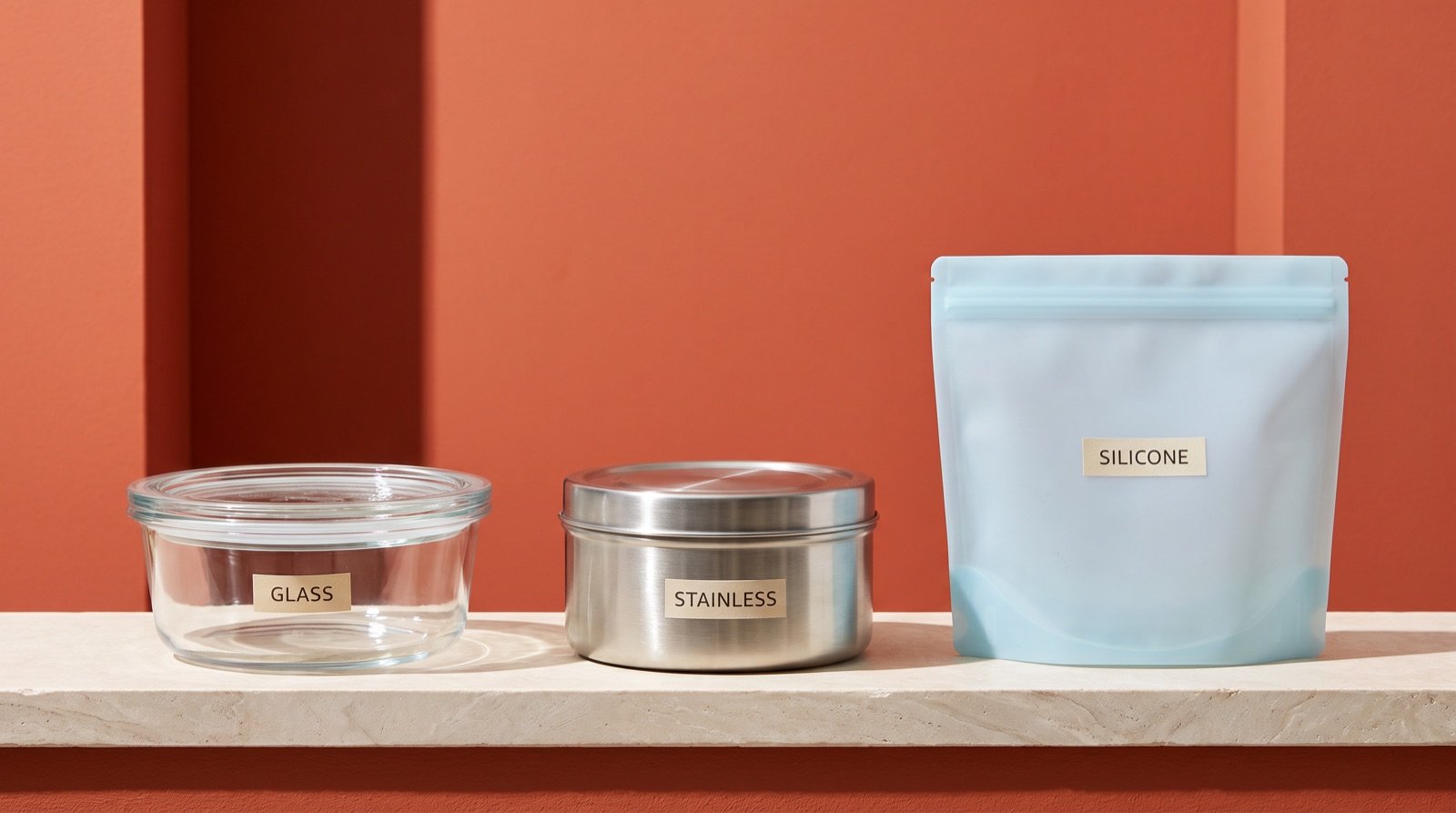
Glass vs Stainless vs Silicone Food Storage: Which Leaches Least?
You’ve probably already decided to get the plastic out of your fridge. The harder question is what replaces it.
Glass, stainless steel and silicone all get sold as the non-toxic answer, and all three are a big step up from old plastic tubs. They’re not identical, though, and the differences show up in specific situations: heat, fat, acid, and the lid nobody thinks about.
Short answer: Plain, clear glass leaches the least. A 2026 review of 69 studies found glass failed metal migration limits in 5.6% of tests, against 11% for stainless steel and 12.5% for plastics. Silicone is fine for cold and frozen storage but releases siloxanes when it’s hot and in contact with fatty food, especially when new. And on most glass containers the real weak point is the plastic lid, which shouldn’t go in the microwave.
The headline comparison
A 2026 systematic review in Food and Chemical Toxicology pulled together 69 studies of metal migration from food-contact materials. Glass had the lowest rate of exceeding limits, at 5.6%. Stainless steel came in at 11%, and plastics at 12.5%.
That’s the broad picture, and it matches what most people already suspect. The details are where it gets useful.
| Quick facts | Glass | Stainless steel | Silicone |
|---|---|---|---|
| What can migrate | Lead and cadmium from decorated glass; almost nothing from plain clear glass | Nickel and chromium, mostly with acidic food and new steel | Siloxanes, mostly with heat and fatty food |
| Best use | Storage and reheating | Lunch boxes, cold and dry foods | Bags, freezer, cold storage |
| Watch out for | Painted rims, thermal shock on soda-lime glass | Long storage of tomato or citrus | Baking fatty foods in brand-new silicone |
| The lid | Usually polypropylene plastic | Often steel or silicone | It’s all silicone |
Glass: the safest, with two caveats
Plain clear glass is about as inert as food storage gets. The caveats are both specific, and both easy to avoid.
The first is decoration. A 2018 study of 72 decorated drinking glasses found 13 of the 14 lip areas tested exceeded the lead limit. A larger Polish survey of 736 ceramic and glass items found only one lead exceedance, and it was the rim of a glass mug. So the risk is in paint and enamel, especially on rims, and Consumer Reports advises hand-washing painted glassware. Storage containers are almost always plain glass, which is the point.
The second is temperature. Most US glass storage is soda-lime glass, which can only handle a sudden temperature change of about 55°C, compared with about 183°C for borosilicate. In Consumer Reports’ testing, every soda-lime dish broke when moved from a 450°F oven to a wet counter. That’s a breakage risk, not a chemical one, but it decides whether you can go fridge to oven.
Stainless steel: great for lunches, less so for tomato sauce
Steel doesn’t break and it’s light, which is why it owns the lunch box market. What it can release is nickel and chromium, and the condition that matters is acid. In one study of tomato sauce cooked in stainless pots, nickel rose up to 26-fold, with new steel leaching the most and levels settling after about six uses.
Cold storage is a much gentler test than six hours of simmering. Still, if you have a nickel allergy, store acidic leftovers in glass instead. We go deeper on steel grades and the lead-seal question in is stainless steel safe.
Silicone: fine cold, worth care when hot
This one is a little tricky, because silicone behaves very differently depending on what you do with it.
What migrates from silicone is siloxanes, the building blocks of the material. Germany’s risk agency sets a limit of 0.5% volatile content in silicone rubber for food contact. The conditions that push migration up are heat and fat. In German testing of baking molds, siloxanes migrated into cakes at levels below the limit, but meat loaf exceeded it, reaching up to 177 mg/kg, while milk-based foods stayed low. Molds that hadn’t been properly heat-treated by the manufacturer released considerably more.
Two findings make this manageable. Migration drops with use: a 2025 Health Canada study found a steady decline over repeated bakes, and Bavarian researchers found reusing a mold substantially cut emissions. And cold use is a different world. FDA researchers found no siloxanes in milk or formula after six hours on silicone at body temperature.
The Danish consumer council’s advice after testing 18 molds is the practical version: wash new silicone, then heat it empty at 200°C for a few hours before first use. For storage bags that live in the fridge and freezer, this mostly doesn’t apply. For more on the material itself, see is food-grade silicone safe.
The lid is usually the weak link
Here’s what most glass container reviews skip. The lid is plastic.
IKEA is unusually clear about it: its glass container lid is polypropylene plastic, not oven-safe, and shouldn’t be closed in the microwave. Many brands just say “BPA-free plastic” without naming the polymer, which isn’t the reassurance it sounds like.
And heat is where plastic sheds most. A 2023 study found microwaving some plastic containers released millions of microplastics and billions of nanoplastics per square centimeter in three minutes. The FDA’s position is that current evidence doesn’t demonstrate a health risk from detected levels. Either way, the fix is free: take the lid off before you microwave, and cover the glass with a plate instead.
What we’d actually do
Use plain glass for leftovers and anything you’ll reheat, with the lid off in the microwave. Use stainless for lunches and dry or cold foods, and move tomato-based leftovers into glass. Use silicone bags for the freezer and for snacks, and if you bake in silicone, run new pieces through a hot empty cycle first.
Then keep the plastic lids out of the dishwasher’s bottom rack and away from heat, and replace them when they warp or crack. Our non-toxic food storage picks note which lid each set uses, and what “food-grade” actually certifies explains what the claims on the box are worth.
Frequently asked questions
Is glass or stainless steel better for food storage?
Glass leaches less overall, with the lowest rate of metal-limit failures in a 2026 review of 69 studies. Stainless steel is lighter and unbreakable, which makes it better for lunches. Store acidic foods like tomato sauce in glass, since acid is what pulls nickel and chromium from steel.
Does silicone leach into food?
It can release siloxanes, mainly when it’s hot and in contact with fatty food, and most when it’s new. Cold use is very different: FDA researchers found no siloxanes in milk after six hours on silicone at body temperature. Migration also drops with repeated use.
Can you microwave glass containers with plastic lids?
Microwave the glass, not the lid. Plastic lids are usually polypropylene, and heat is what drives plastic to shed particles. Take the lid off and cover the container with a plate or paper towel instead.
Is borosilicate glass better than regular glass?
For temperature changes, yes. Borosilicate can handle a sudden change of about 183°C, compared with about 55°C for the soda-lime glass most US storage is made from. For leaching, both plain clear glasses perform about the same.
Should I wash silicone before using it?
Yes, and for anything you’ll bake in, a Danish consumer council recommends heating it empty at 200°C for a few hours before first use. Research shows siloxane release falls with repeated use, so the first few uses matter most.
Related reading
The rest of this series: do plastic cutting boards shed microplastics and what “food-grade” actually means. For vetted picks, see the best non-toxic food storage containers. We’ve also covered the plastics in your kitchen and non-toxic cookware.
Sources: Mahmoud et al., Food and Chemical Toxicology, 2026. Turner, Science of the Total Environment, 2018. Mania et al., 2018. Kamerud et al., Journal of Agricultural and Food Chemistry, 2013. BfR, Recommendation XV. Helling et al., 2009 and 2010. Zhu et al., Journal of Hazardous Materials, 2025. Fromme et al., Environment International, 2019. Zhang et al., 2012. Hussain et al., Environmental Science & Technology, 2023.