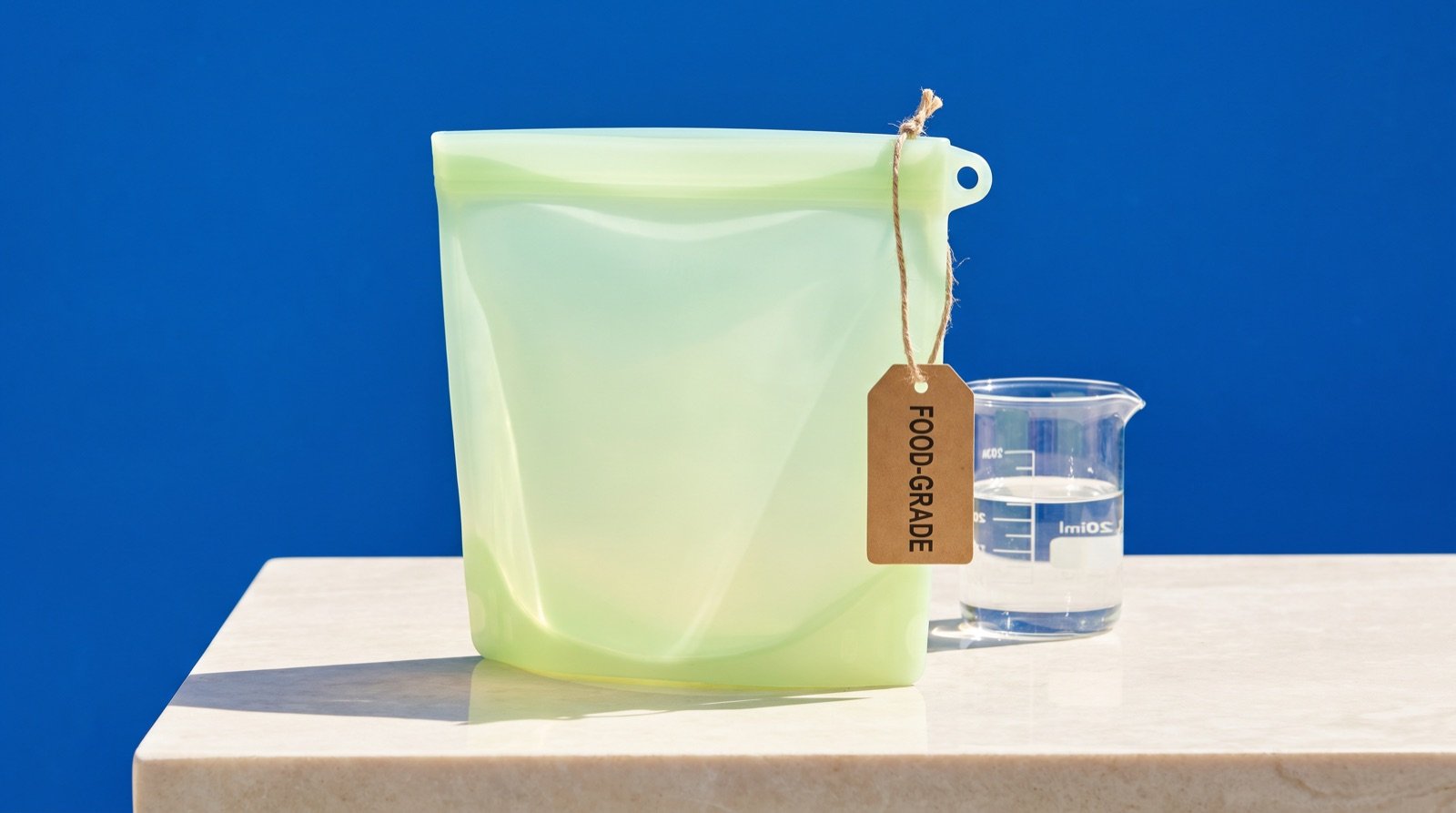
What Food-Grade Actually Means: FDA vs LFGB
You may have assumed “food-grade” means someone checked. A government agency, a lab, a standard with a number on it.
In US food-contact rules, it’s not a defined term at all.
Short answer: “Food-grade” has no legal definition in the US rules that govern food-contact materials. The FDA authorizes substances, not finished products, and says plainly that it doesn’t approve food products. In the EU, every food-contact item must meet a general safety standard, and plastics have specific migration limits. “LFGB” refers to Germany’s food law, and an LFGB claim usually means a lab tested the item against German and EU requirements, which is a real test but not a government certification.
How the FDA handles food-contact materials
Here’s how the US system works. Any substance that’s expected to migrate from packaging or kitchenware into food needs a legal basis: a listing in the food-contact regulations, generally-recognized-as-safe status, a pre-1958 prior sanction, a very-low-exposure exemption, or an effective Food Contact Notification.
Three details change how you should read a “food-grade” claim. Food Contact Notifications are specific to the manufacturer that filed them. Compliance is the manufacturer’s responsibility, not something the FDA checks product by product. And once a substance is cleared, manufacturers generally aren’t required to send post-market data.
The FDA’s own consumer guidance puts it in five words: the FDA does not approve food products. It authorizes ingredients and materials. A container described as “FDA approved” is, at best, made from materials the regulations permit.
And the phrase itself? We searched Title 21 of the Code of Federal Regulations. “Food grade” appears 51 times, all in ingredient contexts, and zero times in Parts 174 to 178, the sections that cover food-contact materials. There’s no definition.
The EU’s general rule, and its specific ones
Europe starts from a broader rule. Under Regulation 1935/2004, every food-contact material, whatever it’s made of, must not transfer anything that could endanger health, unacceptably change the food, or spoil its taste or smell. Labeling can’t mislead, and items carry “for food contact” or the glass-and-fork symbol, which Finland’s food authority describes as not compulsory but highly recommended.
Specific EU rules exist for only a few materials: ceramics, regenerated cellulose film, plastics, and active or intelligent packaging, according to the European Commission. For plastics, the overall migration limit is 60 mg per kilogram of food, or 10 mg per square decimeter of surface, with specific limits for individual substances. Manufacturers issue a declaration of compliance, which travels down the supply chain up to, but not including, the shop.
Silicone, glass and stainless steel have no specific EU-wide rules. They’re held to the general standard, which is where national rules come in.
So what is LFGB?
LFGB is Germany’s food and feed code. Its section 31 bans marketing items that fail the EU’s general safety standard. For materials without specific EU rules, German testing labs typically check products against the recommendations of the federal risk agency, the BfR. For silicone, that’s Recommendation XV, which caps the volatile content at 0.5%.
Here’s the part the marketing glosses over. The BfR says its recommendations are not legal norms, that there’s no authorization system for food-contact materials, and that the BfR does not issue certificates. Testing is done by private testing institutes. We couldn’t find a government source for an official LFGB certification mark.
So “LFGB tested” usually means a lab ran the item through German and EU migration and sensory tests and it passed. That’s a meaningful test, often stricter in practice than “FDA compliant”, but it’s a lab report, not a government seal.
| Quick facts | What the claim means |
|---|---|
| “Food-grade” | No legal definition in US food-contact rules |
| “FDA approved” | The FDA doesn’t approve finished products; materials may be permitted |
| “FDA compliant” | The maker says its materials are permitted; compliance is self-assessed |
| EU glass-and-fork symbol | Meets EU food-contact rules; recommended, not compulsory |
| “LFGB tested” | A lab tested it against German and EU requirements; no government certificate exists |
| NSF/ANSI 51 | A standard for materials in commercial food equipment |
How to check a claim yourself
It should only take an email.
Ask the brand for the document behind the claim. In the EU and for many exporters, that’s a declaration of compliance. In the US, buyers can request a “letter of guaranty” from suppliers stating the materials comply with FDA regulations. For an LFGB claim, ask for the lab’s name and the test report, including the date and which product was tested.
For silicone specifically, ask whether the product meets the BfR’s volatile limit, or whether it’s been post-cured, the extra heat treatment that drives off leftover siloxanes. A brand that has the report will usually send it. A brand that answers with a paragraph of reassurance has told you something too.
The same logic applies across everything a green badge promises. And if you’re choosing between materials, glass vs stainless vs silicone covers what each one can actually release.
Frequently asked questions
What does food-grade mean?
In the US, it isn’t a defined term in the regulations that govern food-contact materials. It generally signals that a product is made from materials permitted for food contact, but the claim is self-made by the manufacturer. Ask for the compliance documentation or test report if it matters to you.
Does the FDA approve food containers?
No. The FDA authorizes substances that can be used in food-contact materials, through regulations, GRAS status or Food Contact Notifications, but it states that it does not approve food products. Compliance is the manufacturer’s responsibility.
What does LFGB mean on silicone?
It refers to Germany’s food and feed code. An “LFGB tested” claim usually means a private lab tested the item against German and EU requirements, including the BfR’s 0.5% limit on volatile content for silicone. The BfR says it doesn’t issue certificates, so it’s a lab result rather than a government certification.
Is LFGB stricter than FDA?
Often, in practice. LFGB testing usually includes migration and sensory tests on the finished product, while US compliance is based on whether the materials are permitted and is self-assessed. But neither one is a government inspection of the specific item you’re buying.
Does the glass and fork symbol mean anything?
It indicates that an item is intended for food contact under EU rules. It isn’t compulsory, but EU food authorities recommend it, and items must meet the EU’s general safety standard either way.
Related reading
The rest of this series: do plastic cutting boards shed microplastics and glass vs stainless vs silicone food storage. For vetted picks, see the best non-toxic food storage containers. We’ve also covered whether food-grade silicone is safe and what the plastic recycling numbers mean.
Sources: US Food and Drug Administration, Determining the regulatory status of food contact material components, How FDA regulates food contact substances, and Is it really FDA approved?. Regulation (EC) 1935/2004. European Commission, Food contact materials legislation. LFGB § 31. BfR, FAQ on recommendations for food contact materials.