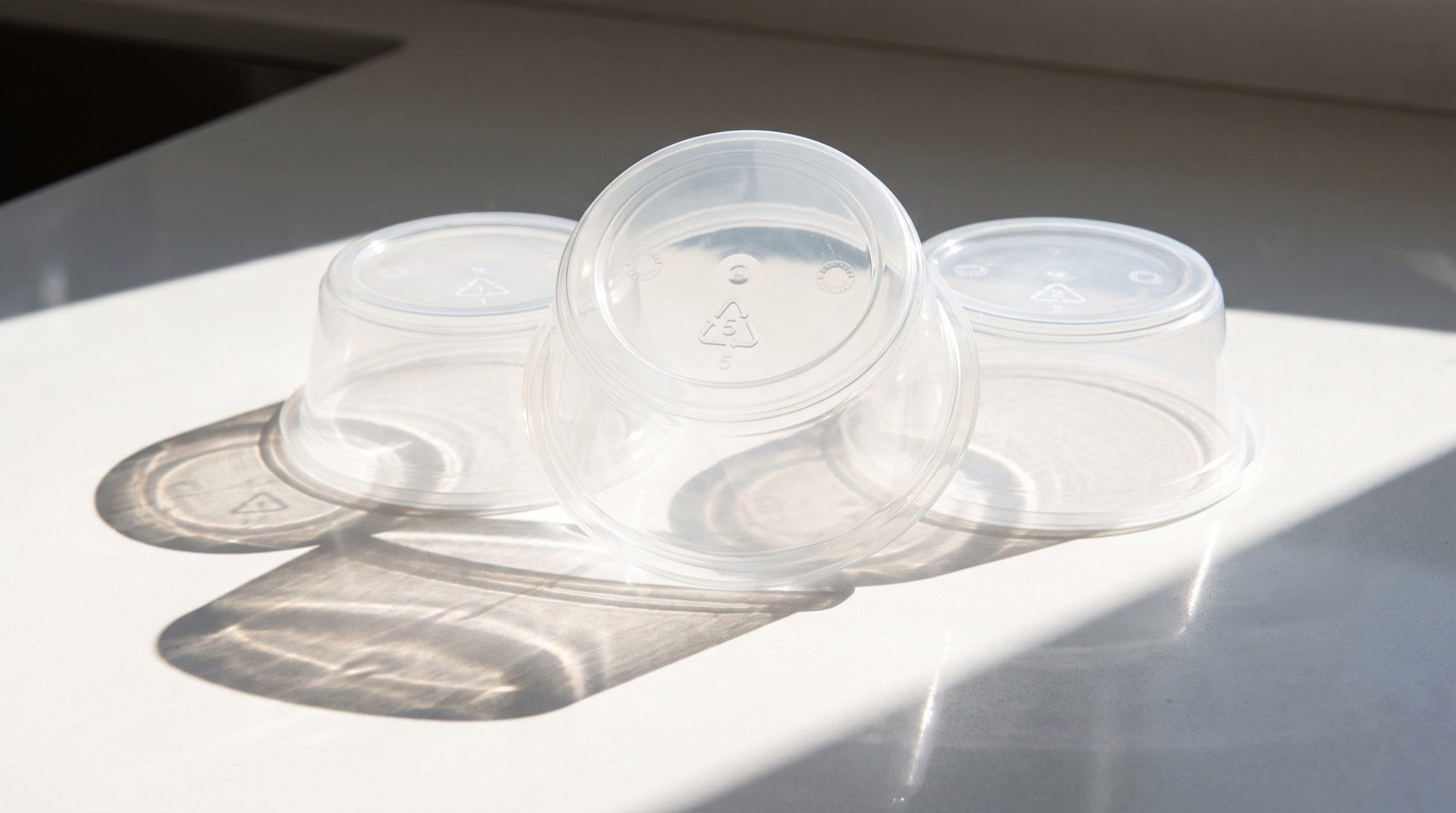
Do the Recycling Numbers on Plastic Mean Anything?
Turn over a yogurt pot and there it is. A little triangle, a number inside it, and the reassuring sense that somebody has this handled.
Short answer: the number identifies which plastic the container is made from. That’s it. The standard that governs it says outright that the code doesn’t imply the article is recyclable, and forbids putting the word “recyclable” anywhere near it. In practice only numbers 1 and 2 have real end markets, and the overall US recycling rate for plastic has never reached 10 percent.
The standard says so itself
The resin identification code was created by the plastics industry’s trade group in 1988 and later handed to ASTM, where it lives as standard D7611.
The wording is unambiguous: using a resin identification code “does not imply that the article is recycled or that there are systems in place to effectively process the article for reclamation or re-use,” and the term “recyclable” or other environmental claims “shall not be placed in proximity to the Code.” The system exists to identify resin content, not product recyclability.
It’s a sorting aid for the people at the facility. Never meant for you.
Those arrows were deleted in 2013
Here’s the detail that surprised us. The arrows are gone.
ASTM removed the chasing-arrows symbol from the standard over a decade ago, replacing it with a plain solid triangle around the number. The stated reason was exactly what you’d hope: consumers were reading three chasing arrows as a recycling promise, and the standard needed to get back to identifying resin.
So every chasing-arrows-with-a-number you’ve seen since is a manufacturer choosing to keep a retired symbol. Not a violation, since the code isn’t mandatory federal law. Just a choice, made repeatedly, about which impression to leave.
So how much actually gets recycled
The official number comes from the EPA, and its most recent published plastics data is from 2018: 35.7 million tons generated, 3.09 million tons recycled. That’s 8.7 percent. Nearly 27 million tons went to landfill.
Independent analysts put it lower and falling. Beyond Plastics and The Last Beach Cleanup estimated a 2021 rate of 5 to 6 percent, and noted that plastic recycling has never hit 10 percent while paper sat at 66 percent in 2020.
We should be careful here, because those two figures aren’t measuring quite the same thing. Different years, different methods, and one of the two organizations campaigns on this. The decline is real, driven substantially by China’s 2018 ban on importing recycled material, and it isn’t a clean before-and-after comparison. Say both numbers, name both sources.
Break it out by resin and the picture sharpens. PET bottles recycle at 29.1 percent, natural HDPE bottles at 29.3. Roughly three times the average for all plastics. Everything from 3 to 7 is where the average gets dragged down.
| Code | Plastic | Real end market? |
|---|---|---|
| 1 PET | Bottles, clamshells | Yes, bottles best. Clamshells often not |
| 2 HDPE | Milk jugs, detergent bottles | Yes, natural better than colored |
| 3 PVC | Pipe, some packaging | Effectively none in curbside |
| 4 LDPE | Films, bags | Store drop-off only, and thin |
| 5 PP | Tubs, caps | Growing, still limited |
| 6 PS | Foam, cutlery | Effectively none |
| 7 Other | Mixed, bioplastics | No. It’s the miscellaneous bin |
They said out loud what it was for
In 2020, NPR and Frontline interviewed the executives who ran the plastics industry’s lobbying operation in the late 1980s and early 90s, when the codes and the recycling push were rolled out.
Larry Thomas, who led the industry’s main lobbying group: “If the public thinks the recycling is working, then they’re not going to be as concerned about the environment.”
Lewis Freeman, a former vice president of government affairs at the Society of the Plastics Industry, said there had been “never an enthusiastic belief” that recycling would work “in a significant way.”
That’s not an activist’s characterization. That’s the people in the room.
California tried to fix the label, and a court stopped it
The most serious attempt to repair this is California’s SB 343, passed in 2021. It bars the chasing-arrows symbol, or any other recyclability indicator, unless the material is collected by programs serving at least 60 percent of the state’s population and is actually sorted and reprocessed into new products. CalRecycle published the study defining which materials qualify in April 2025, starting the clock on an October 2026 compliance date.
Then in July 2026 a federal court preliminarily blocked enforcement, in a case brought by twenty trade associations arguing the law was unconstitutionally vague and infringed commercial speech protections.
The law hasn’t been struck down. Not yet, anyway. Enforcement is halted while the case proceeds, and the October deadline is suspended. So the most promising fix for the symbol on the bottom of your yogurt pot is currently in litigation.
So what should you do with a triangle
Recycle 1 and 2. They have real markets, and your bottle has a decent chance of becoming something.
Treat 3 through 7 as landfill unless your local program specifically names them, because wishcycling contaminates the good material and costs facilities money. Check your municipality rather than the triangle, since the code tells you nothing about what your city accepts.
And carry the bigger lesson forward, which is that the recycling number is a claim about chemistry wearing the costume of an environmental promise. That’s the exact structure our greenwashing guide teaches you to spot.
The reduction that works is buying less of it. Unglamorous, effective, and the reason our zero-waste swaps start with the things you replace weekly rather than the things you sort.
Frequently asked questions
What do the numbers 1 to 7 on plastic actually mean?
They identify which resin the item is made from, so recycling facilities can sort by material. The standard governing them states explicitly that the code doesn’t imply the item is recyclable or that any system exists to process it. It’s a materials label, not an environmental claim.
Which plastic numbers are actually recyclable?
In practice, 1 and 2, and even those recycle at around 29 percent for bottles rather than anything close to complete. Number 5 has a growing but still limited market. Numbers 3, 4, 6 and 7 have effectively no curbside end market in most of the US, and 7 is a catch-all for anything that doesn’t fit elsewhere.
Why does plastic packaging still show the chasing arrows?
Because the symbol was optional, not required. ASTM replaced the chasing arrows with a plain triangle in its standard back in 2013, specifically because shoppers read arrows as a recycling promise. Manufacturers that kept the arrows are using a retired symbol, and California’s attempt to restrict that is currently blocked in court.
Is the US plastic recycling rate really only 5 percent?
Estimates range from about 5 to 9 percent depending on the year and the method. EPA’s most recent published figure is 8.7 percent for 2018; an independent analysis put 2021 at 5 to 6 percent. Both are far below paper, and neither has ever approached the impression the symbol gives.
Related reading
More on household plastic: what plastic boards and sponges shed, whether detergent sheets are really plastic-free, and how to spot greenwashing. For swaps, see zero-waste home swaps and the kitchen version.