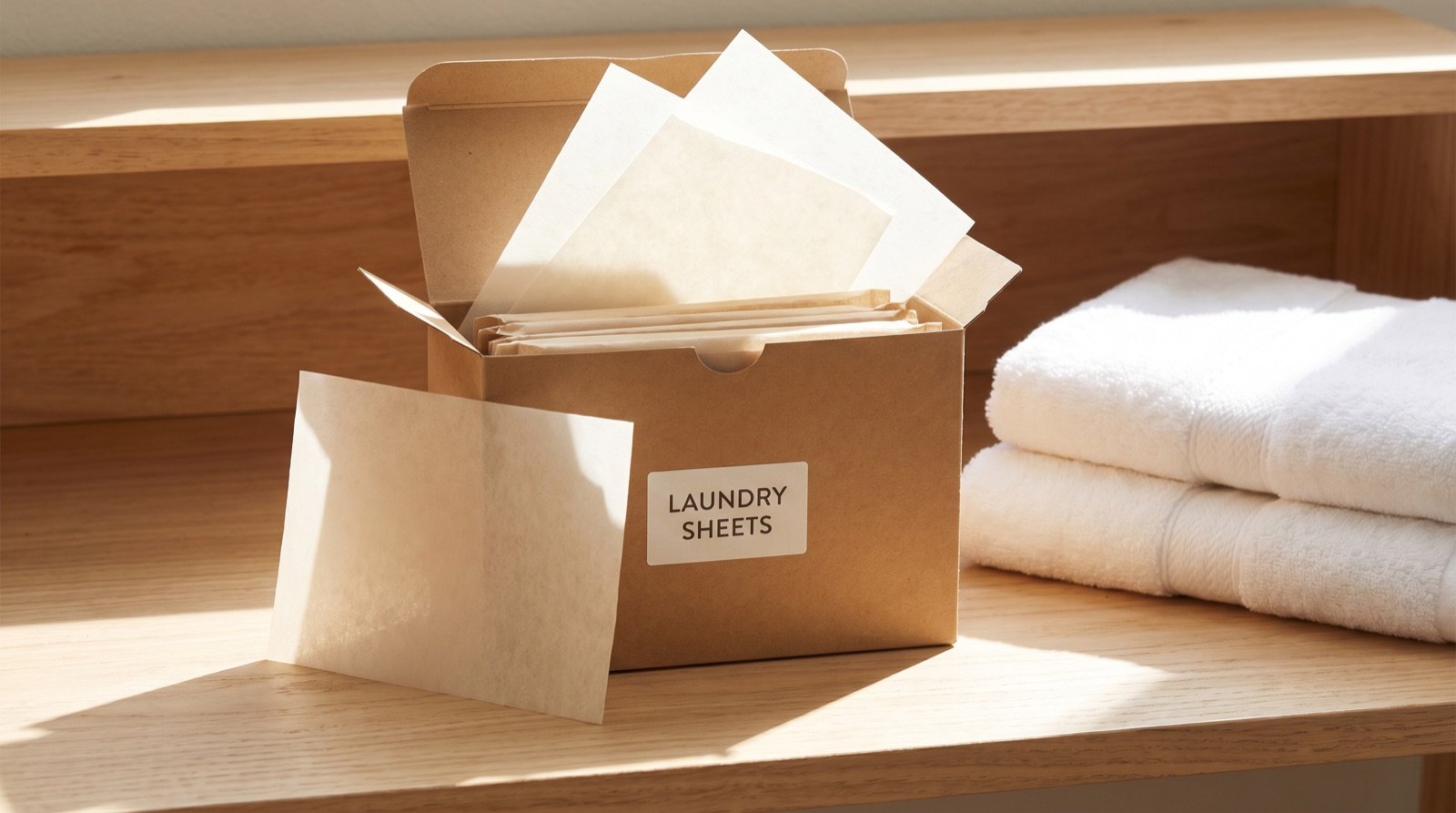
Are Laundry Detergent Sheets Actually Plastic-Free?
Detergent sheets are the poster child of the plastic-free laundry aisle. No jug, no scoop, no shipping water around the country. Drop the sheet in, it vanishes, done.
Then somebody points out the sheet is made of plastic, and the whole thing gets complicated.
Short answer: the film is polyvinyl alcohol, a petroleum-derived synthetic polymer, so “plastic-free” is a stretch. Whether it’s an environmental problem is unresolved, and the campaign that tried to settle it lost. The EPA reviewed the case and denied it. We still think sheets beat a plastic jug, and we think the honest version of why is different from the one on the box.
What PVA is, and what dissolving isn’t
Polyvinyl alcohol is the film around laundry pods and the body of most detergent sheets. It’s synthetic, it’s made from petroleum feedstock, and it’s a plastic by any normal definition of the word.
It’s also water-soluble, which is the whole point. It disappears in the drum because it dissolves, not because it’s gone.
That distinction carries the entire argument. Dissolving means the polymer chains separate and disperse into the water. Biodegrading means microbes break those chains down into carbon dioxide and water. The first definitely happens. The second is what’s in dispute.
The study everybody cites
In 2021, researchers at Arizona State published an estimate that roughly 75 percent of the PVA from detergent pods passes through US wastewater treatment plants unchanged, putting total US emissions from that source at around 7,000 tons a year.
You’ll see it dated 2022 in half the articles that quote it. It’s 2021.
More importantly, you should know what kind of study it is. It’s a literature-based modelling exercise. The researchers didn’t run experiments or generate new data; they pulled parameters from existing published work and calculated a national figure from them. That’s a legitimate method, and it’s not the same thing as measuring.
The rebuttal is substantial, and it comes from the manufacturer
Procter and Gamble published a technical review attacking the paper on four fronts, and we’d rather show you it than pretend it doesn’t exist.
Its strongest point is about grades. PVA isn’t one substance; it comes in forms ranging from insoluble construction and textile grades to the highly soluble grade used in detergent film. P&G’s analogy is that treating them as one is like arguing sugar doesn’t dissolve by pointing at the whole sugar family. That criticism lands.
The others: the model aggregates parameters from literature that in places goes back decades, it doesn’t apply the established methods for scaling lab degradation rates to full-size treatment plants, and a review panel identified possible errors in the concentration modelling. P&G also notes that the paper’s own supplementary material shows PVA biodegrading at around 80 percent in lab-simulated conditions.
It’s an industry rebuttal from a company selling pods. It’s also substantively right about the grades.
Then the campaigners took it to the EPA, and lost
In late 2022 Blueland and the Plastic Pollution Coalition petitioned the EPA under section 21 of the Toxic Substances Control Act, asking the agency to require health and environmental testing of PVA in consumer products and, until that testing was done, to strip PVA from its Safer Choice programme.
The EPA denied it in April 2023. It reaffirmed PVA’s place on the Safer Chemical Ingredients List, said there was no evidence of toxicity or bioaccumulation potential for the soluble grade used in pods and sheets, and criticized the petition for not engaging with the existing data.
That’s a notable outcome, because the agency being asked was the one with no commercial stake. Worth disclosing that Blueland, which filed the petition, sells tablets in reusable bottles rather than PVA sheets. That’s not a reason to dismiss the petition, and it’s a reason to know who was asking.
The fight has since moved to city and state level, with New York City weighing a ban on PVA in laundry pods.
Where that leaves you
Some of this is settled and some of it isn’t, and the settled part is the part the marketing gets wrong.
Settled: PVA is a synthetic petroleum-derived polymer. A product built on it is not plastic-free, and any brand using that phrase is overreaching.
Disputed: what happens after it dissolves. The 75 percent figure comes from a model with no experiments behind it and a substantive critique against it. The counter-evidence comes largely from the industry and a commissioned review panel. Neither side is disinterested and neither has closed the question.
So we’d keep buying sheets, and for the reason that doesn’t depend on any of this. A detergent sheet ships a fraction of the weight of a jug, arrives in cardboard, and eliminates a rigid plastic bottle that definitely exists and definitely lasts centuries. That’s a certain gain against an uncertain one, which is usually how you should bet.
If the PVA question bothers you, the tablet and powder brands in our non-toxic laundry roundup skip the film entirely. And if a brand tells you its sheets are plastic-free without qualification, remember that’s a claim about a word rather than a fact about the product, which is the pattern our greenwashing guide is built around.
Frequently asked questions
Is PVA a plastic?
Yes. Polyvinyl alcohol is a synthetic polymer made from petroleum feedstock, which meets the ordinary definition of plastic. Its distinguishing property is that it’s water-soluble, so it doesn’t persist as a visible particle the way polyethylene does. Soluble is not the same as biodegradable.
Do detergent sheets leave microplastics in water?
That’s the disputed part. One 2021 modelling study estimated most PVA survives wastewater treatment; the manufacturer’s rebuttal argues the model conflated soluble and insoluble grades and understated real-world biodegradation, and the EPA declined to act on a petition built on the study. Dissolved PVA isn’t a microplastic particle in the usual sense, but dissolved isn’t destroyed either.
Are detergent sheets better than liquid detergent in a bottle?
On packaging and transport, clearly. Sheets ship in cardboard at a fraction of the weight, and they remove a rigid plastic jug from the equation. That gain is certain, which is more than can be said for either side of the PVA argument.
Which laundry detergents have no PVA?
Powders and pressed tablets sold in cardboard or metal skip the film entirely, as do liquid concentrates in glass. If a product is a sheet or a pod, assume PVA or PVOH unless the brand states otherwise in its full ingredient list.
Related reading
More on what’s in your laundry: what “non-toxic” actually means on a detergent, 1,4-dioxane and what the testing found, and the best non-toxic laundry detergents. For the wider swap list, zero-waste home swaps.