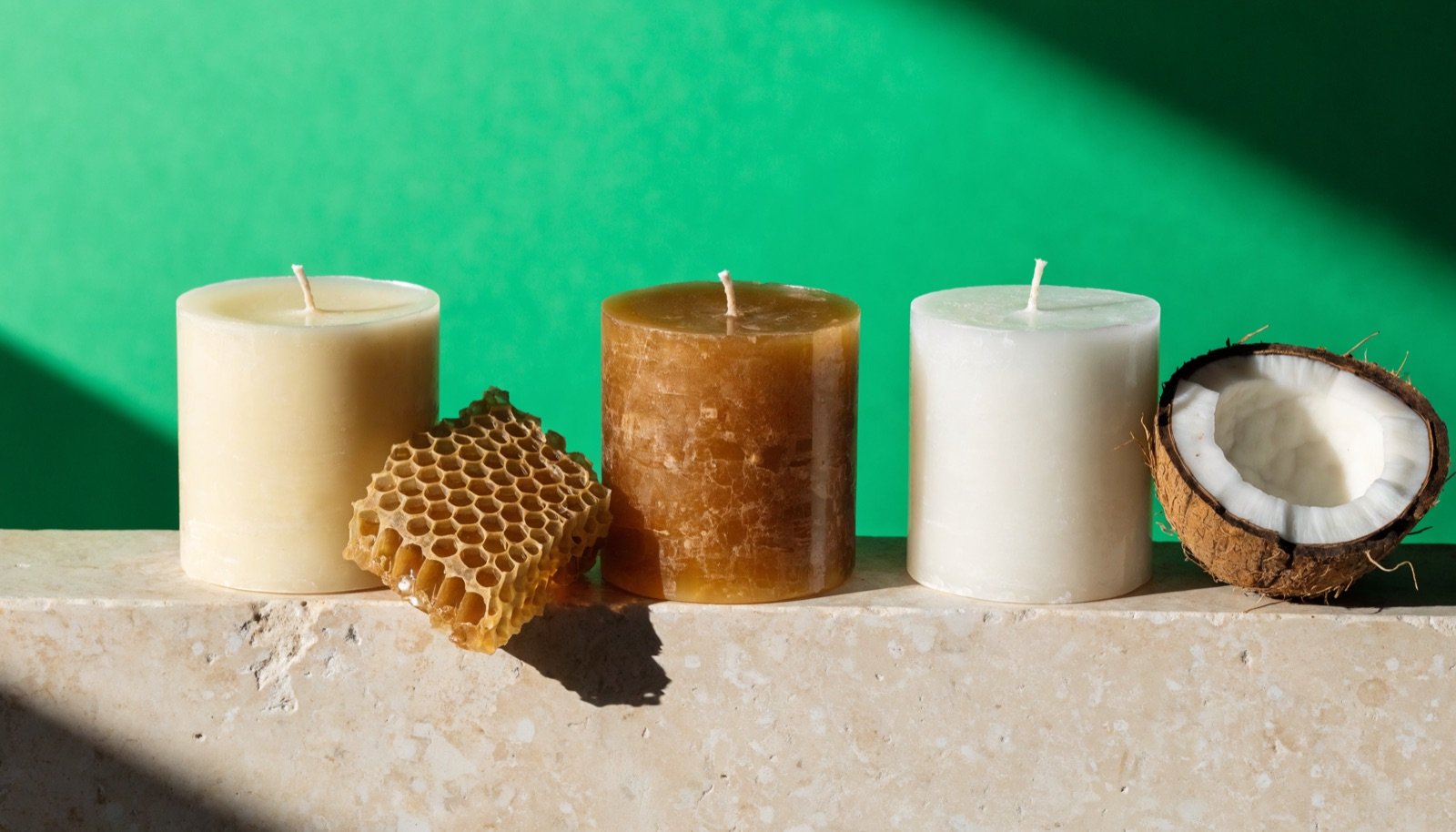
Soy vs Beeswax vs Coconut Wax: Which Candle Wax Wins?
Once you’ve decided against paraffin, you land in front of three options, and every brand selling one of them will explain why the other two are worse.
They’re all partly right. Each of these waxes does something the others don’t, and each carries a problem its marketing skips. Nobody’s lying to you exactly. They’re just describing the half of the picture that suits them.
Here’s the whole thing.
Soy: the default, with an asterisk
Soy is the wax most clean candles use, and the reasons are practical. It’s cheap, it’s vegan, it holds fragrance well enough for a strong scent throw, and it burns cooler than paraffin with a lower melting point around 120°F.
Its weakness in performance terms is that among the natural waxes, it’s the most prone to soot when conditions aren’t ideal, and it’s the one that misbehaves cosmetically. Soy frosts, which is that pale crystalline bloom on the surface, and it tunnels readily if the first burn is cut short. Neither affects your air, but both make people think the candle is faulty.
The bigger asterisk is agricultural. Most soy is grown at industrial scale in the US and Brazil, largely from genetically modified crops, and soy cultivation is one of the drivers behind land conversion in South America. A soy candle is not automatically a low-impact object just because the wax came from a plant.
Beeswax: the oldest, and not vegan
Beeswax is what candles were made from for most of human history, and it has the best raw material story of the three. No petroleum, no monoculture, and beekeeping supports pollinators that the rest of the food system depends on.
It also burns beautifully. Its melting point is much higher, around 145°F, so it burns slower and a beeswax candle of the same size will generally outlast a soy one. It gives off a faint natural honey scent.
Two real problems. It isn’t vegan, and for a lot of readers that ends the conversation. And that honey scent competes with whatever fragrance has been added, which is why beeswax candles are often unscented or lightly scented and rarely deliver the room-filling throw people expect.
Worth adding a detail the beeswax marketing omits: in the emissions testing covered in our piece on candle soot, reference beeswax candles produced more particulate than reference paraffin, soy or palm. It’s a lovely material. It is not automatically the cleanest-burning one.
Coconut: the best performer, the newest problem
Coconut wax is the current favorite of the premium clean-candle brands, and on performance it earns that. It burns cool and slow, holds scent unusually well, and produces very little soot when made properly. If you want the longest, cleanest, best-smelling burn, this is generally where you land.
The catch is where it comes from. Coconut production is concentrated in the Philippines and Indonesia, and expanding demand for coconut products carries the monoculture and land-conversion risks that come with any tropical cash crop. It’s a newer supply chain with less scrutiny than palm has faced, which is not the same as a cleaner one.
Coconut wax is also soft, so it’s usually blended, often with soy, to hold its shape. A “coconut wax” candle is frequently a coconut-soy blend, and the ratio is rarely on the label.
So which one
If you want the honest ranking, it depends on which problem you mind least.
For scent throw and burn quality, coconut, with soy close behind. For the material itself and the longest burn, beeswax, if you’re not vegan and don’t need strong fragrance. For price and availability, soy.
For actual air quality, none of the above is the deciding factor, because how the candle burns matters more than what it’s made of.
And whichever you choose, the fragrance question sits on top of the wax question and is usually the more consequential one. A coconut-wax candle scented with an undisclosed synthetic blend is not the clean choice its wax implies. Our roundup of the best non-toxic candles picks brands that handle both.
Frequently asked questions
Is palm wax a reasonable option?
We’d avoid it. Palm wax burns well and takes a decorative crystalline finish, but palm oil’s record on deforestation and habitat loss is the worst of any wax feedstock, and the certification schemes covering it have a mixed reputation. The performance gain doesn’t justify it when coconut and soy exist.
What does “coconut soy” on a label mean?
That the candle is a blend, usually because pure coconut wax is too soft to hold up in a container on its own. The proportions are rarely stated. It’s not a red flag the way “soy blend” hiding paraffin is, since both components are plant waxes, but you’re not getting a pure coconut candle.
Does the wax affect how strongly a candle smells?
Yes. Coconut and soy hold and release fragrance well, which is why scented candles usually use them. Beeswax carries its own aroma that competes with added scent, so it works best unscented or with simple essential oils. Wax choice and scent strength are linked, which is why brands that want a big throw rarely choose beeswax.
Is any candle wax actually carbon neutral?
Not in a strict sense. Every wax has a production footprint, whether that’s farming, refining or beekeeping, and burning it releases carbon regardless. Some brands offset, which is worth what offsets are generally worth. Candles are a small pleasure with a small footprint, and the honest framing is choosing the better version rather than a zero-impact one.
Related reading
The rest of the candle picture: is paraffin wax actually toxic, why burn quality beats wax type, and what’s inside the wick. For the brands we’d buy, see the best non-toxic candles.