Bamboo or Recycled Toilet Paper: Which Is Better?
Charmin Ultra Bamboo and Who Gives A Crap Premium Bamboo score identically on the most rigorous scorecard in the category. Both get a B. Both score exactly 400 points.
That isn’t a mistake. It’s what happens when the scoring is a formula rather than a vibe.
Short answer: recycled beats bamboo, and bamboo comfortably beats virgin forest fiber. The NRDC’s scoring gives postconsumer recycled content five times the weight and FSC-certified bamboo four, which is why Who Gives A Crap’s own recycled roll outscores its own bamboo roll by 151 points. If you want the best answer, buy recycled with high postconsumer content.
The scorecard, and the formula behind it
NRDC’s Issue With Tissue is the reference here, and its seventh edition graded 152 products. Sixteen got an A+, twenty got an A, thirty-six got a B or B+, and eighty got a D or F.
The weighting is published, which is what makes the results checkable. Postconsumer recycled content scores 5 times. Pre-consumer recycled 4 times. FSC-certified 100 percent bamboo 4 times. Non-FSC bamboo 2 times, the same as forest fiber. Non-chlorine bleaching adds 1.
NRDC’s position isn’t neutral and it says so: brands made from recycled content receive the highest overall score. On bamboo, it cites peer-reviewed lifecycle work finding much smaller land use and climate impacts than forest fiber, and a larger footprint than recycled forest fiber.
So the hierarchy is recycled, then FSC bamboo, then everything else, and it falls out of arithmetic rather than opinion.
So who actually scores what
Worth naming names, because this is the useful part.
At the top, A+: Aria, Green Forest, Natural Value, Trader Joe’s, and 365 by Whole Foods 100% Recycled, all scoring 580 or 590.
A grade: Marcal, Simple Truth, Field and Future, Who Gives A Crap 100% Recycled at 551, Everspring, GreenWise, Seventh Generation Extra Soft and Strong.
B+, and all of them unbleached FSC bamboo: Betterway Natural Brown, Caboo Unbleached, PlantPaper, Silk’n Soft Oh’ Natural, each at 500.
B, all 100 percent FSC bamboo with ECF bleaching, all at exactly 400: Amazon Aware, Betterway, Bim Bam Boo, Caboo, Charmin Ultra Bamboo, Grove Co., Reel Paper, Save Trees, Silk’n Soft White, and Who Gives A Crap Premium Bamboo.
F, scoring between 0 and 20: Charmin’s standard rolls, Angel Soft, Quilted Northern, Kirkland, Amazon Basics, Great Value, Up and Up, Wegmans and a couple of dozen more.
The 2025 edition was the first time the biggest US brand escaped the F category at all, and it did so by launching a bamboo line that scores the same as everyone else’s bamboo line.
Why virgin fiber is the real problem
The reason any of this matters sits north of the border.
NRDC’s reporting found that industrial logging claims more than a million acres of boreal forest every year, and that between 1996 and 2015 more than 28 million acres were logged, an area roughly the size of Ohio, with over 90 percent of it clearcut. Americans are just over 4 percent of the world’s population and account for over 20 percent of global tissue consumption.
The numbers on the material itself are stark. A metric ton of forest-fiber toilet paper carries 32,500 pounds of carbon dioxide equivalent and 103,000 gallons of water. The same tonnage from recycled content: 17,000 pounds and 81,300 gallons.
Roughly half the climate impact. For a product with a service life measured in seconds.
One caveat nobody mentions about bamboo
Here’s the part that gave us pause, and it’s about the certification the whole bamboo case rests on.
NRDC awards bamboo four times weighting only when it’s FSC certified, and two times without. So FSC is doing the work.
In June 2022 FSC opened a transaction verification exercise on bamboo covering 23 countries and 425 certificate holders, many in China, after detecting potential false claims by certificate holders trading in bamboo. Consequences included suspensions, terminations and revoked trademark licenses.
China is the region nearly every bamboo tissue brand sources from. So the certification underwriting bamboo’s score is one FSC has itself had to investigate for fraud, which is a version of the same problem we found in organic cotton certification.
FSC does certify bamboo legitimately, as a non-timber forest product, and its conversion policy blocks certification for plantations created by clearing natural forest after the end of 2020. Both things are true.
What about PFAS, and BPA
Two chemical worries come up, and they land differently.
PFAS first. A 2023 study in Environmental Science and Technology Letters tested 21 major brands across four continents and found one PFAS, 6:2 diPAP, most prevalent in both the paper and in wastewater sludge. Toilet paper was estimated to contribute between 6.4 and 80 micrograms per person per year to wastewater, and in France up to 89 percent of that PFAS in sewage was attributable to toilet paper.
The suspected source is a wetting agent used during pulping, which means it isn’t a recycled-versus-virgin distinction. You’ll see it reported as recycled brands having the same PFAS as virgin ones; we couldn’t verify that comparison in the paper itself, so we’ll say only what the authors point at, which is pulping chemistry rather than fiber source.
BPA second. Recycled paper products do carry it, because thermal receipt paper enters the recycling stream. Research measured microgram-per-gram concentrations of BPA in napkins and toilet paper made from recycled paper. The counterweight comes from researchers in that same coverage: nobody has tested how readily the body absorbs BPA from recycled paper goods, and in a recycled product the chemical is mixed through the fiber rather than coated on top, so there may be less opportunity for absorption than from handling a receipt.
Neither of these changes our answer. Both are worth knowing rather than worrying about.
What we’d actually buy
Recycled, with the highest postconsumer content you can find. That’s where the climate and water savings actually are, and it’s what the scorecard rewards most.
If recycled is unavailable or you can’t get on with the texture, FSC-certified bamboo is a solid second and vastly better than virgin. Unbleached scores higher than ECF-bleached, and the difference is one grade band.
Skip anything from virgin forest fiber, which is most of the supermarket shelf and every brand in the F band.
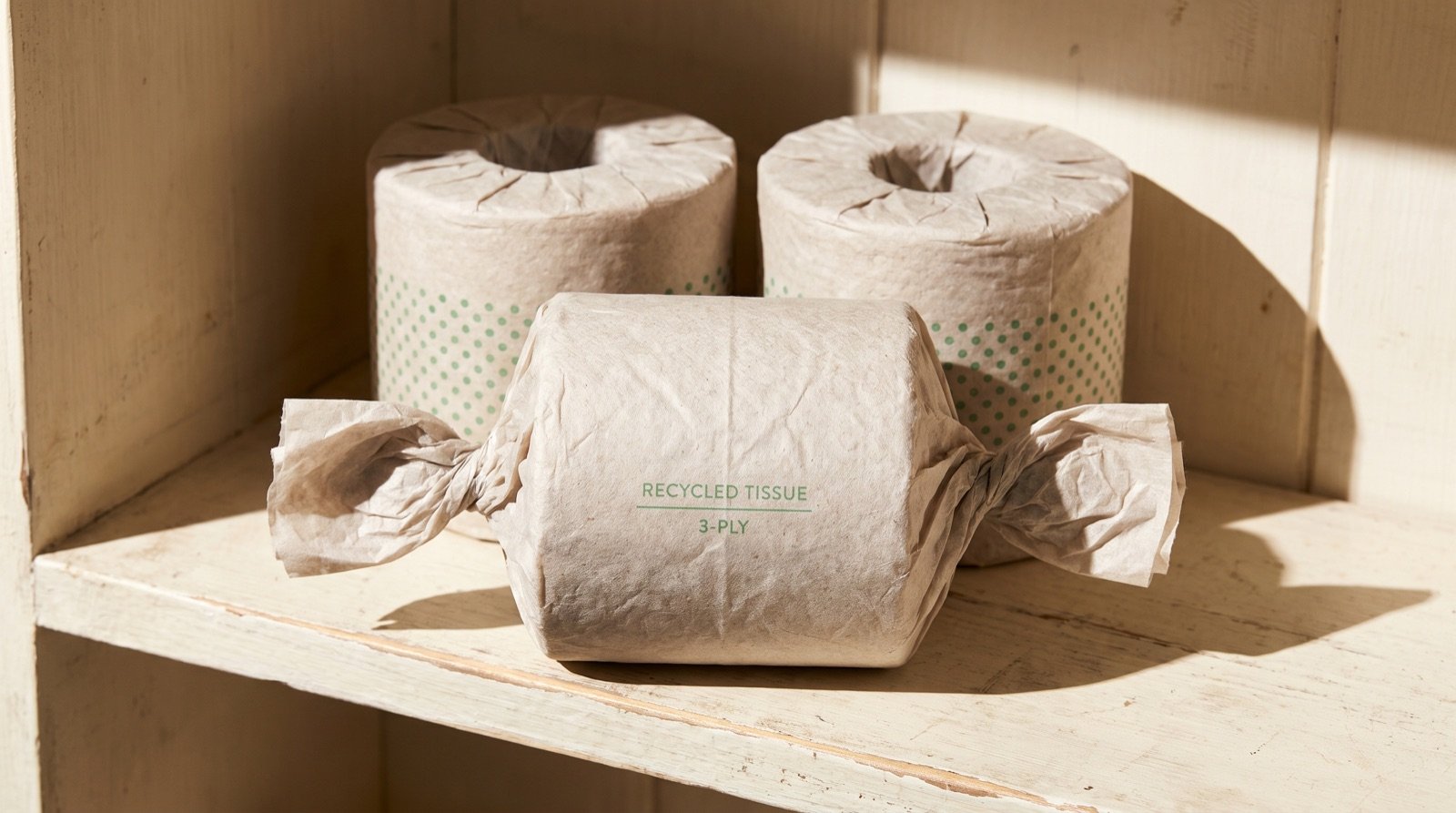
One useful detail on Who Gives A Crap, the best-known ethical brand here: its 100 percent recycled roll uses at least 51 percent postconsumer content and scores A, while its bamboo roll scores B. Same company, and the recycled one is the better buy. That kind of within-brand difference is exactly what our zero-waste home swaps tries to surface.
Frequently asked questions
Is bamboo toilet paper better than recycled?
No, on the most detailed scoring available. NRDC weights postconsumer recycled content above FSC-certified bamboo, because recycled fiber has the smallest land use and climate footprint. Bamboo is much better than virgin forest fiber and it isn’t the top of the ranking.
Does recycled toilet paper contain BPA?
Some does, in microgram-per-gram amounts, because thermal receipt paper enters the recycled fiber stream. Researchers who study it note that nobody has measured how much is actually absorbed from a paper product, and that it’s dispersed through the fiber rather than sitting on the surface as it does on a receipt.
Is Charmin bamboo actually sustainable?
It scores exactly the same as every other 100 percent FSC bamboo, ECF-bleached toilet paper, which is a B. That’s a real improvement on the brand’s standard lines, which score in the single digits. It doesn’t beat recycled.
Does toilet paper contain PFAS?
Testing of 21 brands across four continents found one PFAS present in both the paper and downstream sewage sludge. The suspected route is a wetting agent used in pulping rather than the fiber source, and the estimated per-person contribution is in the tens of micrograms per year.
Related reading
More on household paper and plastic: are detergent sheets really plastic-free, what compostable actually means, and our zero-waste home swaps.