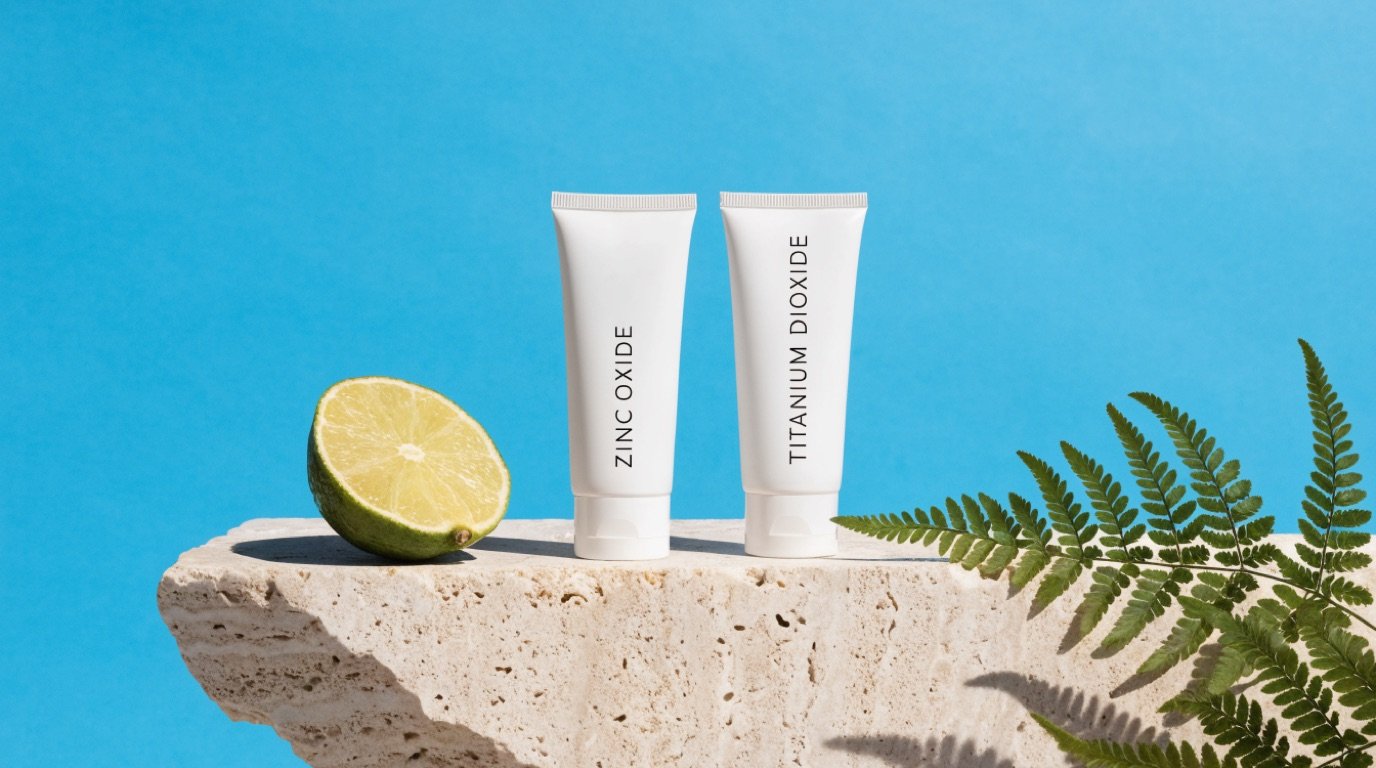
Zinc Oxide vs Titanium Dioxide: Which Mineral Actually Protects You
“Mineral sunscreen” gets talked about as though it’s one product. It isn’t. It’s two different ingredients, and they don’t do the same amount of work.
Zinc oxide covers the whole ultraviolet range on its own. Titanium dioxide doesn’t, and the gap is in the part of the spectrum that ages your skin.
If you take one thing from this: when a mineral sunscreen lists titanium dioxide alone, that’s the one to look at twice.
The gap, in plain terms
Ultraviolet light that reaches you comes in two bands worth caring about. UVB is the one that burns. UVA is the one that goes deeper, drives visible aging, and doesn’t care whether it’s cloudy.
UVA also splits. UVA2 is the shorter end. UVA1 runs longer, past 350 nanometers, and it’s the hardest to filter.
Titanium dioxide handles UVB very well and manages UVA2. Then its protection drops off sharply past about 350nm, which leaves UVA1 largely uncovered. Zinc oxide covers all of it: UVB, UVA2 and UVA1, by itself, with no help.
That’s the entire comparison. Everything else is texture and preference.
So why does titanium dioxide get used at all
Because it looks better on skin, and that’s not a trivial concern.
Both minerals work by sitting on the surface and scattering light, which is also why they’re visible. Titanium dioxide scatters with less of a heavy chalky finish and gives a smoother feel, so it softens the white cast that makes people abandon mineral sunscreen entirely.
And a sunscreen you’ll actually put on beats a better sunscreen sitting in a drawer. That’s a real argument, not a cop-out.
Which is why plenty of good formulas use both. Titanium dioxide carries some of the UVB load and improves how it wears, zinc oxide closes the UVA1 gap. Seeing the two together on a label isn’t a compromise. It’s usually a sign somebody knew what they were doing.
The formula I’d question is titanium dioxide on its own, sold as broad spectrum. It can meet the labeling standard while leaving you thinner on long UVA than the front of the bottle suggests.
Nano versus non-nano, without the panic
Nano just means the particles are under 100 nanometers. Grinding the minerals finer makes them scatter less visible light, which is the main trick behind mineral sunscreens that don’t leave you gray.
Two separate worries get mixed together here, and they deserve different answers.
The skin worry is the one people raise most, and it’s the weaker of the two. Safety reviews have found that at the amounts used in sunscreen, nano zinc oxide and titanium dioxide aren’t known to cause harm applied to intact skin. They sit in the outer layer rather than crossing into the body.
The inhalation worry is the one I’d take seriously. Breathing fine titanium dioxide particles is a different exposure from wearing them, and it’s the reason to be wary of aerosol sprays and loose mineral powders rather than lotions. If a product can become airborne near your face, choose the version that can’t.
The reef question is separate again, and it’s why “non-nano” appears on so much sunscreen marketing. Larger particles are less available to be taken up by coral. If you’re swimming over a reef, non-nano is the safer default, and it’s the standard our reef-safe roundup screens for.
So: non-nano lotion for the water, either for daily land use, and skip the sprays regardless.
What this means at the shelf
Read the actives panel, which is the boxed list that has to appear on any sunscreen sold in the US. It’ll name the filters and the percentage of each.
Zinc oxide on its own is the simplest good answer. Zinc plus titanium is also good and often wears better. Titanium alone is the one worth a second thought, especially if UVA and aging are why you’re wearing sunscreen in the first place.
Percentage matters too, though less than people think. Something in the high teens to mid twenties of zinc is a serious sunscreen. Kokua runs 25% non-nano zinc and still manages a light finish, which is pretty hard to pull off. Raw Elements loads high zinc and survives sweat and surf. If you want the shortest possible ingredient list, Badger is five or six things and one of them is zinc.
For daily face use where the white cast decides whether you’ll keep wearing it, All Good blends more easily than most, and a tinted mineral formula disappears on a far wider range of skin tones than an untinted one. That last point gets left out of a lot of clean beauty advice, and it shouldn’t be: the white cast problem isn’t equal across skin tones, and tinted versions are the practical fix.
None of this changes the reapplication rule. Mineral filters work the second they’re on, which is their best trick, but they rub off on towels and shirts like anything else. Every couple of hours, and after you dry off.
Frequently asked questions
Is zinc oxide better than titanium dioxide?
For coverage, yes. Zinc oxide protects across UVB, UVA2 and UVA1 on its own, while titanium dioxide is strong on UVB and shorter UVA but falls away past roughly 350nm, leaving a UVA1 gap. Titanium dioxide’s advantage is cosmetic: it feels smoother and reduces white cast, which is why many good sunscreens combine the two.
Is nano zinc oxide safe?
On intact skin, safety reviews have found no known harm at the amounts used in sunscreen, because the particles stay in the outer skin layer. The clearer caution is about inhaling them, which makes aerosol sprays and loose powders the formats to avoid. For reef safety, non-nano is the better choice because larger particles are less available to coral.
Can a titanium dioxide sunscreen be broad spectrum?
It can carry the label, since the broad-spectrum test doesn’t specifically require strong UVA1 coverage. That’s the catch. If long-wave UVA and photoaging are your concern, look for zinc oxide in the actives panel rather than relying on the phrase on the front.
Do mineral sunscreens need time to work?
No, and that’s a real advantage over chemical filters. They protect from the moment they’re spread, because they work by sitting on the surface and scattering light rather than by absorbing into skin first. The 15-to-30-minute wait applies to chemical sunscreens.
Related reading
The rest of this series covers the filters worth avoiding: is oxybenzone safe and octinoxate, the banned filter nobody talks about. For vetted picks, see the best reef-safe sunscreens. Building a cleaner routine more broadly? Start with the best non-toxic skincare brands. Every brand named has a scored profile in our brand directory.
Sources: US Food and Drug Administration, Sunscreen Drug Products for Over-the-Counter Human Use, proposed rule, 2019. Scientific Committee on Consumer Safety, Revision of the addendum to opinion SCCS/1489/12 on zinc oxide (nano form). Michigan State University Center for Research on Ingredient Safety, Trending: Mineral Sunscreen.