Is Aluminum in Antiperspirant Bad for You? An Honest Answer
Pick up a stick of antiperspirant and read the small print on the back. There’s a line on there that most people have never noticed: ask a doctor before use if you have kidney disease.
Short answer: the two scary claims about aluminum, breast cancer and Alzheimer’s, are not supported by the evidence, and both the National Cancer Institute and the Alzheimer’s Association say so directly. Human tracer work puts the amount of aluminum that crosses your skin at about 0.00052 percent of what you put on. The kidney warning is real, it’s federally required, and it matters for a small group of people.
So why do we still recommend aluminum-free deodorant? Stick with us. The reasons are good ones, and they’re not the ones you’ve been sold.
First, antiperspirant and deodorant are not the same product
This trips up almost everyone, and it’s the thing to get straight before anything else makes sense.
Deodorant is a cosmetic. It works on the smell. Antiperspirant is legally a drug, because it changes what your body does: under 21 CFR 350.3, it’s defined as a product that reduces the production of sweat at the site. That’s why it comes with drug-facts panels and mandatory warnings and a deodorant doesn’t.
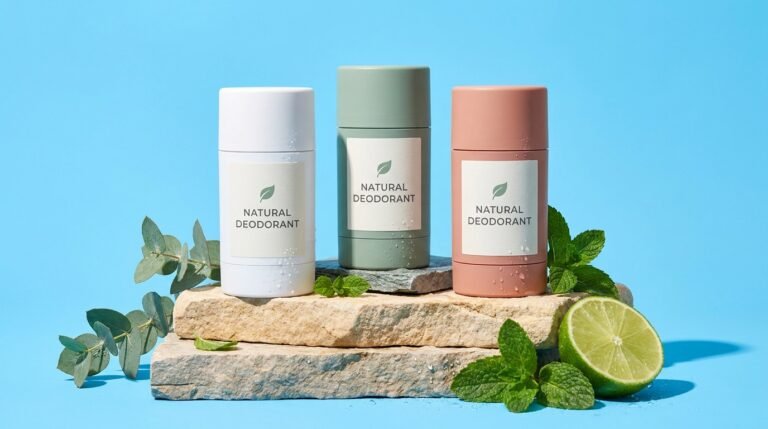
Aluminum salts are the only actives the FDA permits for that job. Aluminum chlorohydrate up to 25 percent, aluminum zirconium salts up to 20 percent, aluminum chloride up to 15 percent. Everything sold as “aluminum-free” is a deodorant. It is not a weaker antiperspirant, it’s a different category of product, which is exactly why switching feels like the thing stopped working.
What it’s doing in there is stranger than the usual explanation
You’ve probably read that aluminum forms a gel plug in the sweat duct. That was the accepted picture for decades, and then somebody looked properly.
A 2017 paper in Soft Matter ran sweat through microfluidic channels with X-ray scattering and found the plug isn’t aluminum hydroxide gel at all. Aluminum polycations aggregate the proteins already in your sweat. Those clumps stick to the duct wall, build a thin membrane, and then that membrane catches more protein flowing past until the duct is blocked.
Your own sweat proteins are the cork. The aluminum just makes them stick together.
The breast cancer claim, and where it came from
The theory sounds plausible, which is most of why it spread. Antiperspirant goes on skin near breast tissue, aluminum is a metal, breast tumors are common in the upper outer quadrant, therefore.
The National Cancer Institute’s position is that no scientific evidence links these products to breast cancer, and that no study to date has confirmed any substantial adverse effect of aluminum that could raise the risk. The American Cancer Society reached the same conclusion: none of the major health organizations have found conclusive evidence linking antiperspirants or aluminum to breast cancer.
The FDA went further back in 2003 and formally rejected the mechanism, writing that the theories lacked sufficient evidence and that the calcification argument was inconsistent with how calcification actually works.
Two honest wrinkles. NCI does concede the studies have been conflicting and that more research is warranted, and its fact sheet hasn’t been reviewed since 2016. That’s a decade old. It’s still the best answer anyone has.
Alzheimer’s got the same treatment, and the same result
This one is older. Aluminum turned up in the brain tissue of Alzheimer’s patients in the 1960s and 70s, and a wave of worry followed about cookware, foil, cans, antacids and, yes, antiperspirants.
The Alzheimer’s Association’s own summary is blunt: studies have failed to confirm any role for aluminum in causing Alzheimer’s, almost all researchers have moved on to other areas, and most experts believe aluminum doesn’t pose a threat. We walked through the same scare from the cookware side in our piece on aluminum pans, and it collapses the same way.
How much aluminum actually gets through your skin
Here’s the number that should have ended the argument. Researchers applied radiolabeled aluminum chlorohydrate to the underarms of volunteers under normal use conditions and tracked where it went. The EU’s Scientific Committee on Consumer Safety accepted the result and uses it in its risk assessment: dermal absorption of 0.00052 percent.
Roughly five parts per million of what you apply. The SCCS also concluded that aluminum from cosmetics doesn’t add significantly to your total body burden, because the dominant source for almost everybody is food.
Now the caveat, because it’s a real one. That absorption figure came from a study submitted by the cosmetics industry, with six subjects. The committee reviewed it and agreed with it, which is how the process is meant to work, but it isn’t independent and it isn’t large. And the SCCS phrased its conclusion carefully: accumulation can’t be ruled out, but significant accumulation is unlikely with daily cosmetic use. That’s a hedge, and it deserves to be read as one.
The thing everyone gets backwards about Europe
You’ll see it claimed that the EU restricts aluminum where America doesn’t. It’s a good line. It’s also wrong here.
The FDA caps the salt: 25 percent aluminum chlorohydrate. The SCCS caps the elemental aluminum: 6.25 percent. Read the SCCS document and it spells out the conversion in its own test formula, 25 percent ACH being 6.25 percent aluminum. Same ceiling, two units. This is one of the few places the two regulators landed on the identical answer, which is worth knowing before you repeat the claim, and worth remembering next time a brand’s marketing leans on it. Our greenwashing guide covers more of these.
So why go aluminum-free anyway
Four reasons, none of them cancer.
The kidney warning is genuine and it’s on the label because the FDA put it there in 2003 out of concern that people with reduced kidney function might not know aluminum was a daily exposure. The National Kidney Foundation reads it as applying to stage 4 or 5 disease, around 30 percent function or less, and notes it’s nearly impossible to absorb enough through skin to hurt healthy kidneys. If that’s not you, it isn’t about you.
Second, the FDA hasn’t looked at this since 2003. The monograph text was carried over wholesale into the current one in 2020 without a fresh review. “The FDA says it’s fine” really means the FDA said it was fine 23 years ago.
Third, sweating is a normal thing your body does, and blocking it every single day is a choice worth making deliberately rather than by default. Plenty of people sweat a modest amount and never needed a drug for it.
And the fourth is the one we’d actually lead with: aluminum-free deodorants tend to come from brands that disclose everything else too, where the conventional stick hides synthetic fragrance behind one word. That’s the same pattern we keep finding across ingredients worth a second look in personal care.
If you sweat heavily, or you have hyperhidrosis, or an interview is riding on it, use the antiperspirant. We’d rather be straight with you than sell you a bad swap.
Frequently asked questions
Does aluminum in antiperspirant cause breast cancer?
There’s no evidence that it does. The National Cancer Institute states that no scientific evidence links antiperspirant use to breast cancer, and the American Cancer Society says no major health organization has found conclusive evidence for the link. The FDA reviewed and rejected the proposed mechanism in 2003. Both bodies note the research has been mixed and more would help, which is not the same as a warning.
Why does antiperspirant carry a kidney disease warning?
Because aluminum leaves the body mainly through urine, so people with badly reduced kidney function clear it more slowly. The FDA added the warning in 2003 as a precaution, drawing on the history of aluminum toxicity in dialysis patients, who received it in far larger amounts by other routes. The National Kidney Foundation treats it as relevant at stage 4 or 5 chronic kidney disease.
Is aluminum-free deodorant less effective?
At stopping sweat, yes, completely, because it isn’t trying to. Deodorant works on the bacteria that turn sweat into smell, so you’ll still get damp. A good one controls odor all day. Expect to sweat and the switch goes fine; expect dry underarms and nothing plant-based will satisfy you.
What about aluminum salts marketed as natural, like alum crystal?
Potassium alum is still an aluminum salt. It’s a bigger molecule and it’s used at low levels, so it acts more like a deodorant than an antiperspirant, but a brand selling it as aluminum-free is being loose with the word. Read the ingredient list rather than the front of the pack.
Related reading
More on what goes on your skin daily: the ingredients worth avoiding in personal care and hormone disruptors in cosmetics. For picks, see the natural deodorants that actually work.