PFAS in Nonstick Cookware: The Bans Are Actually Arriving
On January 1, 2025, Minnesota became the first state in the country to ban the sale of cookware with intentionally added PFAS. Maine and Colorado followed this January. Connecticut, Vermont and Washington have bans queued behind them.
That’s unusual. Rare, in fact. Most of what we write about here involves a regulatory gap and a shrug. This is the opposite: a live, spreading, state-by-state ban on a product category most people have in a cupboard right now.
California went a different route and required companies to disclose PFAS in cookware on their websites instead, after a full ban bill was vetoed on cost grounds. Which is its own kind of useful, because a disclosure rule turns an invisible question into a page you can go and read.
The bit people get wrong: PTFE is a PFAS
There’s a persistent idea that the PFAS problem in cookware got solved when PFOA was phased out around 2015. It didn’t, and the confusion is understandable, because two different chemicals are involved.
PFOA was a processing aid used to make the coating. It’s gone from US manufacturing, and pans have said “PFOA-free” ever since.
PTFE is the coating itself, the thing sold as Teflon. And PTFE is a fluoropolymer, which puts it inside the PFAS family. So a pan can be truthfully labeled PFOA-free while its entire cooking surface is still made of a forever chemical.
That’s the whole reason states are legislating on cookware rather than treating it as solved. “PFOA-free” answers a question nobody is asking anymore.
What a scratch actually does
Here’s the finding that reframed this for me. It’s a big number.
Researchers at Flinders University used Raman imaging to count what comes off a damaged nonstick surface during cooking. A single surface crack released roughly 9,100 plastic particles. A coating in worse shape shed up to 2.3 million micro- and nanoplastic particles.
Read that carefully, because it’s easy to run past what it does and doesn’t show. It’s a measurement of particle release, not a measurement of harm to anyone. Nobody has demonstrated a health outcome from eating flakes of your frying pan, and PTFE is famously inert, which is the property that makes it useful in the first place.
What it does establish is that the coating doesn’t stay put once it’s damaged. And for a substance in a family defined by not breaking down, “it ends up in your food and then in the water” is a reasonable thing to want to avoid even without a proven dose-response.
The intact-pan question is different again, and here the honest answer is reassuring. An undamaged PTFE surface at normal cooking temperatures is stable. The known acute risk is overheating: run a pan dry on high heat and the coating starts to break down and release fumes, which causes flu-like symptoms in people and can kill pet birds. Don’t preheat an empty nonstick pan on full blast. That’s the actual rule.
So when do you throw one out
When it’s scratched, chipped, flaking, or discolored. Not before.
I’d rather say that plainly than tell everyone to bin a functional pan, because replacing cookware costs real money and a perfectly good undamaged nonstick pan is not an emergency. The failure mode here is gradual, visible, and easy to check: look at the middle of the pan, where the spatula lives.
Once it’s damaged, though, it’s done. There’s no restoring a nonstick coating, and “it still mostly works” is exactly the state the particle research was measuring.
The replacements, and what each one costs you
The good news is that the alternatives are cheap, good, and mostly last forever.
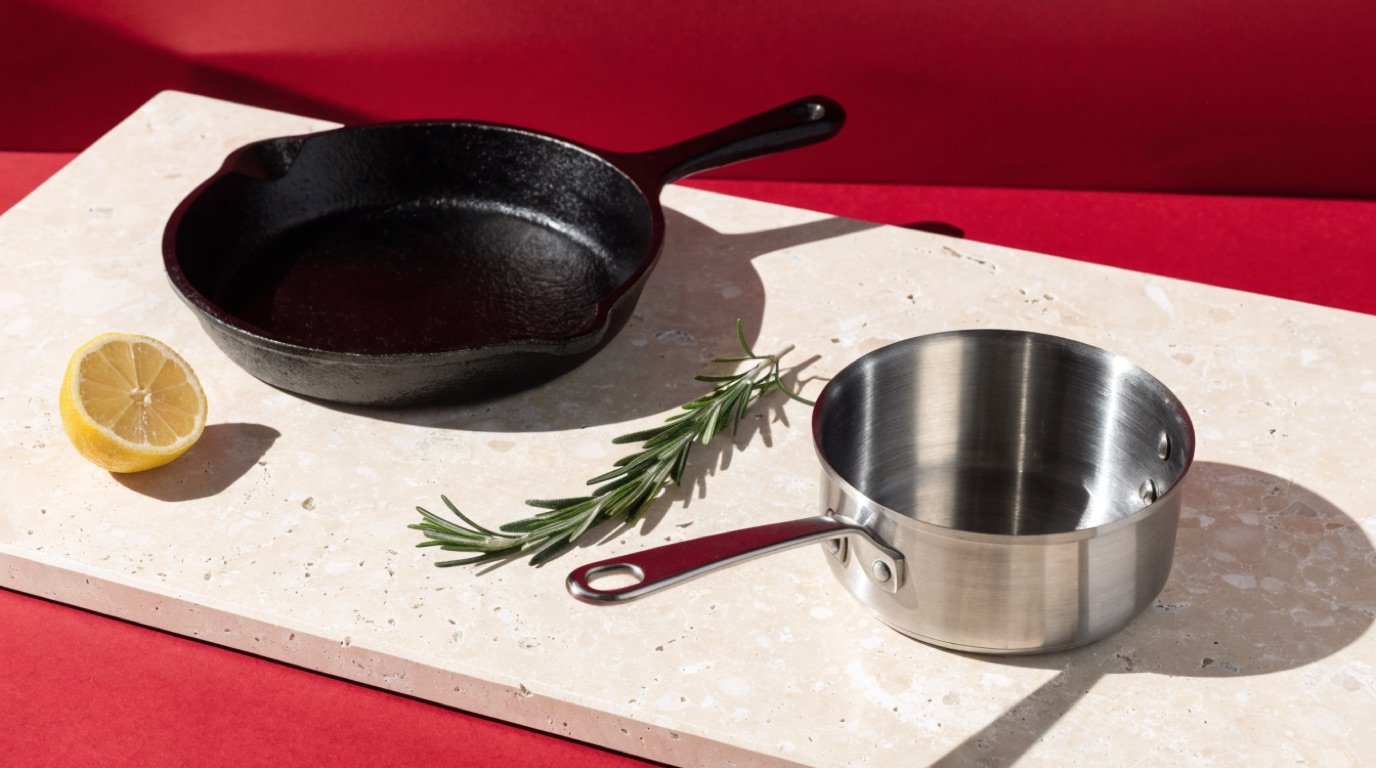
Cast iron is the obvious one. Lodge has been making it in Tennessee since 1896, a skillet costs less than a mid-range nonstick pan, and it will outlive you. It needs seasoning and it isn’t the pan for a delicate omelet on day one, which is the honest tradeoff.
For stainless, Made In is the one professional kitchens actually use, and stainless has no coating to fail at all. Field Company makes lighter, smoother cast iron if the weight of a traditional skillet is what’s put you off.
If you want something that behaves like nonstick, that’s ceramic coating, and it’s a real option with its own catch: it’s a consumable that wears out in a few years rather than a lifetime purchase. Our Place is the popular version. And if you want no coating and no metal whatsoever, Xtrema is ceramic all the way through.
We’ve sorted all of them by material in the best non-toxic cookware, because the right answer depends on how you cook rather than on which brand is best.
Frequently asked questions
Is PTFE the same as PFAS?
PTFE is a fluoropolymer, which sits within the PFAS family, so yes in the sense that matters. This is why “PFOA-free” on a nonstick pan doesn’t mean PFAS-free: PFOA was a processing aid removed from US manufacturing around 2015, while PTFE is the coating itself and is still there.
Is it safe to use a scratched nonstick pan?
No proven health harm has been shown from ingesting the particles, but a scratched coating sheds them in large numbers. Flinders University researchers measured roughly 9,100 particles from a single crack and up to 2.3 million from a badly damaged surface. Given these are forever chemicals, replacing a damaged pan is the sensible call. An undamaged one is fine.
At what temperature does nonstick become a problem?
The risk is overheating an empty pan rather than normal cooking. Run dry on high heat, PTFE begins to degrade and release fumes that cause flu-like symptoms and can kill pet birds. Keep birds out of the kitchen, don’t preheat empty on full blast, and normal stovetop cooking is not the problem.
Which states have banned PFAS cookware?
Minnesota was first, under Amara’s Law, effective January 1, 2025. Maine and Colorado followed in January 2026, and Connecticut, Vermont and Washington have bans scheduled. California requires companies to disclose PFAS in cookware rather than banning it, after a ban bill was vetoed.
Related reading
PFAS end up in drinking water too, where the filter aisle is full of claims that don’t survive checking. We went through whether a Brita removes PFAS and the water filters worth buying.
The rest of this series: is ceramic cookware safe and is aluminum cookware safe. For vetted picks sorted by material, see the best non-toxic cookware. Our zero-waste kitchen swaps guide covers the rest of the kitchen, and every brand named has a scored profile in the brand directory.
Sources: Luo et al., Raman imaging for the identification of Teflon microplastics and nanoplastics released from non-stick cookware, Science of The Total Environment, 2022. Minnesota Pollution Control Agency, 2025 PFAS prohibitions. Environmental Working Group, A California law makes it easier to spot PFAS in kitchen products, 2026.